
Installing drip irrigation solves only part of the water-management problem. A farm can have an efficient delivery system and still over-irrigate, irrigate too late, or apply water without accounting for weather and soil conditions. The next opportunity in agricultural water management therefore sits around control: knowing when irrigation is required, how much is required, and whether the crop is actually responding.
That shift is creating demand for smart irrigation technologies.
The Value Is in the Decision, Not the Sensor
Soil-moisture sensors, automated valves, weather-linked scheduling, and satellite-based monitoring are increasingly being combined into irrigation-management systems.
Their commercial value comes from changing irrigation decisions. Sensors can identify soil moisture conditions across root zones. Weather-linked systems can postpone irrigation when rainfall is expected. Automated valves can execute schedules without repeated field visits.
The technology becomes economically meaningful when these interventions reduce water and electricity consumption while protecting yield.
Crop Sensitivity Determines Willingness to Pay
The economics of smart irrigation vary sharply by crop.
High-value horticulture, vineyards, protected cultivation, seed production, and export-oriented farms can absorb higher technology costs because a small improvement in crop quality or yield can have a meaningful financial impact.
Broadacre crops face a different equation. A sensor package costing tens of thousands of rupees per acre requires recurring savings or yield protection large enough to justify the investment.
This makes crop-level water-stress sensitivity an important market segmentation variable. The relevant question is not simply how much water a crop uses, but how expensive a moisture-management error becomes.
Smart Irrigation Has an Architecture
The market extends beyond a single hardware category.
In-situ sensors measure volumetric water content or soil-water tension at different root depths. Weather and satellite platforms can combine forecasts with crop and field information to improve irrigation timing. Automated controllers and solenoid valves translate those decisions into physical water application.
At the advanced end, variable-rate irrigation can adjust application across different soil conditions within the same field. Closed-loop fertigation systems add nutrient management to the water-control equation.
These technologies have different customer segments, capital requirements, and payback periods. Treating them as one smart-irrigation market can therefore obscure where actual demand is developing.
Adoption Still Runs Into the Field
Smart irrigation faces practical barriers that conventional market sizing can overlook.
Sensors can deteriorate under harsh field conditions. Hard-water scaling can affect equipment performance. Rural connectivity may be inconsistent. Smallholders may also lack the technical capacity to interpret moisture data or configure automated systems.
Consequently, product reliability and service infrastructure can matter as much as software functionality.
A company entering this market must understand whether customers want standalone monitoring, automated irrigation, or a managed service that turns data into irrigation decisions.
The Commercial Opportunity Is Moving Toward Outcomes
Field applications cited in the research indicate that smart irrigation can produce substantial water savings, lower pumping requirements, and protect yields when irrigation timing is optimized.
That creates room for alternative commercial models. Leasing, pay-per-acre pricing, equipment-as-a-service, or performance-linked contracts can reduce the upfront barrier for farmers.
For technology providers, the resulting market opportunity is therefore partly a product question and partly a business-model question.
Nexdigm’s Smart Irrigation Technology Market Analysis Framework
Nexdigm’s smart irrigation technology assessment can assess smart irrigation opportunities through five dimensions:
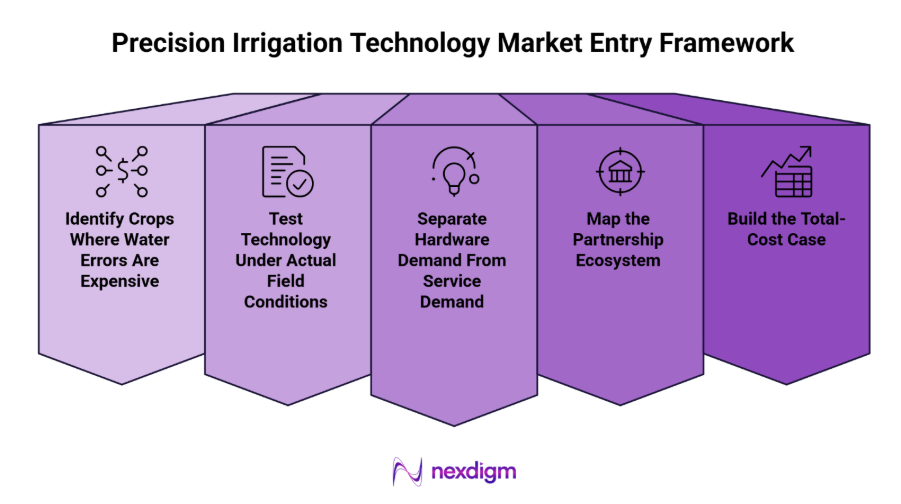
- Identify Crops Where Water Errors Are Expensive: Measure yield sensitivity, quality penalties, crop value, and critical irrigation windows to determine where precision irrigation can generate sufficient economic value.
- Test Technology Under Actual Field Conditions: Evaluate sensor durability, water quality, maintenance requirements, connectivity, and operating conditions before scaling a technology across regions.
- Separate Hardware Demand From Service Demand: Assess whether customers are likely to purchase sensors and controllers outright, subscribe to software, adopt managed irrigation services, or use performance-linked models.
- Build the Total-Cost Case: Compare equipment, installation, connectivity, maintenance, and software costs against water savings, electricity savings, labour reduction, and yield protection.
- Map the Partnership Ecosystem: Identify irrigation OEMs, solar-pump providers, FPOs, contract farming networks, and processors that can accelerate distribution and adoption.
Nexdigm Case Study: Turning Water Savings Into Market Demand
In a scenario-based commercialization assessment for an agricultural technology startup, Nexdigm segmented 210,000 acres across high-value farming clusters and identified 72,000 acres with sufficient irrigation expenditure and crop value to support smart-system adoption. A performance-based model targeting 2,200 contracted acres delivered a projected 32% water reduction and 24% electricity savings, while reducing the customer’s upfront technology investment.
To take the next step, simply visit our Request a Consultation page and share your requirements with us.
Harsh Mittal
+91-8422857704