

Smart logistics solutions are helping businesses build competitive advantage by using data, automation, and real-time insights to improve supply chain performance. As part of a market entry strategy, these solutions enable companies to plan routes, monitor inventory, track shipments, automate workflows, and respond quickly to demand shifts in new markets.
Smart logistics solution market entry approach supports faster execution, lower operating costs, and better service reliability from the start. By combining analytics, connected systems, and automated decision-making, businesses can create agile logistics networks that improve efficiency, strengthen customer experience, and support scalable regional expansion.
The Smart logistics solution market entry opportunity is supported by strong digital logistics growth. The global digital logistics market was valued at USD 37.64 billion in 2025 and is projected to reach USD 155.29 billion by 2034, growing at a CAGR of 17.10%. Smart logistics platforms were valued at USD 19.9 billion in 2025, with 17.5% CAGR expected through 2035, reflecting demand for automation, IoT, and data-led supply chain efficiency.
Role of Smart Logistics Solutions in Market Entry Strategy
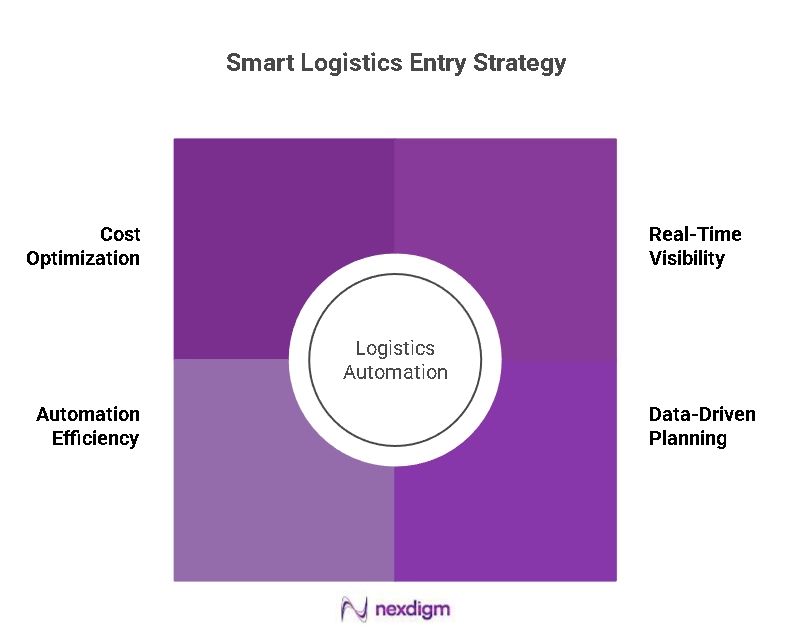
Smart logistics solutions support market entry strategy by using data, automation, and real-time visibility to improve planning, reduce costs, strengthen delivery reliability, and scale operations in new markets:
-
Data-Driven Planning
Uses demand, inventory, and route data to support better logistics planning during new market entry.
-
Automation Efficiency
Automates warehouse and transport tasks to reduce manual errors, improve speed, and support efficient market operations.
-
Real-Time Visibility
Tracks shipments, inventory, and delivery milestones to improve control and responsiveness across new market logistics.
-
Cost Optimization
Identifies inefficiencies in routes, storage, labour, and transport to reduce operating costs during expansion.
Nexdigm Process Automation Roadmap for Warehousing and Transport Efficiency
Nexdigm can help design a phased automation roadmap by assessing warehouse workflows, transport planning, inventory handling, order processing, shipment tracking, and reporting gaps. This supports improved productivity, reduced manual errors, faster fulfilment, better route efficiency, and stronger market entry execution through data-led logistics operations.
Nexdigm Cost-Benefit Assessment for Smart Logistics Investment
Nexdigm can evaluate automation costs, technology investments, productivity gains, savings potential, implementation risks, and scalability benefits to support informed smart logistics investment decisions.
-
Investment Cost Review
Assesses software, hardware, integration, training, and implementation costs required for smart logistics adoption.
-
Productivity Gain Analysis
Evaluates expected improvements in warehouse speed, transport planning, order processing, and workforce efficiency.
-
Savings Potential Assessment
Identifies cost reductions from lower manual effort, fewer errors, better routing, and improved inventory control.
-
Implementation Risk Review
Examines technology readiness, process disruption, user adoption, vendor dependency, and integration risks before investment.
Nexdigm’s case:
Recently, Nexdigm helped a retail company assess the cost-benefit of smart logistics investment across warehousing and transport operations. By evaluating automation costs, productivity gains, technology risks, scalability benefits, and savings potential, Nexdigm helped the company identify 16 improvement opportunities, reduce projected logistics costs by 14–18%, improve order processing productivity by 32%, and shorten fulfilment turnaround time by 24%.
To take the next step, simply visit our Request a Consultation page and share your requirements with us.
Harsh Mittal
+91-8422857704