

A manufacturer evaluating smart production may be considering machine vision on an assembly line, sensors on critical equipment, analytics for production planning or a connected factory platform. These investments solve different problems, involve different suppliers and carry different implementation costs. Treating them as one market can obscure where customer spending is actually moving.
Demand is also shaped by operational maturity. A plant with unreliable production data may need connectivity and systems integration before advanced analytics can deliver value. A facility with established data infrastructure may be ready for predictive maintenance, automated inspection or digital twins.
The commercial opportunity therefore sits across a layered technology market, from equipment and connectivity to software, integration and ongoing services.
The Spending Pattern Reveals Where the Market Is Maturing
The World Economic Forum’s Global Lighthouse Network had reached 201 industrial sites by September 2025, demonstrating that advanced production technologies are being deployed across multiple sectors and geographies. The newest cohort reported average labour-productivity gains of 40% and lead-time reductions of 48%. These results show what coordinated digital transformation can deliver, although Lighthouse sites represent leading performers rather than a typical factory.
For suppliers, the implication is that demand increasingly extends beyond individual machines. Manufacturers need systems that connect equipment, make production data usable and translate information into operating decisions.
Four technology layers deserve separate assessment:
- Automation and robotics: Industrial robots, machine vision, automated handling and programmable control systems that improve throughput, consistency and labour productivity.
- Industrial IoT and connectivity: Sensors, gateways, industrial networks and edge devices that make equipment status and process conditions visible.
- Analytics and AI: Predictive maintenance, production optimisation, defect detection, demand planning and energy management.
- Connected production systems: Manufacturing execution systems, digital twins, production scheduling and integration between shop-floor equipment and enterprise systems.
Each layer has a different buying cycle. Hardware purchases may be driven by capacity expansion or replacement, while software and analytics spending often depends on the availability of usable data and a clear business case. Integration services can become critical when manufacturers operate equipment from multiple vendors or rely on legacy production systems.
The Integration Gap Is a Commercial Opportunity
Many factories operate with a mixture of modern equipment, older control systems and disconnected software. A new analytics application may perform well in a demonstration but fail to scale if data definitions vary across production lines or equipment cannot communicate reliably.
This creates demand for integration, industrial data management, cybersecurity, workforce training and ongoing support. Suppliers that address these requirements can capture value beyond the initial technology sale.
The market assessment must distinguish between announced digital-transformation budgets and addressable spending. A manufacturer’s stated intention to adopt AI does not establish a funded project, an approved business case or readiness for deployment.
For a Smart manufacturing market assessment, Nexdigm can segment demand by technology layer, manufacturing vertical, plant maturity and purchasing objective. This helps identify which customer groups are ready to buy, what implementation barriers remain and where suppliers can differentiate.
From Technology Demand to Revenue Potential
A credible market model should estimate demand through identifiable buying units: factories, production lines, critical machines, inspection stations or software deployments. The model can then apply adoption rates, replacement cycles, average project values and likely service requirements.
It should also account for the economics of implementation. A large installed base does not necessarily mean a large immediate market if customers face long payback periods, limited engineering resources or strict production-continuity requirements.
Supplier positioning matters as well. Hardware vendors may compete on reliability and throughput, software providers on usability and integration, and service partners on deployment speed and measurable operational outcomes.
Smart Manufacturing Opportunity Mapping Framework
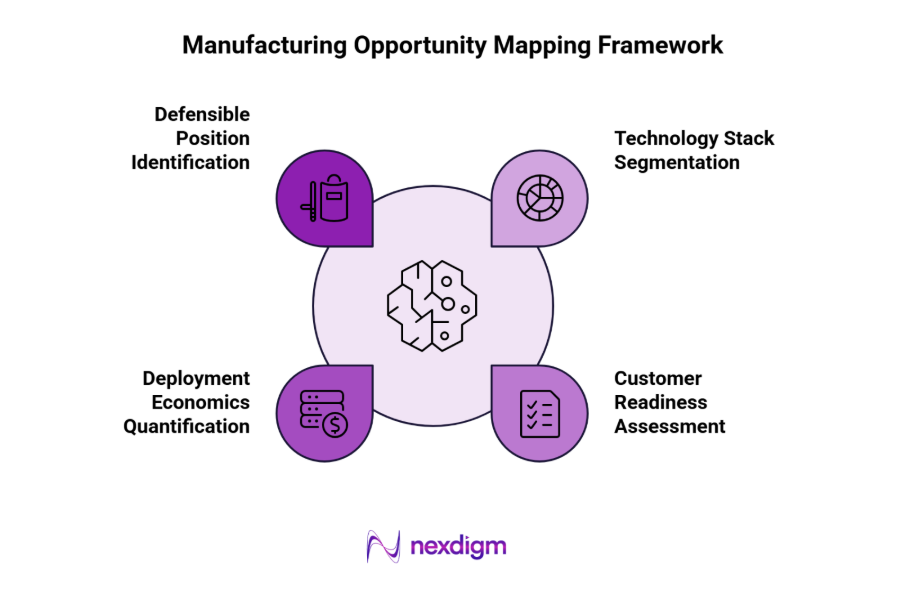
- Segment the Technology Stack
Separate automation, connectivity, analytics, software and integration services into distinct addressable markets. - Measure Customer Readiness
Assess installed equipment, data maturity, workforce capability, investment budgets and the operational problems customers need to solve. - Quantify Deployment Economics
Estimate the number of addressable plants and production lines, project values, replacement cycles and recurring service potential. - Identify the Defensible Position
Compare competitors, integration capabilities, customer access and implementation performance to identify the most commercially attractive technology layers.
Nexdigm Case Study: Prioritising Smart Factory Demand
Nexdigm assessed demand for smart manufacturing solutions across 240 plants in four industrial sectors. The team mapped automation, connectivity, analytics and production-software requirements, then screened investment readiness and estimated project values. Of the plants assessed, 68 had near-term requirements supported by defined operational priorities and budget visibility. Predictive maintenance and machine-vision inspection represented the strongest initial opportunities, with a combined addressable project pipeline of ₹52 crore.
To take the next step, simply visit our Request a Consultation page and share your requirements with us.
Harsh Mittal
+91-8422857704