
Warehouses are moving from manual storage facilities toward connected operating environments. Automation, robotics, sensors, warehouse software, and real-time data are changing how companies manage inventory, labor, space, and fulfillment.
DHL reported that more than 90% of its warehouses globally have at least one automation or digitalization solution, alongside more than 7,500 robots and nearly 800,000 IoT sensors.
However, installing technology does not automatically create a smart warehouse. For logistics companies, retailers, manufacturers, 3PL providers, warehouse developers, investors, and technology vendors, the challenge is identifying which technologies create measurable value and where investment makes commercial sense.
A Smart warehouse market study helps evaluate this transition.
Nexdigm combines warehouse demand, operational requirements, technology maturity, facility conditions, investment economics, and scalability to identify practical smart-warehouse opportunities.
Reading the Technology Shift
Warehouse automation is expanding across storage, picking, movement, sorting, inventory management, and fulfillment.
Nexdigm evaluates technologies such as automated storage and retrieval systems, conveyors, warehouse management software, autonomous mobile robots, robotic arms, IoT sensors, computer vision, and predictive analytics.
The assessment focuses on how these technologies address specific operational challenges.
A high-volume fulfillment center may benefit from extensive automation, while a smaller warehouse may generate better returns from software, inventory visibility, or selective robotics.
Nexdigm therefore evaluates the fit between technology and warehouse requirements, rather than assuming every facility needs the same solution.
Nexdigm in Connecting Automation With Operations
Automation becomes valuable when it improves an existing workflow. Nexdigm examines receiving, put-away, storage, picking, packing, sorting, replenishment, and dispatch to identify processes where automation can reduce repetitive work or improve consistency.
The analysis also considers product characteristics, order volumes, labor availability, peak-season requirements, and facility design. This helps identify where automation can increase throughput without creating unnecessary complexity.
How Nexdigm Makes Data More Useful
A smart warehouse depends on connected information. Nexdigm evaluates how warehouse management systems, transportation platforms, inventory tools, sensors, robotics, and enterprise systems exchange information.
Real-time data can help managers understand inventory positions, equipment performance, order flows, bottlenecks, and workforce productivity. The value increases when data moves beyond reporting and supports better decisions around inventory, labor, maintenance, routing, and capacity.
Nexdigm’s Smart Warehouse Market Assessment
Nexdigm’s assessment conducts Smart Warehouse Market Study that evaluates the adoption potential and operational impact of digital warehouse technologies across several dimensions. The assessment helps organizations to identify transformation opportunities that can enhance efficiency, visibility, and scalability through:
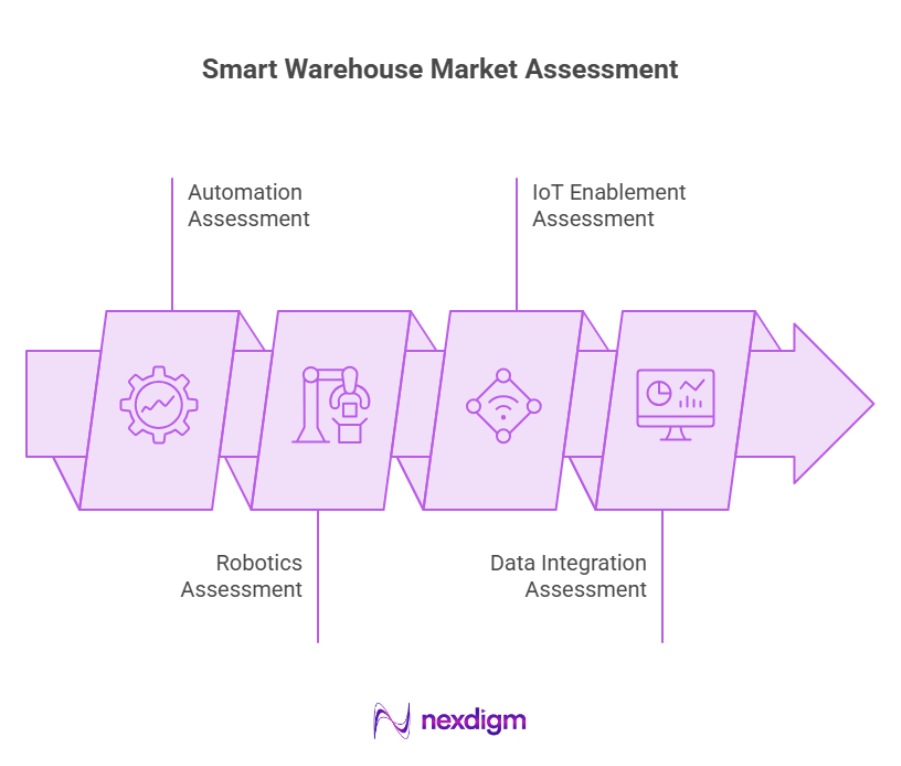
- Automation Assessment: Assessment of the extent to which warehouse processes can be streamlined through automated technologies. The evaluation focuses on repetitive activities, material movement, storage operations, order fulfillment processes, and the integration of automated workflows to improve operational efficiency and consistency.
- Robotics Assessment: Evaluation of opportunities for deploying robotic solutions across warehouse operations. The assessment considers the applicability of autonomous mobile robots, robotic handling systems, collaborative robots, and the scalability of robotic deployments to support current and future operational requirements.
- IoT Enablement Assessment: Reviewing the use of connected devices and sensor-based technologies to improve warehouse visibility and control. The assessment focuses on equipment monitoring, inventory tracking, environmental condition management, and predictive maintenance capabilities that enhance operational reliability.
- Data Integration Assessment: Assessment of the ability of warehouse systems to collect, integrate, and utilize operational data effectively. The evaluation examines real-time visibility, analytics capabilities, decision-support systems, and data readiness for advanced applications such as artificial intelligence and predictive optimization.
Insights of Nexdigm’s Smart Warehouse Market Assessment
The key findings from Nexdigm’s assessment provide a comprehensive view of an organization’s preparedness for smart warehouse adoption. The analysis evaluates the maturity of automation technologies, robotics deployment potential, IoT enablement capabilities, and data integration readiness across warehouse operations.
It also assesses process standardization, operational requirements, infrastructure capabilities, and scalability considerations to identify both enablers and barriers to digital transformation.
These insights help organizations understand their current state, uncover high-impact improvement opportunities, and establish a clear foundation for developing a prioritized and business-focused smart warehouse transformation strategy.
How Nexdigm Turns Smart Warehouse Into Strategy
A Smart warehouse market study helps organizations understand where technology can improve warehouse performance and where investment may not yet be justified.
Nexdigm connects technology maturity with operational requirements, market demand, facility conditions, investment economics, and future scalability.
This allows logistics leaders to prioritize technologies according to measurable business outcomes rather than adopting automation simply because competitors are doing so.
Nexdigm’s Case
A logistics operator used Nexdigm’s Smart warehouse market study to prioritize automation and improve facility performance. Within 12 months, warehouse throughput increased 31%, labor productivity improved 26%, and operating costs fell 18%, delivering measurable efficiency gains and stronger fulfillment performance.
To take the next step, simply visit our Request a Consultation page and share your requirements with us.
Harsh Mittal
+91-8422857704