
The global smartphone market is entering an unusual phase in 2026; The Smartphone Market Is Shrinking in Units While Growing in Value. IDC forecasts worldwide shipments to decline 16.7% to just over 1 billion units, the steepest annual contraction recorded, while total market value is still expected to increase 6.3% to $613 billion. Average selling price is forecast to rise 27.6% to $581, as memory costs reshape device portfolios and pricing.
The shift changes how smartphone demand should be evaluated. Shipment growth alone no longer indicates market attractiveness. Brands need to understand which price bands are expanding, which consumers are being displaced, how channel economics are changing, and whether operating-system ecosystems are gaining or losing relevance.
Price Tiers Are Producing Two Different Smartphone Markets
Memory inflation is creating the sharpest pressure at the bottom of the market. IDC reports that NAND and DRAM costs have increased by more than 300% year over year, making the economics of sub-$100 smartphones increasingly difficult. The segment, which shipped approximately 173 million units in 2025, is expected to contract sharply in 2026.
India provides a useful illustration of this restructuring. In Q1 2026, smartphone shipments declined 4.1% year over year to 31 million units, while market value increased 5.8%. The sub-$100 segment fell 59%, whereas the $100–200 segment grew 10%. Higher price bands also expanded, with $400–600 smartphones growing 29% and $600–800 devices growing 32%.
This creates a more complicated demand environment. Consumers who previously purchased entry-level devices may move into the next price band because affordable models are disappearing, while higher-income consumers continue upgrading into premium devices. A market can therefore experience declining unit demand while selected segments become more commercially attractive.
Channel Mix Is Becoming a Strategic Variable
The shift in purchasing behaviour is also affecting distribution. India’s Q1 2026 market illustrates the change clearly: offline channels represented 62% of shipments and grew 3% year over year, while online shipments declined 14% and their share fell from 42% to 38%.
The economics explain part of this movement. Higher device prices increase the importance of financing, trade-ins, demonstrations, after-sales support, and physical retail relationships. Online channels remain important for promotions and price comparison, but brands must assess whether discounting can compensate for rising component costs without damaging margins.
Channel analysis should consequently examine more than sales volume. Distributor margins, retailer incentives, financing arrangements, inventory turns, promotional intensity, returns, geographic coverage, and online customer acquisition costs can materially change the profitability of the same smartphone portfolio.
Operating Systems and Product Portfolios Are Diverging
The memory shortage is also influencing the competitive balance between operating systems. IDC expects Android to absorb almost the entire global shipment decline in 2026 as manufacturers reduce exposure to low-margin devices. iOS and HarmonyOS are expected to gain share as premium portfolios and stronger ecosystem positions provide greater resilience.
Foldables represent another area where portfolio strategy is diverging from the broader market. IDC forecasts global foldable shipments to grow 12.6% in 2026, supported by Apple’s entry into the segment.
For manufacturers, the implication is a need to manage the portfolio at the SKU level. Product decisions increasingly involve balancing component availability, target price, feature differentiation, expected sell-through, channel economics, and inventory exposure. A device can have strong consumer appeal and still be commercially unattractive if its component structure prevents the required margin.
Nexdigm Framework for Testing Smartphone Market Attractiveness
A structured smartphone market assessment can translate these market shifts into decisions around where to compete and which segments to prioritize:
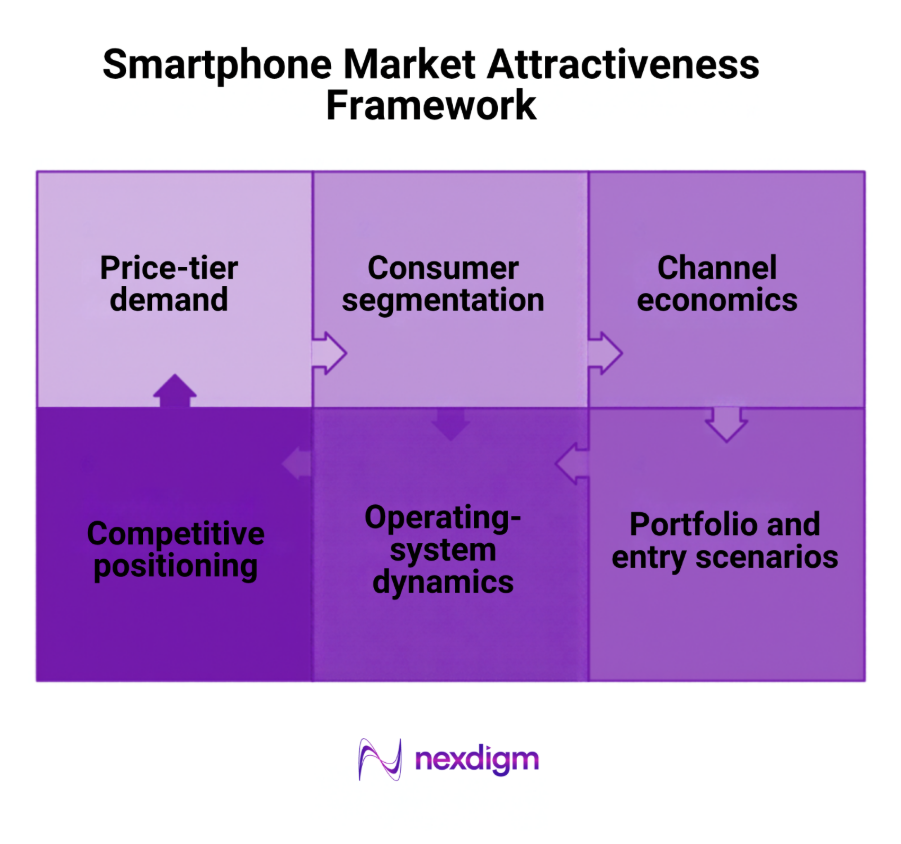
- Price-tier demand: Measure shipment trends, market value, consumer migration, ASP movement, and affordability across price bands.
- Consumer segmentation: Assess income, replacement cycles, feature priorities, financing dependence, brand loyalty, and willingness to pay.
- Channel economics: Compare online, offline, carrier, distributor, and direct channels by margins, inventory requirements, reach, and promotional intensity.
- Competitive positioning: Benchmark brands by price, specifications, ecosystem strength, distribution footprint, and market share.
- Operating-system dynamics: Track Android, iOS, and alternative ecosystems by geography, price tier, installed base, and switching behaviour.
- Portfolio and entry scenarios: Model SKU rationalization, pricing corridors, channel combinations, sourcing constraints, and market-entry priorities under different cost scenarios.
The objective is to identify where demand remains structurally attractive after pricing pressure, channel costs, competitive intensity, and component constraints are incorporated.
Nexdigm Case: Benchmarking Consumer Electronics Brands
Nexdigm supported a consumer electronics company in benchmarking competing brands across innovation, pricing, product features, and market positioning. The assessment identified feature gaps, compared value propositions, and supported refinement of the client’s pricing approach. Nexdigm’s published benchmarking work covers smartphones and other connected consumer devices within the broader consumer electronics category.
The engagement demonstrates how competitive benchmarking can connect product specifications with commercial positioning. For smartphone manufacturers, that same analysis becomes increasingly important as rising component costs make pricing, feature prioritization, and portfolio decisions more tightly connected.
To take the next step, simply visit our Request a Consultation page and share your requirements with us.
Harsh Mittal
+91-8422857704