

SME borrowing needs evolve with maturity: early-stage firms borrow for seasonal liquidity, scaling suppliers need working capital to bridge customer payment cycles, and established manufacturers fund long-term expansion and machinery.
This creates a product-fit challenge. One-size-fits-all term loans saddle businesses with misaligned repayment terms, driving up drop-offs and portfolio risk. Instead, a targeted demand assessment aligns financing with a firm’s maturity, cash-flow cycles, and true repayment capacity.
Working Capital Is Often the Immediate Constraint
The gap between supplier payments and customer collections is a persistent source of financing demand. Corporate buyers may take 60 to 120 days to settle invoices, while SMEs may need to pay suppliers, employees, utilities, and other operating expenses within 15 to 30 days.
For businesses experiencing order growth, this timing mismatch can directly restrict expansion. An SME may have sufficient confirmed demand but lack the liquidity required to purchase inventory, pay suppliers, or fulfil an order.
The financing requirement varies accordingly:
- Invoice discounting and factoring can fund verified receivables from established corporate buyers.
- Revolving credit facilities can support inventory accumulation and seasonal requirements.
- Equipment term loans can finance machinery and longer-term capacity expansion.
- Business revolvers can provide liquidity for temporary payroll, maintenance, or operating shocks.
The appropriate product depends on the duration and predictability of the underlying cash requirement.
Conventional Underwriting Can Exclude Viable SMEs
Traditional SME lending often depends heavily on audited financial statements, historical profitability, and physical collateral. These requirements can disadvantage businesses whose operating economics are stronger than their conventional balance-sheet profile suggests.
Asset-light technology and professional-services companies may have limited collateral despite recurring revenues. Younger businesses may lack the operating history lenders typically require. Businesses with significant informal activity can also be difficult to assess using conventional debt-service measures.
Processing time creates another constraint. Manual document collection, branch assessments, and collateral appraisals can take weeks, while an SME facing an immediate inventory or payroll requirement may need financing much sooner.
Digital Records Are Expanding the Credit Evidence Available
SMEs increasingly leave financial records across digital systems that can provide lenders with more current information about business performance.
GST and digital invoicing records can help verify sales and transaction activity. Account Aggregator data can provide visibility into bank inflows, average balances, payment patterns, and cash-flow volatility. Supply-chain platforms, enterprise systems, merchant-acquiring records, and TReDS can provide additional evidence of orders, invoices, and corporate buyer payment behaviour.
Government-backed programmes such as CGTMSE can provide partial credit support, allowing lenders to serve businesses that may otherwise fall outside secured lending criteria.
Revenue Alone Does Not Determine Credit Quality
Two SMEs with similar turnover can present very different lending opportunities.
One may have diversified customers, predictable collections, and a stable operating history. Another may depend heavily on a single buyer; experience extended receivable cycles or use short-term borrowing to finance long-term assets.
Lenders can therefore examine:
- Verified operating cash flow and its consistency over time.
- Concentration among major customers and the credit quality of those counterparties.
- Receivable and inventory cycles.
- Alignment between loan tenor and the underlying financing requirement.
- Availability of collateral or credit guarantees.
- Operating history across different market conditions.
An SME lending demand assessment can connect financing requirements with business maturity, cash-flow patterns, counterparty strength, and repayment capacity.
Nexdigm’s SME Lending Demand Framework
Nexdigm evaluates SME lending opportunities across cash-flow visibility, counterparty strength, guarantee coverage, alternative-data availability, and portfolio economics.
The assessment examines:
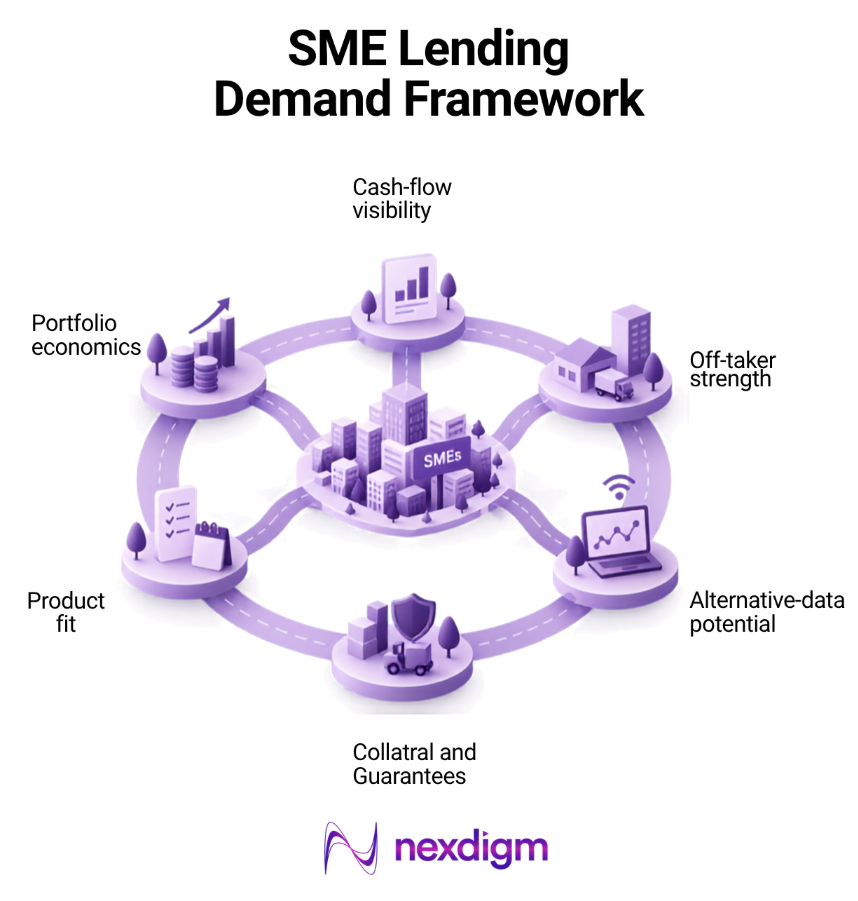
- Cash-flow visibility: banking, tax, invoicing, and transaction data that can establish actual operating performance.
- Off-taker strength: corporate buyer quality, payment history, invoice disputes, and customer concentration.
- Alternative-data potential: whether GST activity, POS settlements, utility payments, or other operating signals can strengthen underwriting.
- Collateral and guarantees : receivables, equipment, and government-backed credit support that can reduce uncovered exposure.
- Product fit: alignment between financing purpose, loan tenor, and the SME’s commercial cash cycle.
- Portfolio economics: expected lending yield, servicing requirements, capital consumption, and loss exposure.
The framework allows lenders to assess demand at the segment level rather than treating the SME market as a single borrower category.
How Nexdigm Identifies the SME Financing Pools Worth Serving
Nexdigm screens sectors and borrower groups to identify where financing demand is supported by observable business activity and manageable credit risk. Invoice-backed lending can serve SMEs selling to established corporate buyers. Merchant working-capital facilities can support businesses with consistent digital payment flows. Industrial clusters can offer opportunities where machinery and working-capital requirements are supported by established operating histories and credit guarantees.
The Nexdigm Approach: From Market Demand to Credit Strategy
A lender screened 10 SME financing segments and found that invoice-backed and merchant working-capital products represented 61% of modeled near-term demand. Nexdigm assessed cash-flow visibility, customer concentration, collateral coverage, and repayment cycles to prioritize segments with stronger lending potential.
The assessment gives lenders a basis for deciding which SME financing needs justify dedicated products, where digital underwriting can improve access, and where portfolio risk makes expansion less attractive.
To take the next step, simply visit our Request a Consultation page and share your requirements with us.
Harsh Mittal
+91-8422857704
[email protected]