

SME Lending Platforms Capture Opportunities in Markets Driven by Small Business Growth highlights the increasing need for faster, more accessible credit solutions for small and medium-sized enterprises. Many SMEs face funding gaps due to limited collateral, informal financial records, and lengthy bank approval processes. Digital lending platforms can address these challenges through automated underwriting, alternative data, digital onboarding, and quicker loan disbursement.
The SME lending platform market entry approach helps firms assess borrower demand, credit risk, regulations, partnerships, and repayment behavior. When aligned with a broader market entry strategy, it supports responsible expansion and sustainable SME credit growth.
MSMEs account for over 90% of all firms, around 70% of employment, and nearly 50% of global GDP. Yet, SMEs across emerging and developing markets face a USD 5.7 trillion finance gap. Digital lending platforms, projected to grow from USD 13.8 billion in 2025 to USD 114.72 billion by 2034, can help close this gap.
SME Lending Platform Market Entry Strategy for Small Business Growth
SME Lending Platform Market Entry Strategy for Small Business Growth helps lenders assess SME credit demand, financing gaps, regulations, risk models, partnerships, digital onboarding, and repayment behavior before market launch:
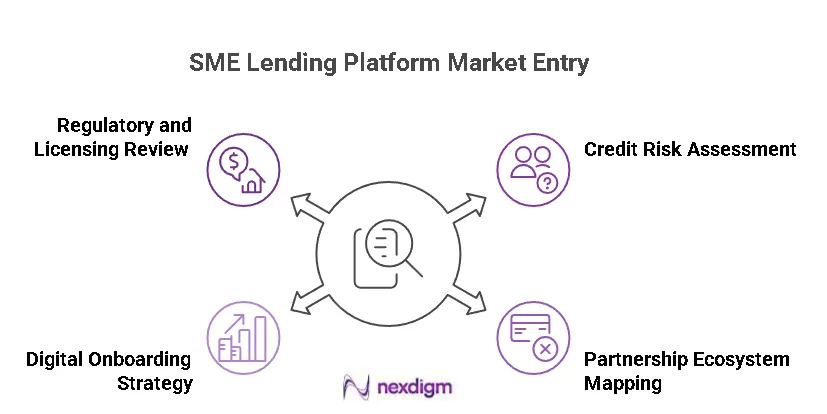
- Regulatory and Licensing Review: Assess lending licenses, KYC, AML, data privacy, disclosure norms, and borrower protection requirements before market entry.
- Credit Risk Assessment: Review cash flows, repayment capacity, business stability, sector risk, and alternative data for SME lending decisions.
- Digital Onboarding Strategy: Design simplified business verification, document upload, e-KYC, account linking, and faster approval journeys for SME borrowers.
- Partnership Ecosystem Mapping: Identify banks, NBFCs, fintechs, marketplaces, accounting platforms, and payment providers supporting SME lending expansion.
Nexdigm’s Support for SME Credit Gap Assessment
Nexdigm’s Support for SME Credit Gap Assessment helps lenders evaluate underserved small business segments, financing needs, collateral limitations, cash flow patterns, documentation gaps, and repayment capacity. This support enables lenders to identify viable SME borrowers, design suitable loan products, reduce entry risks, and build responsible lending strategies in growth markets.
How Does Nexdigm Support Credit Risk Assessment for SME Lending Platforms?
Nexdigm helps evaluate borrower cash flows, repayment capacity, sector risks, documentation quality, default indicators, underwriting models, and portfolio risk exposure.
- Cash Flow Analysis: Nexdigm reviews SME revenue patterns, seasonality, operating expenses, and cash inflows to assess repayment strength.
- Repayment Capacity Review: Nexdigm evaluates debt obligations, margins, working capital needs, and repayment history to determine borrower affordability.
- Sector Risk Assessment: Nexdigm analyzes industry trends, demand volatility, supply chain risks, and regulatory exposure affecting SME borrower performance.
- Documentation Quality Check: Nexdigm reviews financial statements, tax records, bank statements, invoices, and business registrations for credit assessment reliability.
Nexdigm’s case:
Nexdigm helped an SME lending platform strengthen credit risk assessment before entering two small business growth markets. Nexdigm reviewed 6 borrower sectors, analyzed 5 cash flow indicators, assessed 4 documentation quality gaps, and mapped 7 default risk signals.
This helped the company improve projected underwriting accuracy by 24%, reduce credit review timelines by 30%, and build a more resilient SME lending risk framework.
To take the next step, simply visit our Request a Consultation page and share your requirements with us.
Harsh Mittal
+91-8422857704