

Providing competitive intelligence on the shift to software-driven vehicle architectures helps companies understand how digital features are transforming automotive value. The global software-defined vehicle (SDV) market is projected to surpass $400 billion by 2030, with more than 90% of new vehicles expected to support over-the-air (OTA) updates. SDVs allow automakers to deliver continuous feature upgrades, enhance connectivity, and generate recurring revenue streams through software-enabled services, improving customer experience and extending vehicle lifecycles.
These intelligence services also uncover competitor strategies, investment trends, and ecosystem partnerships in digital mobility. Businesses can identify innovation gaps, accelerate development cycles, and adapt to evolving market demands. Additionally, insights into cybersecurity and regulatory requirements help mitigate risks, ensure compliance, and support the delivery of secure, high-quality digital experiences in an increasingly software-centric automotive landscape.
Tools for Competitive Intelligence on Software-Driven Vehicle Architectures
Competitive intelligence services use advanced tools to decode the shift toward software-driven vehicle architectures, where digital capabilities define value. These tools help businesses track innovation, competitor strategies, and evolving ecosystems in the automotive software landscape.
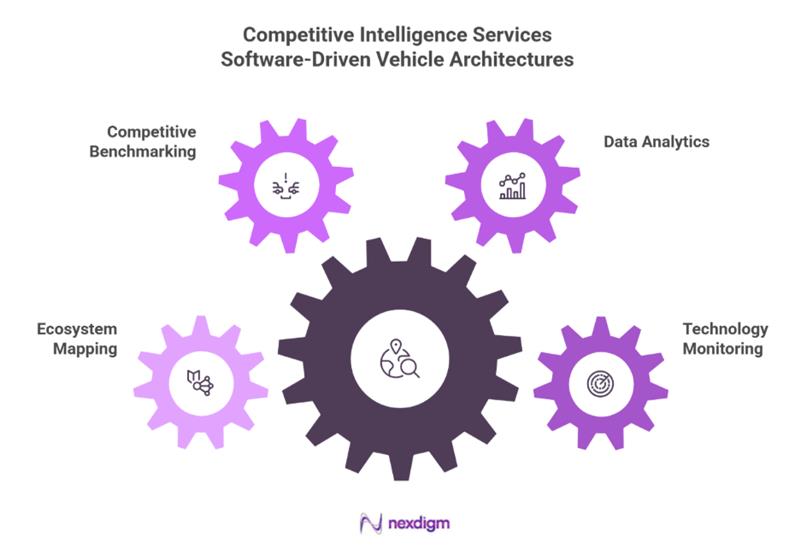
1. Technology Monitoring Platforms
These tools track advancements in software-defined vehicle technologies, including operating systems, cloud integration, and over-the-air updates. They help businesses stay informed about innovations and assess how competitors are evolving their digital capabilities.
2. Data Analytics and Visualization Tools
Advanced analytics tools process large datasets to identify trends in digital vehicle adoption and software investments. Visualization dashboards enable businesses to interpret complex data quickly, supporting better decision-making in software-driven automotive strategies.
3. Competitive Benchmarking Tools
These tools compare competitor capabilities in software integration, digital services, and platform development. Businesses can evaluate their performance against industry leaders and identify gaps in their software-driven vehicle offerings.
4. Ecosystem and Partnership Mapping Tools
These tools analyze collaborations between automakers, tech firms, and software providers. They help businesses understand ecosystem dynamics, identify key partners, and leverage alliances to strengthen their position in the digital automotive value chain.
Nexdigm’s Offerings on competitive intelligence for Software-Driven Vehicle Intelligence
Nexdigm delivers competitive intelligence services covering software architecture benchmarking, digital revenue model analysis, OTA capability assessment, and ecosystem mapping. It provides insights on cloud integration, cybersecurity compliance, and competitor strategies, enabling firms to accelerate software transitions, enhance digital offerings, and capture value from evolving software-defined vehicle ecosystems.
Nexdigm’s Techniques for Competitive Intelligence in Software-Driven Vehicle Architectures
Nexdigm applies structured automotive software competitive intelligence techniques to decode the transition toward software-driven vehicle architectures. These approaches help businesses understand digital value creation, track competitors, and align strategies with evolving software ecosystems in the automotive industry.
1. Software Platform Evolution Tracking
Tracking evolution of vehicle operating systems, middleware, and software stacks shaping digital vehicle architectures.
2. Digital Value Chain Mapping
Analyzing how value shifts from hardware to software, services, and recurring digital revenue streams.
3. OTA and Update Capability Assessment
Evaluating competitors’ over-the-air update capabilities and frequency of software-driven feature enhancements.
4. Digital Revenue Model Analysis
Studying subscription models, feature-on-demand services, and monetization strategies built on vehicle software.
5. In-Vehicle Experience Benchmarking
Comparing user interfaces, infotainment systems, and digital experiences offered across competing vehicles.
6. Cloud and Backend Integration Review
Assessing integration of cloud platforms, data infrastructure, and backend systems enabling software-defined vehicles.
7. Cybersecurity and Software Compliance Tracking
Monitoring approaches to vehicle cybersecurity, data protection, and compliance within software-driven automotive ecosystems.
Nexdigm’s Case:
Nexdigm supported an OEM in transitioning to software-defined vehicles, increasing digital feature adoption by 35% and reducing development cycles by 20%, using competitive intelligence on platforms, partnerships, and evolving software ecosystems.
To take the next step, simply visit our Request a Consultation page and share your requirements with us.
Harsh Mittal
+91-8422857704