

Software licensing has become a significant and increasingly complex component of enterprise technology expenditure. Organisations may hold agreements with dozens of software providers, each using different pricing models, renewal cycles, usage definitions and contractual conditions. A licence that appears competitively priced at the point of purchase can become expensive as employee numbers grow, product requirements change or additional features are introduced.
Software licensing cost benchmarking helps procurement teams understand whether their current agreements reflect competitive market conditions. It also provides a basis for identifying negotiation opportunities, reducing unnecessary expenditure and improving the commercial structure of future software contracts.
Why Software Licence Costs Are Difficult to Compare
Software suppliers rarely follow a uniform pricing model. Some charge per named user, while others use concurrent users, devices, transactions, consumption, processing capacity or enterprise-wide agreements. Products with similar functionality may therefore have very different cost structures.
The licensing model can also influence how an organisation uses the software. Named-user licences may be suitable for employees who need regular access, but they can create unnecessary expenditure when users require the application only occasionally. Concurrent licensing may improve utilisation in certain environments, although it can introduce access limitations during periods of peak demand.
Enterprise agreements add another layer of complexity. Large customers may receive volume discounts, bundled products or preferential support terms. However, these agreements can also include minimum commitments, automatic renewals and restrictions on reducing licence quantities.
A meaningful benchmark must compare equivalent products, usage assumptions and contractual conditions. Looking at the headline subscription price alone provides an incomplete picture.
The Commercial Variables That Influence Licensing Costs
Licence metrics and consumption patterns
The first step is to understand what the supplier actually charges for. Procurement teams should identify whether pricing is based on users, devices, environments, transactions, storage, computing capacity or a combination of metrics.
Actual usage should then be compared with contracted entitlements. Organisations may discover inactive accounts, duplicate subscriptions, unused modules or licences assigned to employees who no longer require access.
Contract duration and renewal terms
Suppliers may offer lower annualised rates in exchange for longer commitments. While multi-year agreements can provide price stability, they may limit the organisation’s ability to respond to workforce changes, technology migration or changing business requirements.
Renewal clauses should be reviewed carefully. Automatic renewal provisions, notice periods, price escalation mechanisms and minimum purchase commitments can affect the organisation’s negotiating position.
Bundling and product dependencies
Software vendors frequently package multiple products into a single subscription. Bundling can reduce costs when all included applications are actively used. However, it can also conceal expenditure on features that provide little operational value.
Procurement teams should assess the standalone cost of relevant products against the bundled price and determine whether the organisation is paying for capabilities already available through other agreements.
Support, maintenance and implementation
Licence costs may not include premium support, implementation services, training, upgrades or specialised technical assistance. These additional charges should be included in the comparison to establish the actual cost of maintaining the software.
For perpetual licences, maintenance and upgrade fees can become a substantial recurring expense. For subscription products, organisations should understand what happens to access, data and support when an agreement expires.
How to Establish a Meaningful Market Benchmark
A licensing benchmark should begin with a consistent view of the organisation’s software inventory. This includes supplier names, product editions, licence quantities, contracted prices, renewal dates and actual usage.
The next step is to identify comparable market alternatives. Procurement teams should compare products with similar functional scope and enterprise suitability rather than treat every product in the same category as interchangeable.
Market intelligence can provide insight into prevailing commercial structures, available discount mechanisms and the conditions under which suppliers may negotiate. Where direct market pricing is not publicly available, organisations can use competitive proposals, historical contracts and structured supplier enquiries to strengthen the benchmark.
It is also important to separate list prices from realised prices. Published prices may not reflect enterprise discounts, negotiated bundles or regional commercial arrangements. A credible assessment should make the assumptions behind every comparison explicit.
Procurement Levers That Can Improve Licensing Economics
Several actions can strengthen the organisation’s commercial position:
- Consolidate demand across departments to improve visibility and negotiating leverage.
- Reclaim unused or duplicate licences before purchasing additional entitlements.
- Align licence tiers with actual user requirements instead of assigning premium editions universally.
- Negotiate renewal protections, flexible quantities and transparent price escalation terms.
- Review bundled products and remove overlapping applications where functionality is duplicated.
These measures should be coordinated with IT asset management and software asset management teams. Procurement savings that compromise essential access, compliance or operational continuity are not sustainable savings.
How Nexdigm Supports Software Licensing Cost Benchmarking
Nexdigm supports organisations through procurement research, supplier benchmarking, market intelligence and commercial analysis. Its work can help clients compare licensing models, assess vendor pricing structures, identify market alternatives and develop evidence-based negotiation strategies. This enables procurement teams to approach renewals with a clearer understanding of contractual value and potential cost improvements.
Software Licensing Cost Benchmarking Framework
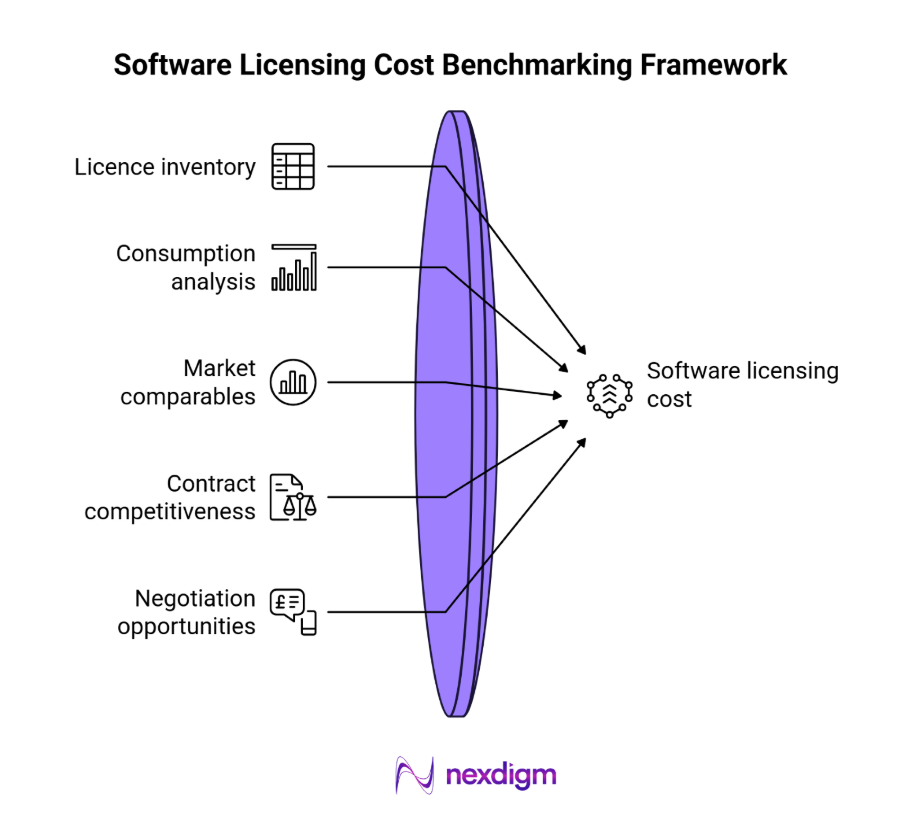
- Build the licence inventory: Consolidate products, vendors, entitlements, contract terms and renewal dates.
- Analyse consumption: Compare contracted quantities with actual usage and identify underutilised licences.
- Establish market comparables: Identify equivalent products, pricing metrics and alternative commercial models.
- Evaluate contract competitiveness: Review discounts, bundles, renewal clauses, escalation terms and support costs.
- Prioritise negotiation opportunities: Quantify potential savings and develop renewal or consolidation strategies.
Nexdigm’s Case Study: Identifying Software Licensing Savings
Nexdigm benchmarked 14 software agreements across six business functions, identified 19 underutilised licence categories and compared renewal terms across eight suppliers. The assessment prioritised five contracts for renegotiation and licence rationalisation.
To take the next step, simply visit our Request a Consultation page and share your requirements with us.
Harsh Mittal
+91-8422857704