

The enterprise software market is large enough to make almost any product pitch sound plausible. Global enterprise software spending is projected to reach $1.47 trillion in 2026, representing 15.5% growth. Yet the size of the market does not answer the more difficult questions facing a new entrant: Does the customer have a sufficiently important problem? Will the buyer switch? Can the product defend its position against an incumbent? And does the pricing model work once the product is deployed at scale?
These questions have become more important as established platforms expand their functionality. Microsoft, Salesforce, ServiceNow, SAP and Oracle are integrating generative interfaces and autonomous capabilities into existing enterprise systems, increasing the competitive pressure on standalone software products.
A Customer Problem Is Not Automatically a Market
A software product can solve a genuine problem without having a commercially attractive market. The problem may occur too infrequently, have limited financial consequences or already be handled adequately through internal processes.
The more useful measure is the economic significance of the workflow. Customer support, finance, cybersecurity, software development and supply-chain compliance all contain repetitive processes where software can potentially reduce labour requirements, shorten processing times or improve compliance.
This is why customer research needs to go beyond general purchase interest. A buyer saying that a solution is “useful” is very different from a buyer identifying an existing budget, a specific workflow and a measurable business outcome that would justify procurement.
Incumbents Change the Product-Market-Fit Equation
The competitive question becomes more complicated when the customer already owns an enterprise platform capable of adding similar functionality.
For example, a new analytical or generative-AI product may compete with a specialist vendor on features, but the customer’s real alternative may be an AI capability already available through its existing CRM, ERP or productivity platform.
The report identifies this as a structural challenge for point solutions. Horizontal products that primarily wrap foundation-model APIs can face pressure when similar functionality is integrated directly into systems of record.
The strongest opportunities therefore tend to sit deeper within specialised workflows, regulated processes, cross-platform integration or areas where proprietary context provides a meaningful advantage.
Pricing Is Becoming Part of Product Design
Software pricing is also changing as AI and autonomous workflows alter the relationship between software usage and employee headcount.
Historically, SaaS providers could link revenue to the number of users. Autonomous systems can perform tasks without adding human seats, while simultaneously generating variable inference and compute costs. The report notes that 37% of surveyed venture-backed enterprise software companies historically operated on pure subscription models, but only 26% expect to remain subscription-only.
For new software products, pricing research therefore needs to establish what customers are actually paying for. It may be access, transaction volume, processing capacity, completed outcomes or measurable cost reduction.
Building a Software Feasibility Framework
A software market feasibility study consulting approach should connect customer need, competition and economics rather than evaluating them independently.
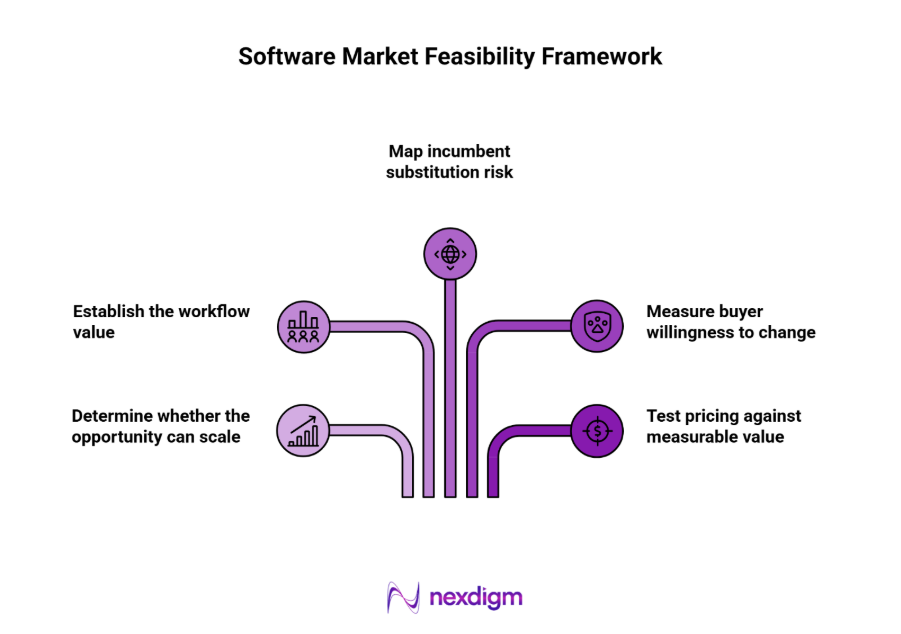
- Establish the workflow value.
Identify the specific process being solved, how frequently it occurs, who performs it and what it currently costs. A high-frequency workflow with significant labour or compliance costs provides a stronger commercial basis than a low-frequency inconvenience. - Measure buyer willingness to change.
Customer research should establish who owns the problem, who controls the budget and what would trigger a purchase. Switching costs, implementation requirements and procurement processes can be as important as product functionality. - Map incumbent substitution risk.
Competitive assessment should include direct software competitors as well as existing enterprise platforms, internal tools and manual workarounds. This establishes the real competitive set facing the entrant. - Test pricing against measurable value.
Pricing should be tested against the economic benefit delivered. Where AI introduces variable infrastructure costs, subscription-only models may create margin pressure, making consumption or outcome-linked structures more appropriate. - Determine whether the opportunity can scale.
The final assessment should combine customer volume, adoption potential, pricing, retention, implementation requirements and sales-cycle length to establish whether a promising product can become a scalable commercial proposition.
This approach is particularly important as enterprise software moves toward specialised workflow automation rather than generic feature expansion.
Nexdigm Case: Testing Software Product-Market Fit and Pricing
A SaaS provider assessed 4 workflows across 6 industries, interviewing 1,800 decision-makers and benchmarking 42 competing solutions. Nexdigm identified 31% purchase intent for one workflow, while value-based pricing increased projected conversion by 16%.
Nexdigm’s software market feasibility study consulting helps companies assess customer demand, competitive positioning, pricing, market attractiveness and product-market fit before scaling a software proposition.
To take the next step, simply visit our Request a Consultation page and share your requirements with us.
Harsh Mittal
+91-8422857704