

The global enterprise software market is projected to reach $1.47 trillion in 2026, growing 15.5% year over year. But a market of that size contains radically different opportunities across industries, workflows and customer segments.
Software growth is also being reshaped by AI. Enterprise applications are increasingly incorporating generative interfaces and autonomous agents, while businesses are reassessing the traditional relationship between software licences and employee headcount. The TMT research notes that autonomous AI agents could grow from approximately $16 billion in 2025 to $29 billion in 2026, an 81.3% increase.
For software companies, this makes opportunity assessment less about identifying a large market and more about locating workflows where customers have sufficient pain, budget and willingness to change.
Software Demand Is Moving Toward Workflow Depth
Generic software functionality is becoming easier to replicate. Incumbent platforms can add AI interfaces, automation and analytics to existing enterprise systems, making it harder for standalone products to differentiate purely through features.
The more defensible opportunities often emerge where software becomes deeply embedded in a specialised process.
Customer support, finance and accounting, cybersecurity, supply-chain compliance and legacy software modernisation are examples identified in the TMT research. These workflows contain structured information, recurring transactions and measurable costs, making them more suitable for automation.
This changes how opportunity assessment should be conducted. The question is not simply which industry spends the most on software. It is which workflow creates enough economic value for a new solution to displace an incumbent, manual process or internal tool.
Industry Attractiveness Depends on the Workflow
The same software category can have very different commercial potential across industries.
A workflow automation platform may face strong competition in general administrative functions but find greater whitespace in a regulated industry with specialised compliance requirements. A data product may have limited differentiation in a mature market but become valuable where information is fragmented across multiple enterprise systems.
Industry assessment should therefore consider the structure of the workflow itself, including transaction frequency, labour intensity, error costs, compliance exposure and integration complexity.
The TMT research describes this as an opportunity for software that can operate across competing enterprise databases and coordinate actions where individual incumbents have limited incentive to optimise interoperability.
Customer Segmentation Determines the Addressable Market
A software opportunity can look attractive at the industry level while remaining difficult to monetise across all customer sizes.
Large enterprises may offer higher contract values but require longer procurement processes and complex integrations. Mid-market customers can have shorter decision cycles but lower budgets. Smaller organisations may value ease of implementation more than extensive functionality.
Pricing must also reflect how the software is used. The TMT research notes that 37% of venture-backed enterprise software companies historically operated on pure subscription models, while only 26% expect to remain subscription-only. Consumption, credit-based and outcome-linked models are becoming more common.
This means customer segmentation should be connected directly to pricing and service economics.
Building a Software Opportunity Assessment Framework
A software opportunity market assessment should move from workflow economics to market prioritisation.
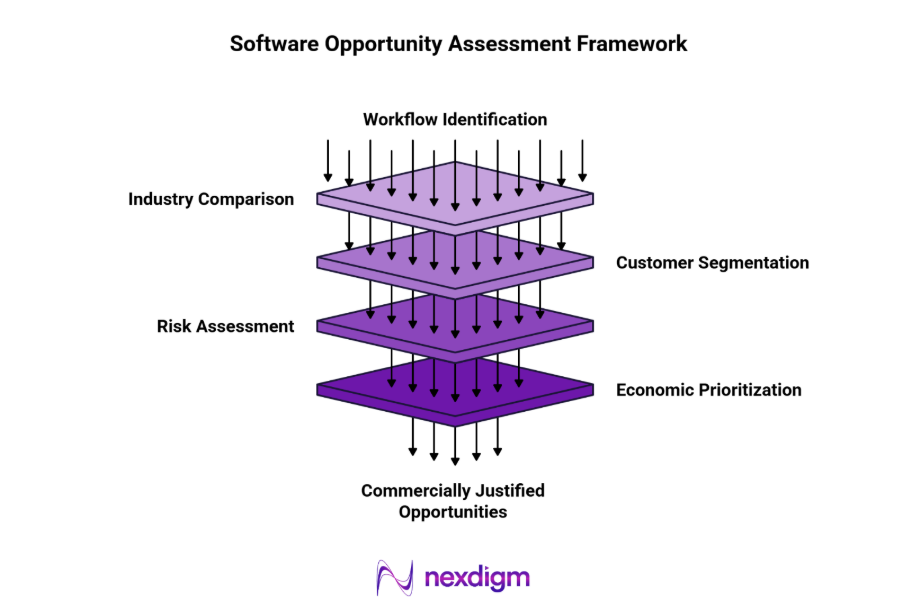
- Map the workflows where spending can be displaced.
Identify processes involving significant labour, recurring transactions, manual review, compliance requirements or operational delays. Estimate the current cost of the workflow and the potential value of automation. - Compare opportunity across industries.
Assess market size alongside workflow intensity, regulatory requirements, technology maturity, incumbent penetration and purchasing behaviour. This helps distinguish large but difficult markets from smaller segments with stronger commercial whitespace. - Segment customers by willingness and ability to pay.
Evaluate company size, budget availability, decision-making structure, technology infrastructure and implementation capacity. A high-value customer segment is useful only if the product can be sold and deployed efficiently. - Assess competitive and substitution risk.
Map direct competitors, enterprise suites, internal development and manual alternatives. The analysis should establish what customers would actually replace if they adopted the new product. - Prioritise opportunities using commercial economics.
Combine addressable customer volume, realistic adoption, pricing, acquisition cost, implementation requirements and retention potential. The output should identify the workflows and customer segments where investment is commercially justified.
This final step is particularly important because software opportunity is increasingly tied to measurable outcomes. A product that saves a customer ₹1 crore annually creates a different pricing opportunity from one that simply provides a more convenient interface.
Where AI Creates New Software Whitespace
AI is expanding the opportunity set while simultaneously increasing competitive pressure. Autonomous agents can perform tasks such as invoice reconciliation, software development, customer support and incident triage, potentially changing the unit economics of enterprise workflows.
But AI readiness remains uneven. Only 6% of enterprises in the TMT research report fully prepared data architecture, despite 34% scaling AI into production.
This creates potential demand for software that sits between enterprise data and AI applications, particularly around governance, context resolution, integration and workflow orchestration.
Nexdigm Case: Prioritising Software Growth Opportunities
A software provider evaluated 9 workflows across 7 industries, combining 3,200 enterprise interviews with 58 competitor assessments. Nexdigm identified 4 priority opportunities, with the leading segment showing 27% purchase intent and a projected 15% annual revenue opportunity.
Nexdigm’s software opportunity market assessment helps companies evaluate workflows, industries, customer segments, competitive whitespace, pricing and commercial potential to identify where software investment can generate sustainable growth.
To take the next step, simply visit our Request a Consultation page and share your requirements with us.
Harsh Mittal
+91-8422857704