

Software vendors often price comparable solutions differently because of feature depth, deployment models, support levels, licensing structures, integrations, and commercial positioning. Software pricing gap benchmarking helps businesses normalize competing offers, quantify price differences, and determine whether premiums reflect genuine customer value or pricing inefficiencies.
Supported by software pricing analysis, vendor pricing benchmarking, competitive pricing intelligence, price-gap analysis, licensing cost comparison, and value-based pricing, businesses can improve cost transparency, sourcing confidence, margin protection, and commercial decision-making.
Benchmarking scenarios showing vendor price differences above 20% can signal meaningful disparities in packaging, licensing, discounts, or service value. Pricing Analysis Services help organizations normalize these differences, identify unjustified premiums, strengthen negotiations, and uncover opportunities for cost optimization and better value realization.
Software Pricing Intelligence for Vendor Cost Gaps and Benchmarking
Software pricing intelligence helps businesses to identify cost disparities, strengthen negotiations, improve transparency, and support informed sourcing decisions. Its key dimensions provide a structured basis for overall software industry growth, including:
- Vendor Premium Justification: Measures price premiums against functionality, service quality, performance, reliability, and brand value to determine whether higher vendor pricing is commercially defensible.
- Renewal Price Escalation: Examines annual price increases, renewal uplifts, and contract resets across vendors to determine how recurring adjustments influence long-term software cost competitiveness.
- Customization Premiums: Compares charges for tailored workflows, configurations, reporting, and integrations to determine whether customization requirements create disproportionate vendor cost differences.
- Commercial Flexibility: Evaluates payment terms, contract amendments, scalability provisions, cancellation rights, and commitment flexibility to compare value beyond headline software pricing.
How Nexdigm Supports Software Vendor Comparison Through Pricing Analysis
Nexdigm supports businesses in comparing software vendors through structured pricing analysis services, combining cost benchmarking, licensing economics, contract intelligence, and value assessment. Using software pricing analysis, vendor pricing benchmarking, competitive pricing analysis, software cost comparison, total cost of ownership analysis, price gap analysis, and pricing intelligence, Nexdigm helps organizations identify cost disparities, strengthen negotiations, evaluate vendor value, and improve sourcing decisions.
Nexdigm’s Pricing Intelligence Framework for Software Vendor Value Assessment
Nexdigm’s pricing intelligence framework combines vendor benchmarks, licensing economics, contract analysis, and value assessment to help businesses compare software providers and strengthen informed sourcing decisions. Its structured steps help analyze vendor pricing data into clearer value comparisons and procurement decisions, including:
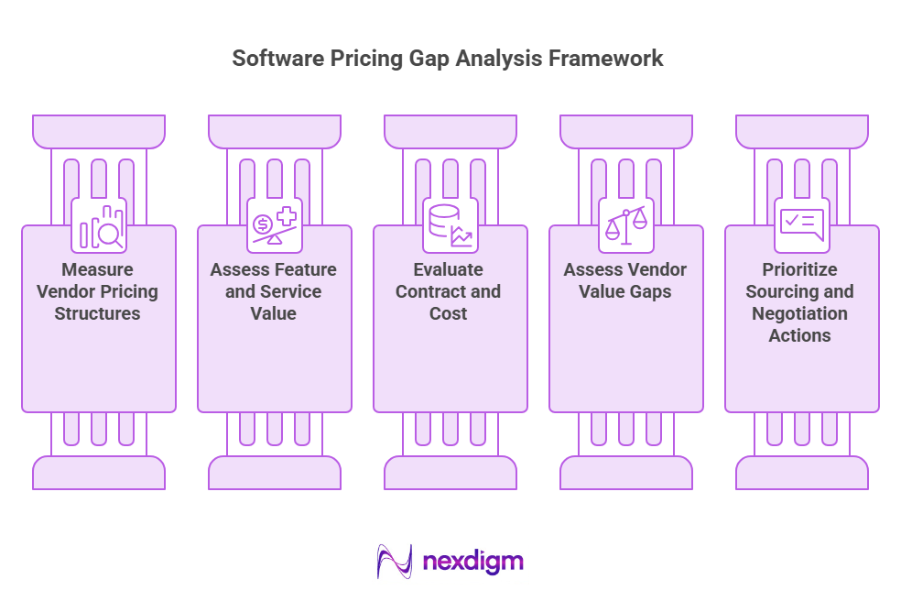
- Measure Vendor Pricing Structures: Standardize subscriptions, licenses, usage charges, support fees, and bundled services to create comparable pricing baselines across competing software vendors and commercial models.
- Assess Feature and Service Value: Compare functionality, integrations, implementation support, service levels, and premium capabilities to determine whether vendor price differences reflect meaningful operational or commercial value.
- Evaluate Contract and Cost: Review discounts, renewal terms, escalation clauses, commitments, deployment costs, and total ownership expenses to identify hidden cost drivers and long-term pricing exposure.
- Assess Vendor Value Gaps: Measure effective price differences against normalized capabilities and service value to identify overpricing, underpricing, negotiation opportunities, and vendors offering stronger overall economics.
- Prioritize Sourcing and Negotiation Actions: Rank vendors according to pricing competitiveness, value delivery, contract flexibility, and cost exposure to support stronger negotiations, supplier selection, and procurement decisions.
Nexdigm’s Case
Nexdigm supported an enterprise in benchmarking software vendors across licensing, contract terms, and total ownership costs. The engagement identified 22% vendor price variance, enabled 14% procurement savings, and improved contract value realization by 11%, strengthening sourcing decisions and negotiation leverage.
To take the next step, simply visit our Request a Consultation page and share your requirements with us.
Harsh Mittal
+91-8422857704