

Soil nutrient management has become more demanding as agricultural businesses seek to improve crop performance while addressing variations in soil fertility. Procurement teams must source a wider range of products, including secondary nutrients, micronutrients, soil conditioners, organic amendments and specialty formulations.
The challenge is that suppliers often offer products with different concentrations, formulations and application recommendations. Two products carrying the same nutrient name may differ in solubility, composition, compatibility and cost per effective application. A robust benchmarking exercise helps buyers assess these differences before making purchasing decisions.
Why Soil Nutrient Procurement Needs Product-Level Benchmarking
Soil nutrient requirements vary by crop, geography, soil type and production system. Deficiencies in zinc, boron, iron and other micronutrients can affect crop development, but the appropriate intervention depends on the soil’s actual condition and the crop’s nutrient demand.
India’s soil health assessments identify regional variability in micronutrient availability, with zinc deficiency reported prominently in parts of Bihar, Uttar Pradesh and Odisha. Iron and boron also show variation across Indian soils. These differences make uniform procurement specifications unsuitable for many agricultural operations.
The supplier landscape is similarly diverse. Manufacturers may specialise in individual micronutrients, blended fertilizers, chelated products, soil conditioners or customised nutrient solutions. Buyers need to compare suppliers within the context of the intended application rather than treating all products as direct substitutes.
What Should Be Compared Across Soil Nutrient Suppliers?
The first requirement is a clear product specification. Buyers should record nutrient concentration, chemical form, solubility, formulation, recommended application rate and compatibility with other inputs. For soil amendments, relevant parameters may include pH, organic matter, particle size and other composition-specific characteristics.
Quality consistency deserves particular attention. A supplier may offer competitive pricing but lack adequate batch-level testing or traceability. Procurement teams should examine manufacturing controls, laboratory capabilities, certificates of analysis and the vendor’s process for handling rejected batches.
Availability must also be evaluated at the regional level. A manufacturer may have substantial national capacity but limited distribution in a particular agricultural market. Delivery lead times, dealer coverage, warehouse locations and seasonal stock positions can determine whether a product reaches farms when it is needed.
Turning Supplier Comparisons into Procurement Intelligence
A structured soil nutrient supplier benchmarking exercise allows agribusinesses to compare vendors across technical, operational and commercial criteria. The process should begin by grouping products according to nutrient category and application. Chelated micronutrients, for example, should not be benchmarked against conventional formulations without accounting for differences in concentration, suitability and application economics.
Commercial comparisons should move beyond the price per kilogram or tonne. Buyers should assess cost per unit of nutrient, application rate, expected coverage, packaging, freight and any additional handling requirements. Where products have different concentrations, normalising prices to a comparable nutrient basis can reveal substantial differences.
The exercise should also identify supplier concentration risks. Dependence on one manufacturer for a critical micronutrient or specialised amendment may expose buyers to production disruptions, regional shortages or sudden price changes. Identifying qualified alternatives can strengthen continuity without requiring immediate changes to existing agronomic programmes.
Evaluating Supplier Quality and Regulatory Readiness
Procurement teams should verify that products meet the applicable Fertiliser Control Order provisions and relevant specifications. Documentation should be checked for accuracy and consistency with product labels. Where product performance depends on a particular formulation or chemical form, buyers should confirm that the delivered material matches the approved specification.
Supplier assessments should examine the following areas:
- Manufacturing processes and quality assurance systems.
- Nutrient composition and batch-level consistency.
- Product documentation, labelling and traceability.
- Regional distribution capacity and seasonal inventory.
- Technical support and agronomic guidance.
For large-volume procurement, buyers can incorporate quality clauses, independent sampling rights and defined remedies for non-conforming deliveries into supplier agreements.
Integrating Soil Data with Procurement Planning
Procurement planning becomes more effective when purchasing decisions are connected to soil testing and crop-level demand forecasts. The Soil Health Card programme in India has generated 25.89 crore cards as of March 2026, covering 12 key soil parameters. This provides a substantial information base for more targeted nutrient management.
Agribusinesses can use available soil data, crop plans and regional agronomic recommendations to estimate product demand by nutrient category. This helps avoid over-purchasing inputs that are not required in a particular region while improving availability where deficiencies are more prevalent.
Nexdigm supports organisations through supplier benchmarking, market intelligence, product and price comparisons, and supply-market analysis. Its research can help procurement teams understand supplier positioning, evaluate regional availability and develop sourcing strategies that account for both technical requirements and commercial considerations.
Soil Nutrient Supplier Benchmarking Framework
A practical benchmarking model should include:
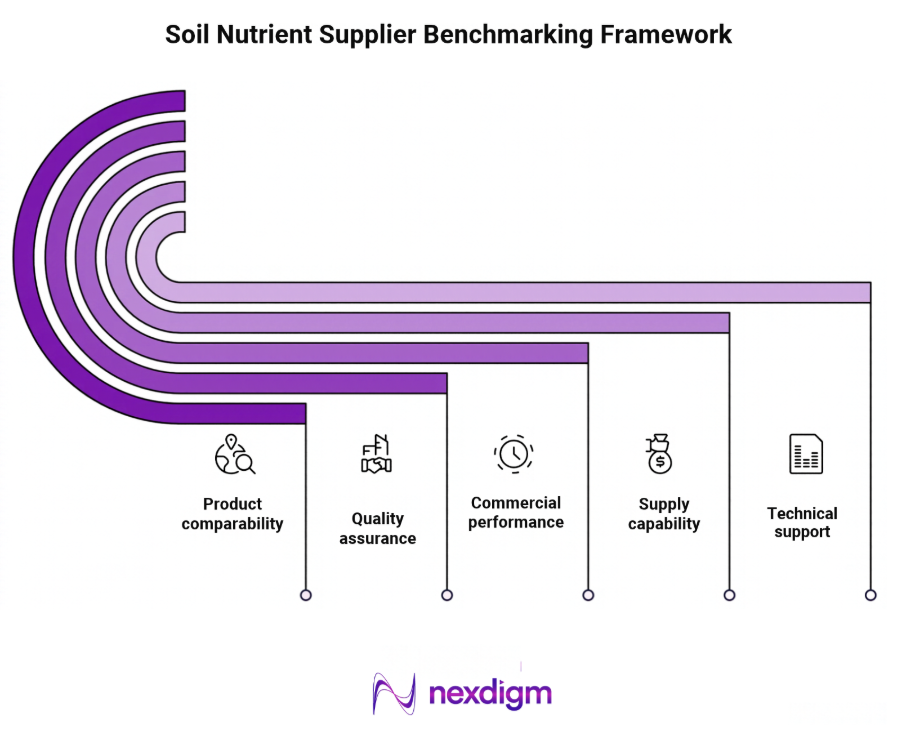
- Product comparability: Nutrient form, concentration, solubility and application suitability.
- Quality assurance: Testing protocols, batch consistency, traceability and documentation.
- Commercial performance: Normalised nutrient cost, freight, packaging and contract terms.
- Supply capability: Manufacturing capacity, inventory, regional coverage and lead times.
- Technical support: Product guidance, compatibility information and agronomic assistance.
Nexdigm’s Case Study: Benchmarking Micronutrient and Soil Amendment Vendors
Nexdigm benchmarked 31 suppliers across 7 nutrient categories, comparing product specifications, quality controls, regional availability and normalised pricing. The analysis identified 8 vendors for further qualification and highlighted 3 categories with limited regional sourcing alternatives.
To take the next step, simply visit our Request a Consultation page and share your requirements with us.
Harsh Mittal
+91-8422857704