
The automotive aftermarket is shaped by what happens after vehicles leave the showroom. As vehicles age, components wear out, require maintenance, or need replacement, creating recurring demand for spare parts.
However, aftermarket demand is not evenly distributed across all components. Brake parts, filters, batteries, suspension components, tyres, lighting, and other wear-related parts can follow different replacement patterns depending on vehicle age, mileage, operating conditions, and failure rates.
For automotive businesses, a structured Spare parts demand analysis can help identify which components are likely to generate recurring demand, where demand is concentrated, and how replacement cycles may evolve.
The Factors Shaping Spare Parts Demand
Spare-parts demand is influenced by several connected factors rather than vehicle sales alone. Organizations can evaluate the aftermarket through:
- Vehicle Parc
- Vehicle Age
- Usage
- Failure
- Replacement
- Demand
This framework helps businesses understand not only how many vehicles are on the road, but also which vehicles are most likely to require specific parts.
Vehicle Parc Aftermarket
The vehicle parc provides the foundation for aftermarket demand. A larger active vehicle population creates a broader base of vehicles requiring maintenance and replacement parts. Organizations can segment the parc by:
- Vehicle type
- Brand
- Model
- Age
- Geography
This allows businesses to identify where the largest addressable aftermarket pools exist and which vehicle groups are likely to generate recurring parts demand.
Vehicle Age and Replacement Potential
Vehicle age is one of the most important indicators of aftermarket activity. As vehicles move beyond their initial ownership period, maintenance and component replacement requirements generally become more relevant. Organizations can analyse the parc by age bands to identify: Newer vehicles, Mid-life vehicles and Ageing vehicles.
Different age groups can create different demand profiles. Newer vehicles may require fewer replacement parts, while older vehicles can generate greater demand for wear components, mechanical repairs, and replacement assemblies. This helps businesses align product portfolios with the changing age structure of the vehicle parc.
Failure Rates
Not every component fails or wears at the same rate. Understanding component-level failure patterns is therefore important for estimating aftermarket demand. Organizations can assess components based on:
- Failure frequency
- Average vehicle usage
- Operating conditions
- Component durability
- Maintenance intervals
This helps identify parts with high replacement frequency and recurring demand, as well as components where replacement demand is more occasional.
Replacement Cycles and Recurring Demand
Replacement timing determines when potential aftermarket demand converts into actual purchases.
Components such as filters, brake pads, batteries, tyres, and suspension parts may have relatively predictable replacement patterns, while other components may be replaced mainly following unexpected failures. Organizations can model replacement cycles by connecting: Vehicle age, mileage, operating conditions and component life
This can help businesses estimate when demand is likely to peak and plan inventory, distribution, and production accordingly.
Which Spare Parts Drive the Strongest Aftermarket Demand?
The strongest aftermarket opportunities often come from components that combine a large addressable vehicle base with regular wear or replacement requirements.
- Fast-Moving Maintenance Parts: Filters, lubricants, spark plugs, wiper components, and other routine-maintenance products can generate recurring demand through scheduled servicing.
- Braking and Suspension Components: Brake pads, discs, shock absorbers, and other chassis components can experience replacement demand influenced by vehicle usage, mileage, road conditions, and driving patterns.
- Batteries and Electrical Components: Batteries and electrical parts can create recurring replacement opportunities, particularly as vehicles age.
- Tyres and Other Wear Components: Tyre replacement is strongly linked to mileage, road conditions, vehicle type, and operating intensity.
Spare Parts Demand Analysis with Nexdigm
Nexdigm can conduct a Spare parts demand analysis using a structured approach that links vehicle characteristics with component-level replacement requirements.
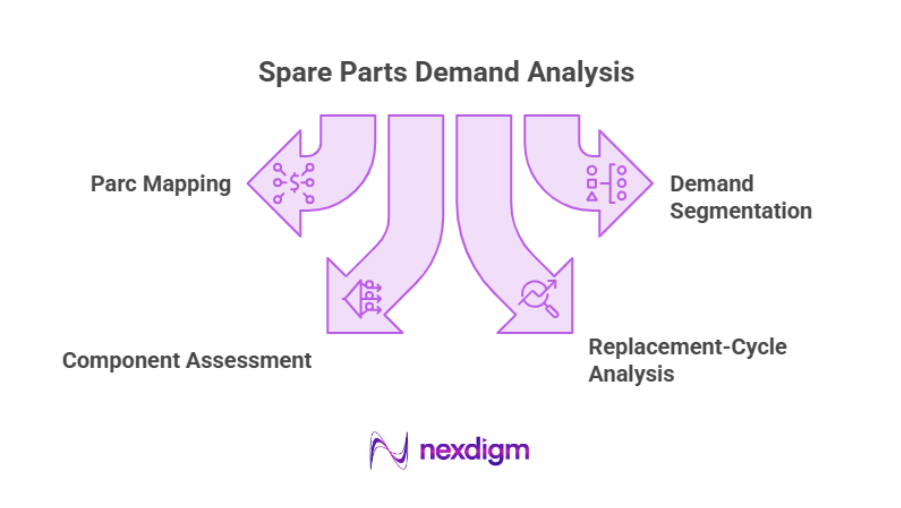
- 1 | Parc Mapping: Map the vehicle parc by type, age, model, geography, fuel type, and usage profile to establish the addressable aftermarket.
- 2 | Component Assessment: Identify major spare-parts categories and assess their maintenance requirements, failure patterns, durability, and replacement frequency.
- 3 | Replacement-Cycle Analysis: Estimate replacement timing using vehicle age, mileage, operating conditions, service intervals, and component life.
- 4 | Demand Segmentation: Segment aftermarket demand by vehicle category, geography, customer type, component, and replacement frequency to identify attractive demand pools.
This approach helps businesses identify which spare parts are likely to drive recurring aftermarket demand and where commercial opportunities are most attractive.
Nexdigm’s Aftermarket Assessment Case
Nexdigm assisted an automotive player in assessing aftermarket demand as India’s replacement market grew 9% to ₹53,160 crore in H1 FY26. The study mapped vehicle age, failure rates, and replacement cycles, identifying priority parts and channels. This resulted in sharper aftermarket targeting and growth opportunities.
To take the next step, simply visit our Request a Consultation page and share your requirements with us.
Harsh Mittal
+91-8422857704