

Entering a specialty chemical market can require more than manufacturing capacity. Buyers may expect application-specific performance, consistent quality, regulatory documentation and technical support before approving a new supplier. For companies seeking to enter these markets, an acquisition can provide capabilities that would otherwise take years to develop. However, buying an established business does not automatically create a successful growth platform.
The commercial question is whether an acquisition provides a defensible advantage over organic entry, a distribution partnership or a technology licensing arrangement. Answering it requires examining the target’s customers, product portfolio, technical capabilities and financial performance together.
Why Specialty Chemicals Can Be Attractive Acquisition Targets
Specialty chemicals serve applications in sectors such as automotive, electronics, construction, agriculture, personal care and industrial manufacturing. Unlike many commodity chemicals, their value often depends on formulation, application performance, technical service and customer qualification rather than price alone.
India’s chemical industry offers a substantial industrial base. The Economic Survey 2025–26 reported that chemicals and petrochemicals contributed 8.1% of manufacturing gross value added in FY2023–24. Selected major chemical and petrochemical production increased from 45.64 million tonnes in FY2015–16 to 58.62 million tonnes in FY2024–25. These figures establish the sector’s industrial significance, but they do not establish the attractiveness of every specialty segment.
An acquisition case must therefore be built around a specific market, product family and customer need. Broad industry growth is context, not an investment thesis.
What an Acquisition Can Deliver That Organic Entry Cannot
The strongest acquisition candidates offer capabilities that are difficult to reproduce quickly. These may include approved supplier relationships, specialised production processes, application laboratories, proprietary formulations or experienced technical teams.
Potential advantages include:
- Faster customer access: Existing relationships and qualification records may shorten the route to commercial orders.
- Technical capability: Formulation expertise, testing infrastructure and process know-how can reduce development time.
- Established market access: A target may already serve customers through a recognised sales network or specialist distributor base.
- Portfolio expansion: An acquirer can add adjacent products and cross-sell to existing customers, provided the applications and buying relationships genuinely overlap.
- Local operating knowledge: Existing staff may understand customer specifications, regulatory requirements and market-specific service expectations.
These advantages must be verified. A customer relationship tied primarily to the former owner, for example, may not survive the transaction.
Assessing Target Quality, Margins and Integration Risk
A specialty chemical target should be evaluated beyond revenue growth and reported earnings. Customer concentration, product-level margins, raw material exposure, quality consistency and working capital can materially change the investment case.
Due diligence should test several areas:
- Customer durability: Review repeat purchases, contract terms, customer concentration, qualification status and the reasons customers choose the supplier.
- Product economics: Analyse gross margins by product, formulation costs, batch yields, waste, pricing power and dependence on imported inputs.
- Technical defensibility: Establish whether intellectual property, process knowledge, regulatory dossiers and application expertise will transfer with the business.
- Operational resilience: Examine capacity utilisation, maintenance requirements, environmental compliance, quality systems and expansion needs.
- Integration complexity: Identify overlapping products, incompatible systems, retention risks and potential disruption to customer service.
The acquirer should also test whether projected synergies are achievable without assuming that every customer will purchase the enlarged portfolio.
Comparing Acquisition with Other Market-Entry Routes
The right route depends on urgency, investment capacity and the capabilities missing from the existing business.
- Acquisition: Most relevant when customer access, technology or qualified production capability is difficult to build internally.
- Organic development: Better suited to companies with established technical teams, patient capital and time to qualify products.
- Joint venture: Useful when market access, local manufacturing or complementary technical capabilities are shared.
- Distribution or licensing: Can test demand before committing to a larger manufacturing investment, although it may limit control over customer relationships and margins.
The phrase specialty chemical acquisition entry consulting reflects a decision that should be grounded in target-level evidence, not the assumption that acquiring an existing player is inherently faster or safer.
Specialty Chemical Acquisition Screening Framework
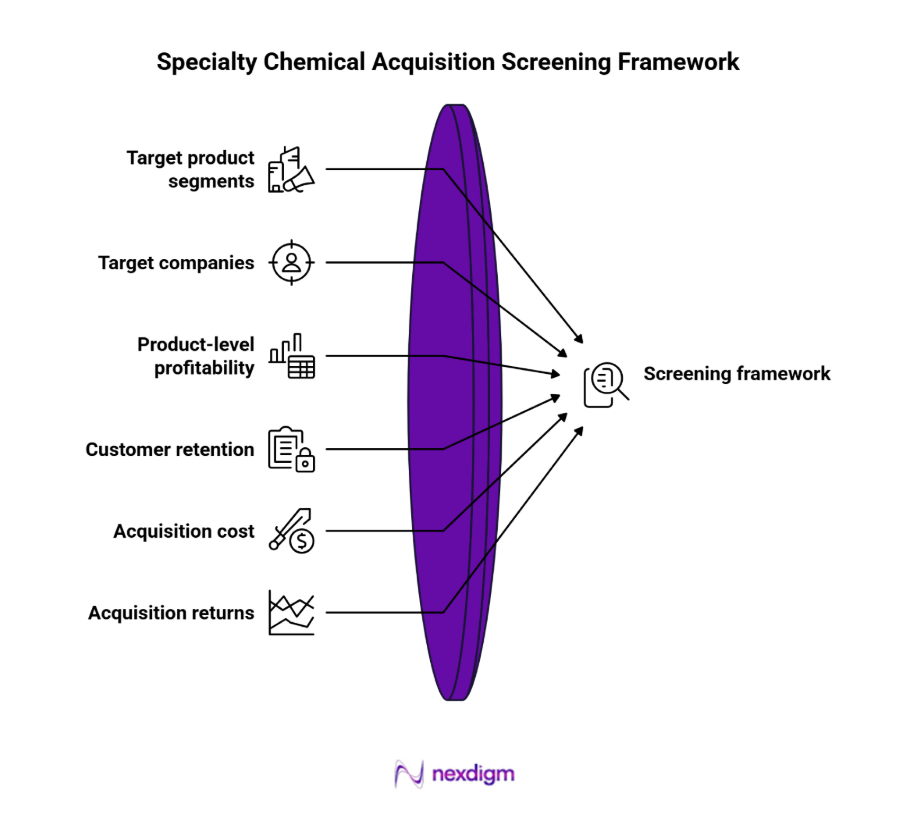
- Define the target product segments and unmet customer needs: Identify priority product categories and market gaps where customer demand is underserved by existing offerings.
- Score target companies on technical capability, customer access and portfolio fit: Evaluate potential acquisition targets based on their expertise, established customer relationships and alignment with the buyer’s strategic objectives.
- Validate product-level profitability, cash conversion and capital expenditure requirements: Assess product margins, working-capital cycles and investment needs to determine the sustainability of the target’s operations.
- Test customer retention, intellectual property ownership and regulatory compliance: Verify the stability of customer relationships, ownership of critical intellectual property and compliance with applicable regulations.
- Model acquisition cost, integration expenditure and downside scenarios: Estimate the total investment, post-acquisition integration costs and potential financial impact of adverse market conditions.
- Compare acquisition returns with organic entry and partnership alternatives: Determine whether acquiring an existing business offers better risk-adjusted returns than building capabilities internally or entering through strategic partnerships.
Nexdigm’s Case Study
A specialty chemical producer considering entry into three adjacent product segments assessed 12 potential acquisition targets. Initial screening reduced the list to 4, while customer concentration, margin quality and integration costs narrowed the final shortlist to two. The analysis prioritised a target with stronger customer retention and transferable technical capabilities over the largest revenue base.
To take the next step, simply visit our Request a Consultation page and share your requirements with us.
Harsh Mittal
+91-8422857704