

In specialty chemicals, a product can be technically impressive and still struggle commercially. Buyers may require extensive testing before approving a supplier, formulations may need to be customised for specific applications, and a small change in product performance can determine whether a customer switches vendors. Market entry therefore depends on more than estimating industry growth or identifying an attractive selling price.
The opportunity is strongest when a manufacturer understands the customer’s process, can deliver consistent performance and has a credible route to qualification and repeat orders.
Why Specialty Chemicals Require a Different Entry Assessment
India’s chemicals industry was valued at approximately US$200–220 billion in FY2025, according to the industry profile published by NITI Aayog in 2026. Specialty chemicals accounted for an estimated US$37 billion of the domestic market, with demand linked to industries such as agriculture, pharmaceuticals, personal care, textiles, construction and automotive manufacturing. These figures indicate scale, but specialty chemicals are too diverse to assess as a single market.
A surfactant, polymer additive, textile auxiliary and high-performance coating ingredient have different buyers, technical requirements and cost structures. Even within one category, demand can vary by formulation, grade, end use, and performance specification.
NITI Aayog’s analysis also identifies import dependence in selected segments, including polymer additives and surfactants. That may indicate room for domestic production, but it does not prove that local manufacturing will be competitive. A new entrant must determine whether the gap reflects limited domestic capacity, specialised technology, feedstock constraints, or customer preference for established suppliers.
The Customer Qualification Process Can Determine Market Access
Specialty chemical buyers often assess products through application trials, quality checks, and production-line testing. A supplier may need to demonstrate consistency across batches, compatibility with existing processes, regulatory compliance, and reliable delivery before securing commercial orders.
Market research should therefore map the buying process as carefully as the demand curve. Procurement teams may negotiate price, while technical teams control product approval, and plant personnel judge performance under actual operating conditions.
A practical customer assessment should establish:
- Application requirements: What performance characteristic does the chemical improve, and how is that benefit measured?
- Supplier qualification: What testing, documentation, audits and approval timelines must a new supplier complete?
- Switching barriers: Would changing suppliers require reformulation, production downtime, revalidation or customer approval?
- Purchasing behaviour: Are buyers willing to trial a new source, dual source for resilience or commit to minimum volumes?
- Service expectations: How important are technical support, formulation adjustments, batch consistency and delivery reliability?
These factors influence realistic time to revenue. A market may show substantial annual consumption while offering a new manufacturer only a gradual route to customer adoption.
Where the Margin Opportunity Actually Sits
Specialty chemicals are frequently described as higher-value products, but higher selling prices do not automatically translate into higher margins. Profitability depends on raw-material exposure, process yield, product complexity, research costs, customer concentration, and the cost of technical support.
Three commercial questions deserve particular attention:
- Can the product command a premium? The premium must be supported by measurable performance, formulation expertise, reliability or another benefit the buyer values.
- Can production scale without losing consistency? Laboratory success does not guarantee economical commercial-scale output.
- Can the business retain customers? Qualification costs may be substantial, but repeat orders and long customer relationships can improve lifetime value.
A specialty chemicals feasibility study consulting services engagement should connect these questions to customer interviews, product-level trade data, competitor benchmarking and manufacturing economics. The objective is to establish whether a specific chemical and grade can secure enough qualified demand to justify investment.
Specialty Chemicals Market Entry Framework
The Specialty Chemicals Market Feasibility Framework links technical validation to commercial viability.
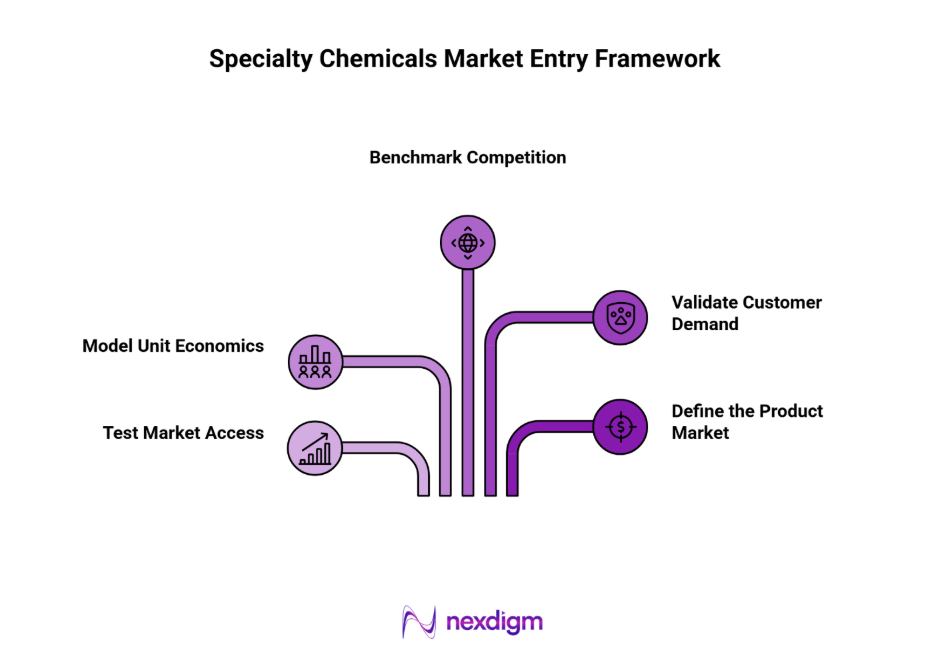
- Define the Product Market: Specify chemical grade, end-use application, customer industry and relevant substitutes.
- Validate Customer Demand: Estimate consumption, purchasing criteria, qualification requirements, and realistic sales volumes.
- Benchmark Competition: Compare domestic and imported suppliers on price, quality, technical service and reliability.
- Model Unit Economics: Assess feedstock costs, process yield, research expenditure, capacity utilisation and contribution margins.
- Test Market Access: Establish a route to customer trials, approvals, initial contracts and repeat orders.
Nexdigm Case Study
Nexdigm assessed 14 specialty chemical opportunities across surfactants, additives and performance formulations. Five progressed to detailed evaluation after screening for customer demand, import competition and production economics. Two were prioritised for buyer validation, with commercial advancement conditional on application testing and credible repeat-order potential.
To take the next step, simply visit our Request a Consultation page and share your requirements with us.
Harsh Mittal
+91-8422857704