

A specialty chemical can look attractive long before it is commercially viable. Superior lab performance and regulatory alignment mean little if qualification drags on, switching risks are high, or the economic upside cannot be proven. Unlike commodities, specialty chemicals are bought to solve specific manufacturing, formulation, or regulatory problems.
Feasibility must therefore be evaluated at the application level, balancing market growth and margin profile against technical complexity, switching friction, and quantifiable value-in-use.
Demand Starts with a Manufacturing Problem
The strongest specialty chemical opportunities tend to solve problems that customers can measure in production.
An additive that improves coating adhesion, reduces curing time, increases thermal stability, lowers defect rates, or extends product life has a different commercial proposition from a formulation that offers only an incremental specification improvement.
This makes the end-use application the starting point for assessing demand.
The relevant questions are:
- What manufacturing or formulation problem is being solved?
- How frequently does the problem occur?
- What does the problem cost the customer?
- How much of that cost can the chemical realistically eliminate?
- What alternatives are already available?
- How difficult would it be for the customer to qualify a replacement?
The answers determine whether technical differentiation can become commercial value.
PFAS-free processing aids are responding to regulatory pressure, EV battery adhesives to increasingly demanding thermal and structural requirements, low-carbon concrete admixtures to formulation challenges created by alternative binders, and ultra-pure semiconductor chemicals to increasingly stringent purity requirements.
Regulatory Pressure Can Create New Application Windows
Regulatory pressure sparks demand for specialty chemicals, but regulation alone does not ensure a viable market. True opportunity lies at the intersection of regulatory mandates and technical substitutability.
For instance, PFAS alternatives must eliminate restricted chemistries without compromising extrusion speed, optical clarity, or product quality. Similarly, semiconductor chemicals must balance extreme purity with supply-chain localization. A commercial assessment must therefore separate customers who are merely exploring alternatives from those structurally compelled to adopt them.
Technical Fit Determines Whether Demand Converts
Specialty chemical demand can remain theoretical until a formulation survives the customer’s production environment.
A product that performs well under laboratory conditions may behave differently at industrial scale. Viscosity, curing behaviour, mixing, shelf life, phase stability, equipment compatibility, or processing speed can all affect qualification.
The qualification pathway therefore needs to be treated as part of market feasibility:
- Laboratory performance: Does the product meet the required technical specification under controlled conditions?
- Process compatibility: Can the customer’s existing equipment and formulation accommodate the product without significant modification?
- Qualification pathway: What testing, certification, customer approval, and regulatory requirements must be completed?
- Production economics: Does the formulation improve throughput, energy consumption, waste, rework, downtime, or product quality?
- Switching threshold: How large must the improvement be before the customer accepts the risk and cost of replacing an incumbent?
This is where specialty chemicals opportunity assessment services become more than a market-sizing exercise. The analysis needs to establish whether identified demand can progress through qualification and conversion.
Pricing Should Reflect Value in Use
Specialty chemicals cannot be priced solely by adding a margin to raw-material costs. The true determinant is customer value-in-use. For instance, a coating additive that cuts curing time from 45 to 20 minutes creates financial value through expanded line capacity, lower energy use, and reduced inventory. Similarly, an EV battery thermal interface material combining high conductivity with structural bonding commands a premium by cutting assembly complexity. The pricing question is not simply what a buyer will pay, but how much measurable economic value the chemical generates and how much of that gain the supplier can capture.
Nexdigm’s Specialty Chemical Feasibility Framework
A robust specialty chemical assessment can organize the opportunity around five connected decision gates. Each gate removes a different source of commercial uncertainty.
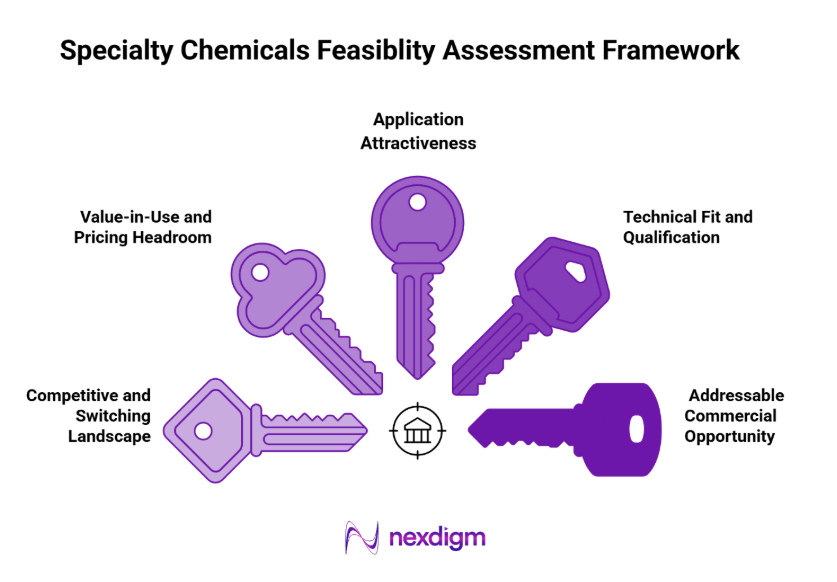
- Application Attractiveness
Market size, application growth, customer concentration, frequency of the underlying problem, and structural demand drivers establish whether the opportunity has sufficient depth. Regulatory transitions, technology shifts, and manufacturing expansion can create stronger demand conditions than simple market growth. - Technical Fit and Qualification
Laboratory results need to be connected to pilot testing, process compatibility, formulation stability, certification requirements, and customer approval. Qualification time should be treated as a commercial variable because a technically attractive product that takes several years to approve may require a very different investment model. - Value-in-Use and Pricing Headroom
The assessment should quantify savings from lower material consumption, higher throughput, reduced energy use, fewer defects, lower downtime, longer asset life, or reduced rework. This establishes the economic ceiling for pricing and identifies whether a premium proposition is defensible. - Competitive and Switching Landscape
The fourth gate examines incumbent formulations, alternative technologies, supplier concentration, technical differentiation, and customer switching costs.
Patents may create an initial barrier, but specialty chemical defensibility can also develop through formulation dependence, application engineering, and qualification investment. Once a chemical becomes embedded in a validated formulation or manufacturing specification, the customer has a stronger reason to remain with the incumbent supplier. - Addressable Commercial Opportunity
Customers should be segmented by application, consumption volume, qualification status, purchasing requirements, and willingness to switch. This prevents the addressable market from becoming a theoretical estimate based on total chemical consumption.
The resulting assessment connects demand, technical feasibility, customer economics, competition, and conversion potential. It gives product teams and investors a basis for deciding where development and commercial investment should be concentrated.
Nexdigm Case: Specialty Chemical Qualification
A specialty additive producer with $42M revenue targeted automotive and electronics customers. Nexdigm screened 18 applications, 74 buyers, and 9 competing formulations, identifying 5 viable applications with 14%–21% value-in-use premiums and qualification periods below 18 months.
To take the next step, simply visit our Request a Consultation page and share your requirements with us.
Harsh Mittal
+91-8422857704