

Specialty chemicals deliver value through formulation performance rather than commodity volume, but technical superiority does not automatically create an attractive market. Advanced products can face small customer bases, lengthy qualification cycles, entrenched incumbents, and limited pricing headroom. Conversely, niche applications can become commercially attractive when they solve critical customer problems, have few effective alternatives, and represent a small share of total manufacturing costs.
As chemical producers shift portfolios toward differentiated, higher-value applications, the opportunity increasingly needs to be assessed at the application level. The supplied research identifies market growth, margin profile, technical complexity, and customer switching friction as four important dimensions for evaluating specialty chemical opportunities.
The strategic question is therefore not simply which specialty chemical markets are growing, but which applications can support defensible revenue and sustainable pricing.
Application Demand Defines the Opportunity
The first question is where the chemical creates measurable value. Specialty chemical demand is increasingly tied to applications requiring specific performance characteristics, regulatory compliance, or process improvements.
Potential opportunity areas include:
- PFAS-free processing aids for polymer applications
- Structural adhesives and thermal interface materials for EV batteries
- Low-carbon concrete admixtures
- Ultra-pure chemicals for semiconductor manufacturing
- Biological and biostimulant formulations for agriculture
The attractiveness of each application depends on more than projected market growth. Qualification requirements, technical complexity, customer concentration, and switching barriers can materially change the commercial opportunity.
Customer Needs Determine Willingness to Pay
Specialty chemical buyers typically evaluate products against a specific operational or technical problem. A higher-priced formulation can still be attractive when it reduces production losses, improves process efficiency, extends equipment life, or helps meet regulatory requirements.
For example, a processing aid may justify a premium if it reduces die build-up and production interruptions. An EV battery adhesive may command higher value when it combines structural bonding with thermal management or fire-performance requirements.
Customer research should therefore establish:
- The problem customers are trying to solve
- Performance specifications that influence purchasing
- Current alternatives and their limitations
- Switching triggers and qualification requirements
- Price sensitivity and willingness to pay
This connects technical product attributes with the economics of the customer’s application.
Margins Depend on Differentiation
The label “specialty” does not guarantee attractive profitability. Margin potential depends on technical differentiation, formulation complexity, intellectual property, qualification barriers, and the availability of substitutes.
A product competing primarily on price may face limited pricing power even in a growing market. Conversely, a formulation that solves a difficult application problem can support stronger margins when customers face high switching costs.
Opportunity assessment should therefore examine both market growth and the economics behind that growth. Key indicators include gross-margin potential, pricing headroom, manufacturing complexity, raw-material exposure, and expected cost-to-serve.
Competitive Gaps Can Create Entry Points
Competitive analysis should move beyond counting suppliers. The more useful question is where existing products fail to meet customer requirements.
Gaps may emerge through:
- Performance limitations in demanding applications
- Regulatory restrictions affecting incumbent formulations
- Long qualification cycles or inadequate technical support
- Limited regional supply or weak customer responsiveness
- High applied costs despite lower product prices
These gaps can reveal opportunities for differentiated formulations, local manufacturing, technical service, or targeted market entry.
Nexdigm’s Five-Point Specialty Chemicals Opportunity Framework
A structured specialty chemicals opportunity assessment services approach helps manufacturers evaluate these factors together, rather than assessing market size or product performance in isolation.
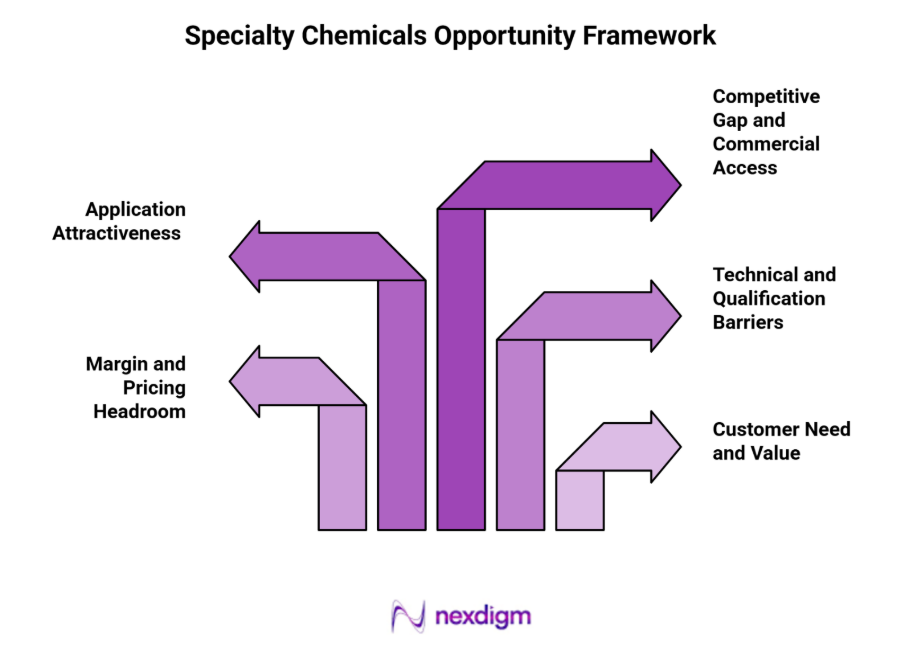
- Application Attractiveness
Assess demand growth, application expansion, technical requirements, and structural drivers shaping the opportunity. - Customer Need and Value
Map customer pain points, buying criteria, switching triggers, and the economic value created by improved chemical performance. - Margin and Pricing Headroom
Evaluate achievable pricing, gross-margin potential, formulation costs, raw-material exposure, and cost-to-serve. - Technical and Qualification Barriers
Examine product specifications, testing requirements, regulatory approvals, customer qualification periods, and formulation complexity. - Competitive Gap and Commercial Access
Identify incumbent limitations, supplier concentration, substitution opportunities, channel access, and the capabilities required to win customers.
Together, these dimensions help distinguish a market that is simply growing from one where a new or differentiated specialty chemical can build a defensible commercial position.
Nexdigm Case: Specialty Chemical Opportunity Screening
A specialty chemical producer assessed 18 applications across 5 end markets. Nexdigm evaluated 74 buyers, 9 competing formulations, pricing headroom, and qualification barriers, narrowing the pipeline to 5 opportunities with 14%–21% value premiums.
To take the next step, simply visit our Request a Consultation page and share your requirements with us.
Harsh Mittal
+91-8422857704