

Specialty chemicals serve industries where product performance, formulation and consistency can matter as much as price. Applications range from coatings, adhesives and personal care to electronics, agriculture, automotive manufacturing and pharmaceuticals. These markets can offer opportunities for specialised producers and distributors, but assessing them requires more than identifying products with high import values.
The central task is to connect demand patterns with technical requirements, supplier capabilities, pricing conditions, and the practical barriers to changing supply relationships.
Demand Is Tied To Application
Unlike broad commodity categories, specialty chemicals often serve defined industrial functions. A coating additive, electronic chemical or performance ingredient may be purchased because it meets a specific formulation or process requirement. Demand can therefore depend on the fortunes of a particular end-use industry, and the technical properties buyers require.
Market research should identify the product grade, application and customer segment before comparing trade data. Broad customs classifications may group together products that differ in composition, performance, and price. Import trends should be interpreted alongside downstream manufacturing activity to determine whether demand is expanding and which applications are driving it.
Pricing Goes Beyond The Unit Cost
Trade values and unit values can provide useful starting points, but they do not necessarily reveal the price a buyer will pay for a specific product. Differences in purity, formulation, packaging, order size, delivery terms, and contractual arrangements can materially affect the final cost.
For specialty chemicals trade intelligence, pricing research should distinguish indicative market benchmarks from supplier quotations and actual transaction terms. Freight, duties, insurance, currency movements, and inventory requirements should be considered when comparing sourcing options.
Buyers may also weigh reliability, technical support, and batch consistency against a lower quoted price. A supplier offering a cheaper product may not be commercially preferable if quality variation creates production losses or requires additional testing.
Supplier Qualification Can Limit Switching
Specialty chemical buyers may need to test products, validate performance and approve suppliers before changing formulations or production inputs. Depending on the application, qualifications can involve laboratory testing, production trials, documentation checks, and customer approval.
Regulatory requirements can add further complexity. Businesses may need to review chemical classification, safety data, labelling, registration obligations and restrictions applicable to the destination market. These requirements affect both the time and cost of entering a market or introducing an alternative supplier.
Build A Specialty Chemicals Intelligence Framework
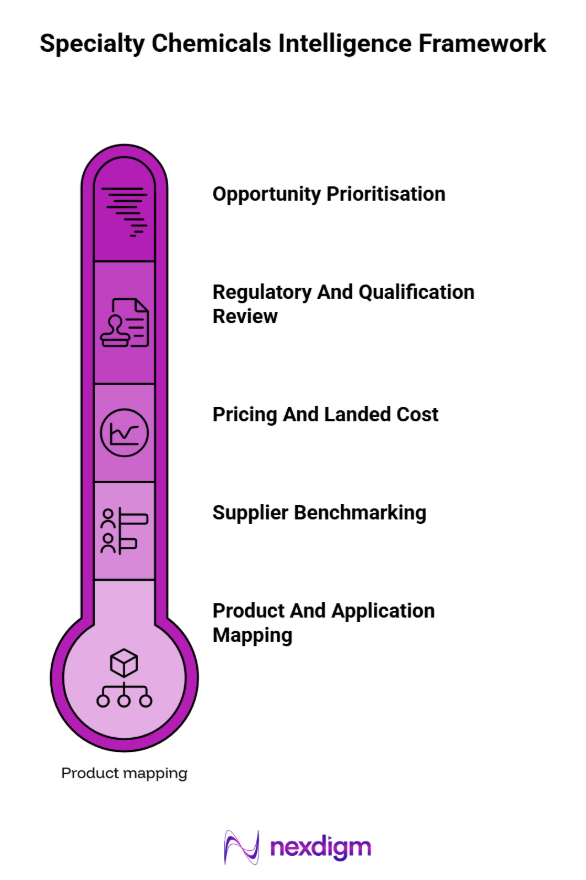
- Product And Application Mapping: Identify relevant chemical grades, technical specifications and end-use industries to establish which products meet the target market’s actual requirements.
- Demand Assessment: Compare import trends, downstream production and customer applications to distinguish sustained demand from temporary purchasing changes or price-driven increases.
- Supplier Benchmarking: Evaluate producers on quality, technical support, supply consistency, production capacity and delivery performance rather than relying on price or export share alone.
- Pricing And Landed Cost: Compare supplier quotations and available market indicators alongside freight, duties, packaging, currency exposure and contractual terms to estimate total acquisition costs.
- Regulatory And Qualification Review: Check registration, classification, safety documentation and customer approval requirements, including the time and cost of qualifying alternative products or suppliers.
- Opportunity Prioritisation: Rank product-market combinations by demand, competitive intensity, margin potential, technical fit and market-entry requirements before committing commercial resources.
The framework should reflect the product’s role in the customer’s process. A chemical used in a tightly controlled manufacturing application may be difficult to replace, creating a high barrier to entry for new suppliers. Products with more interchangeable specifications may offer faster switching opportunities but face stronger price competition.
Convert Intelligence Into Market Opportunities
Specialty chemicals research helps producers assess export potential; distributors identify product gaps, and buyers compare suppliers on more than headline prices. Connecting trade statistics with technical requirements, customer demand and regulatory research clarifies where a company can compete and what is needed to establish a sustainable position.
Nexdigm’s Case Study
A specialty chemical producer evaluates a market where imports of a selected product are increasing. Trade data identifies leading origins, while downstream industry research reveals potential customers. The producer then compares technical requirements, landed costs, and qualification timelines to determine whether its product can compete with established suppliers.
To take the next step, simply visit our Request a Consultation page and share your requirements with us.
Harsh Mittal
+91-8422857704