

Specialty clinics are expanding rapidly as patients increasingly prefer focused healthcare services that offer faster access, specialized expertise, personalized treatment, and lower complexity compared to large hospitals. Specialty clinic market entry strategy helps healthcare providers identify high-demand specialties, assess patient needs, select suitable locations, evaluate competition, and design efficient service models. As part of a market entry strategy, specialty clinics must consider disease burden, affordability, referral networks, medical talent availability, technology requirements, and regulatory approvals.
By focusing on specific services such as dermatology, fertility, orthopedics, cardiology, or diagnostics, specialty clinics can improve patient reach and achieve sustainable growth.
India’s specialty clinics market reached USD 3.3 billion in 2025 and is projected to reach USD 9.7 billion by 2034, growing at a 12.35% CAGR. The broader hospitals and clinics market was valued at about USD 6.66 trillion in 2025 and is expected to reach USD 12.03 trillion by 2032, reflecting rising demand for focused healthcare services.
Specialty Clinic Market Entry Strategy for Focused Healthcare Growth
Specialty Clinic Market Entry Strategy for Focused Healthcare Growth helps providers assess patient demand, specialty gaps, location potential, competition, pricing, regulations, specialist availability, and referral networks before launching clinics:
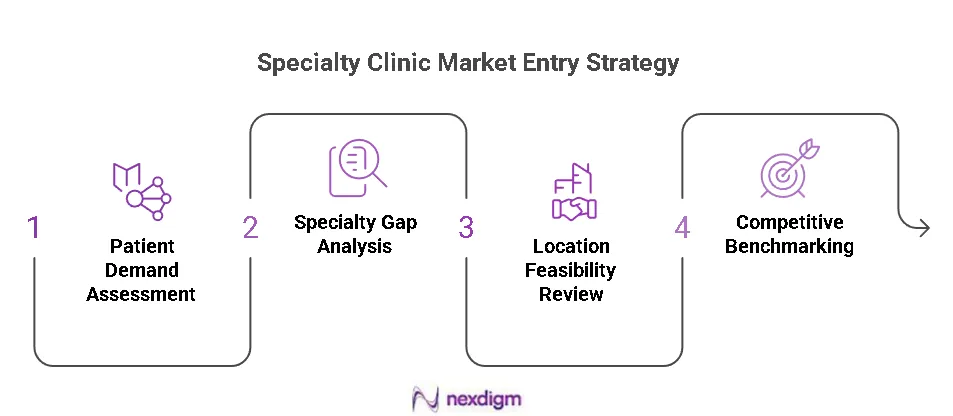
- Patient Demand Assessment: Identifies treatment needs, disease burden, demographics, income levels, and care gaps in the target clinic market.
- Specialty Gap Analysis: Evaluates underserved specialties such as dermatology, fertility, orthopedics, cardiology, diagnostics, oncology, or diabetes care.
- Location Feasibility Review: Assesses accessibility, catchment area, transport links, nearby hospitals, patient convenience, and regional growth potential.
- Competitive Benchmarking: Studies existing clinics, hospitals, pricing, service quality, technology use, patient footfall, and specialty offerings.
Nexdigm’s Expertise on Partnership Strategy with Hospitals, Diagnostics, and Insurers
Nexdigm’s Advisory on Partnership Strategy with Hospitals, Diagnostics, and Insurers helps specialty clinics build strong referral and service networks for faster patient acquisition. It supports partner identification, collaboration models, insurance tie-ups, diagnostic access, and hospital referral pathways. These partnerships improve patient convenience, strengthen care continuity, expand market reach, and support sustainable specialty clinic growth in competitive healthcare markets.
How can Nexdigm assess patient demand before launching specialty clinics?
Nexdigm can assess patient demand by analyzing disease burden, demographics, income levels, treatment gaps, referral patterns, competitor presence, affordability, and specialty-wise healthcare needs in the target clinic location.
- Understanding Local Health Needs: Nexdigm looks at the common health problems people face in the area to identify which specialty services are needed most.
- Knowing the Target Patients: Nexdigm studies age groups, income levels, lifestyle patterns, and care preferences to understand who the clinic will serve.
- Finding Unmet Care Gaps: Nexdigm identifies where patients struggle with limited specialists, long waiting times, high costs, or poor access to focused care.
- Studying Nearby Healthcare Options: Nexdigm reviews existing clinics and hospitals to understand what services are already available and where opportunities remain.
- Understanding Patient Referral Flow: Nexdigm studies how patients move between doctors, hospitals, diagnostics, and specialists to estimate future clinic footfall.
Nexdigm’s case:
Nexdigm assisted a specialty clinic chain assess patient demand before launching focused healthcare centers in a new urban market. The team studied 1.2 million people in the target catchment area, analyzed demand across 6 specialty services, benchmarked 22 competing clinics and hospitals, and reviewed affordability patterns across 1,800 patient profiles.
Nexdigm found a 26% unmet demand gap in dermatology, fertility, and diabetes care. Based on its recommendations, the clinic prioritized 3 specialties, adjusted pricing, and refined its launch location strategy.
To take the next step, simply visit our Request a Consultation page and share your requirements with us.
Harsh Mittal
+91-8422857704