

Retailers operating multiple stores often purchase similar services under different contracts, specifications, and local market conditions. Cleaning, maintenance, security, repairs, consumables, and waste management can therefore carry different costs even when stores appear operationally similar.
The challenge is determining whether those differences reflect genuine local requirements, supplier-market conditions, or inconsistent procurement. Benchmarking provides a way to compare costs and service outcomes on a like-for-like basis.
Build a Comparable Cost Base
Store-level comparisons require more than total expenditure. A larger store naturally incurs different costs from a small-format outlet, while a high-footfall location may need more frequent cleaning, maintenance, or security coverage.
Retailers should establish comparable measures such as cost per square metre, cost per operating hour, maintenance cost per site, or cleaning cost per service visit. Each measure should be matched to the service being evaluated. Combining unlike activities into one cost-per-store figure can conceal rather than explain inefficiency.
Compare Suppliers and Local Markets
Supplier pricing can vary by geography because labour availability, travel distances, service density, and subcontracting arrangements differ. A vendor serving several nearby stores may achieve efficiencies that are unavailable for isolated locations. Local competition and contract scope can also affect pricing.
For store operations procurement spend benchmarking, internal comparisons should be supplemented with market evidence where available. Comparable quotations, tender results, supplier rate cards, and published price indicators can help explain differences, provided they refer to equivalent service specifications and locations.
Link Cost to Service Outcomes
Cost rankings alone can reward the wrong supplier. A lower maintenance rate may be associated with slower response times or repeat faults, while a more expensive cleaning contract may include longer operating hours or additional consumables.
Benchmarking should therefore combine financial measures with delivery-in-full, response time, complaint recurrence, inspection outcomes, and compliance with contractual service levels. The purpose is to understand the relationship between cost and performance, not to reduce expenditure regardless of operational consequences.
Store Operations Spend Benchmarking Framework
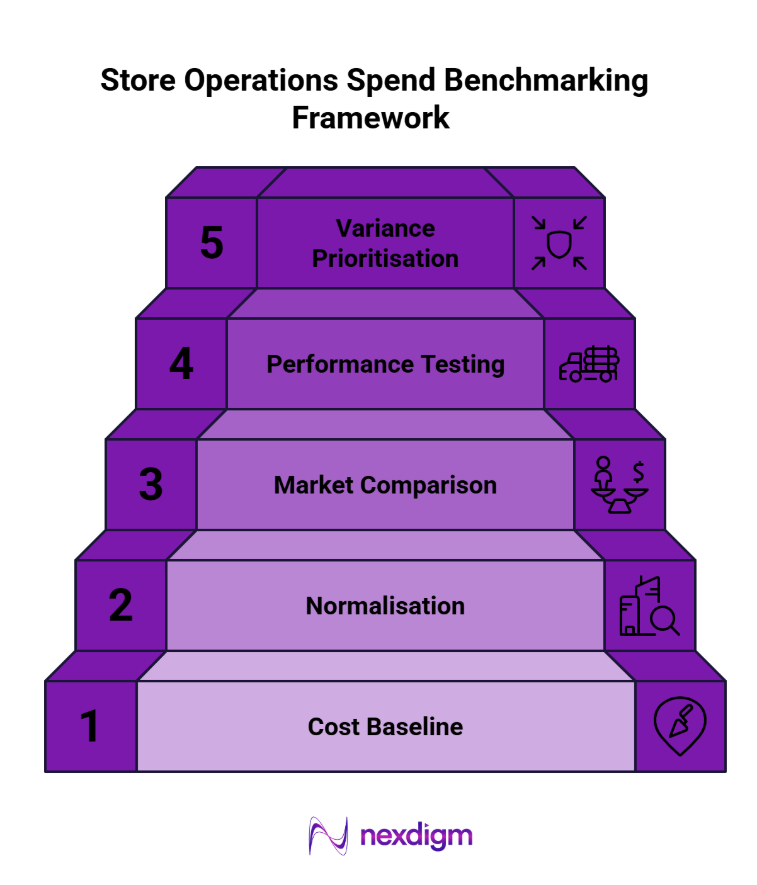
- Cost Baseline: Consolidate invoices, contract charges, purchase orders, and additional fees by service category, supplier, store, and period to establish a consistent expenditure view.
- Normalisation: Adjust comparisons for store size, footfall, operating hours, service frequency, location, and relevant site conditions before identifying unusually high or low costs.
- Market Comparison: Compare equivalent service specifications against available supplier quotations, tender evidence, and relevant official price indicators to assess whether contracted rates are commercially reasonable.
- Performance Testing: Review response times, repeat faults, attendance, inspection results, complaint resolution, and service-level compliance alongside expenditure to identify cost-quality trade-offs.
- Variance Prioritisation: Investigate the largest material differences first, distinguishing contract inconsistencies, local market pressures, supplier performance issues, and genuine operational needs before setting savings targets.
Identify What Should Change
Benchmarking may reveal opportunities to standardise contracts, consolidate service areas, renegotiate call-out rates, or adjust schedules. In other cases, higher expenditure may be justified by location, store operating hours, or specialised requirements. The findings should lead to evidence-based contract decisions rather than uniform cost-cutting targets across every store.
Nexdigm’s Case Study
A retailer compared operational expenditure across 50 stores after adjusting for size, hours, and service scope. The review identified inconsistent maintenance call-out rates and cleaning specifications. Standardised requirements and targeted supplier negotiations generated an illustrative 6% reduction in addressable spend, with response times and inspection outcomes retained as performance controls.
To take the next step, simply visit our Request a Consultation page and share your requirements with us.
Harsh Mittal
+91-8422857704