

A supplier can offer competitive prices and still be a poor fit for retail operations. Late deliveries, inconsistent order quantities, limited-service coverage, and slow issue resolution can disrupt replenishment and increase pressure on store teams.
Choosing suppliers therefore requires more than a quotation comparison. Retailers need to understand whether potential partners can meet operational requirements consistently across locations, product categories, and demand cycles.
Start With Store-Level Requirements
Supplier suitability depends on how a product or service is used. A fresh-food supplier may need to meet strict delivery windows and temperature-control requirements, while a fixtures supplier may need installation capability across multiple stores.
Retailers should define service expectations before approaching suppliers. These may include delivery frequency, geographic coverage, order minimums, product specifications, returns handling, emergency support, and the ability to scale during promotions or seasonal peaks.
Distinguish Capability From Promises
Supplier presentations often describe what a business can provide, but operational evaluation should establish what it can demonstrate. Evidence may include delivery records, customer references, quality documentation, production capacity, distribution coverage, and escalation procedures.
Retailers using store operations supplier evaluation services should compare suppliers against the same requirements and supporting evidence. This makes it easier to distinguish a capable partner from one whose proposal appears attractive but leaves critical service obligations unresolved.
Assess Service Fit Before Awarding Contracts
A supplier’s overall performance may conceal weaknesses in particular regions or product categories. A business may serve metropolitan stores reliably but struggle with remote locations. Another may handle routine orders well but lack capacity during promotional peaks.
Evaluation should therefore consider the intended operating model, not just company-wide credentials. Where evidence is incomplete, a limited pilot can test delivery performance, product quality, responsiveness, and issue resolution before a larger commitment is made.
Nexdigm’s Retail Suppliers Evaluation Framework
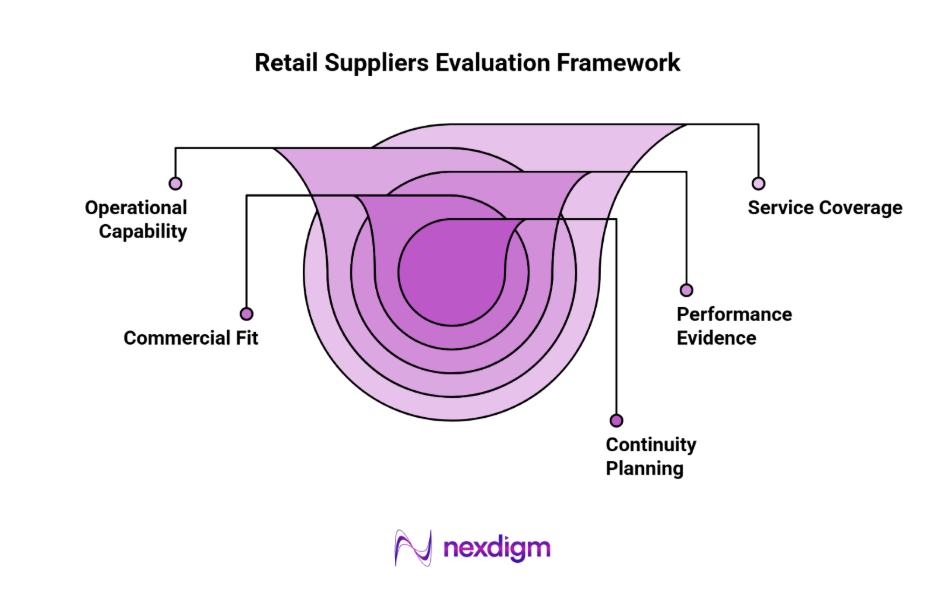
- Service Coverage: Map the supplier’s delivery network, operating hours, service locations, and capacity to meet store-specific delivery windows and replenishment schedules.
- Operational Capability: Verify production or service capacity, workforce availability, technology, quality controls, and the ability to accommodate demand fluctuations without compromising delivery commitments.
- Performance Evidence: Review historical delivery accuracy, defect rates, response times, customer references, and documented corrective actions rather than relying solely on supplier-provided claims.
- Commercial Fit: Compare total costs, payment terms, order minimums, contract flexibility, returns policies, and additional charges that could affect the retailer’s operating budget.
- Continuity Planning: Assess backup capacity, alternative facilities, escalation procedures, and recovery arrangements to determine how the supplier would respond to disruptions or sudden demand increases.
Build a Consistent Supplier Scorecard
A standard scorecard allows procurement teams to compare suppliers using the same criteria while adjusting weights for different categories. Delivery reliability may matter most for frequently replenished goods, whereas technical compliance or installation capability may carry greater weight for store equipment.
The final decision should document both the supplier’s strengths and unresolved risks. Contracts should then translate the evaluation into measurable service levels, reporting requirements, and corrective action procedures.
Nexdigm’s Case Study
A regional retailer assessed eight suppliers supporting 65 stores. Comparing delivery records, service coverage, and issue-resolution times identified two suppliers that lacked sufficient capacity in smaller markets. Revised allocation and service-level requirements reduced late deliveries from 14% to 8% during a 12-week pilot, based on the illustrative scenario’s operating records.
To take the next step, simply visit our Request a Consultation page and share your requirements with us.
Harsh Mittal
+91-8422857704