

Retail stores depend on a wide network of suppliers for fixtures, equipment, consumables, maintenance, security, cleaning, technology, and other operational services. As these supplier relationships expand, compliance and service consistency become increasingly important. Amazon Business found that 71% of organizations now balance cost and risk when shaping procurement strategy, yet only 45% say they are prepared for supply-chain disruptions.
The research also found that 65% still rely on manual reporting to gather supply-chain data, highlighting visibility challenges. For retailers, these gaps can make it difficult to determine whether store suppliers are meeting agreed standards consistently across locations. Store supplier compliance evaluation consulting can help businesses assess supplier adherence, service quality, operational controls, and risk exposure, creating a structured basis for corrective action and supplier management.
Why Store Supplier Compliance Matters
Supplier compliance directly affects the day-to-day functioning of retail locations. A maintenance provider that misses service-level requirements, a supplier that fails documentation checks, or a contractor that does not meet safety standards can create operational disruption. Consistent evaluation helps retailers identify gaps before they affect store performance, customer experience, employee safety, or regulatory obligations.
Key Areas That Define Supplier Readiness
A comprehensive supplier readiness assessment goes beyond verifying contractual compliance to evaluate a supplier’s overall ability to support store operations. This includes reviewing compliance standards such as certifications, documentation, and safety requirements; assessing service performance through delivery reliability, quality, and responsiveness; and examining operational risks related to capacity, continuity planning, workforce capability, and geographic coverage. Together, these factors help retailers determine whether suppliers are compliant, dependable, and operationally equipped to meet business requirements consistently.
Nexdigm’s Store-Level Approach to Assess Supplier Readiness
Nexdigm looks at supplier readiness through the lens of actual store requirements and execution. Rather than treating compliance as a standalone checklist, its experts consider how supplier capabilities translate into consistent service across locations. The approach can help retailers:
- Match Suppliers to Store Needs: Evaluate whether supplier capabilities, coverage, capacity, and service models align with different store formats and operating requirements.
- Test Performance in Practice: Compare agreed standards with actual delivery, response, quality, and issue-resolution performance to identify execution gaps.
- Spot Location-Level Variations: Examine differences across regions or store clusters to determine whether supplier weaknesses are isolated or systemic.
- Connect Gaps to Risk: Assess whether recurring compliance or service issues could affect store continuity, customer experience, safety, or operational efficiency.
This gives retailers a more practical view of supplier readiness based not only on what vendors promise, but on how reliably they perform within the store environment.
Nexdigm’s Store Supplier Compliance Assessment
Nexdigm’s store supplier compliance evaluation consulting approach assesses suppliers against the standards that matter most to store operations. The assessment brings together supplier documentation, performance evidence, operational requirements, and risk indicators to identify meaningful gaps to:
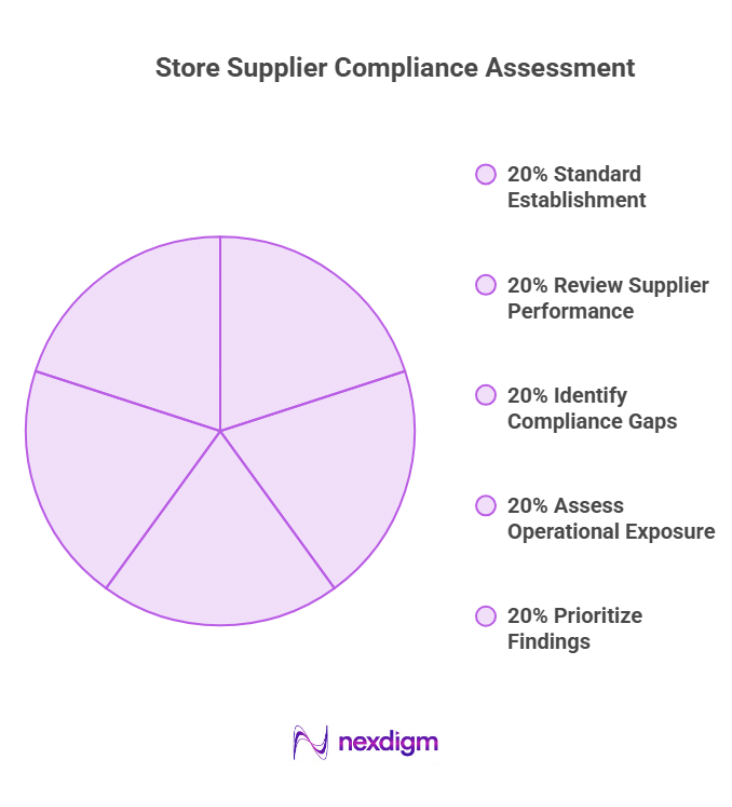
- Establish the Standard: Define applicable service levels, compliance requirements, certifications, safety expectations, and contractual obligations for each supplier category.
- Review Supplier Performance: Examine delivery, quality, response times, issue resolution, service records, and other available evidence against agreed expectations.
- Identify Compliance Gaps: Highlight missing documentation, expired certifications, recurring service deviations, process weaknesses, and other areas requiring attention.
- Assess Operational Exposure: Consider supplier capacity, geographic coverage, workforce capability, dependencies, and potential impact on store continuity.
- Prioritize Findings: Rank identified gaps according to severity, frequency, supplier criticality, and potential business impact to determine where corrective action is most important.
The assessment gives retailers a structured view of supplier compliance and operational readiness, providing a clear basis for remediation, monitoring, supplier development, and ongoing performance management.
Business Impact of Stronger Store Supplier Compliance Assessment by Nexdigm
Nexdigm’s structured supplier assessment can help retailers in the following areas:
- Reliable Store Operations: Addressing recurring supplier gaps can reduce service disruptions and improve consistency across locations.
- Stronger Compliance Control: Better visibility into certifications, documentation, contractual requirements, and standards can reduce avoidable compliance exposure.
- Improved Supplier Accountability: Clear performance gaps and corrective priorities give retailers a stronger basis for supplier reviews and improvement discussions.
- Lower Operational Risk: Early identification of capacity, service, and supplier dependencies can support timely mitigation and contingency planning.
- Better Supplier Decisions: Assessment findings can inform supplier development, monitoring, renewal, diversification, and sourcing decisions.
Overall, the assessment helps retailers move from identifying supplier shortcomings to strengthening compliance, operational reliability, and supplier performance across the store network.
Nexdigm’s Case
Nexdigm’s review found 21% of store suppliers requiring closer performance oversight, with 14% showing service consistency gaps and 8% requiring compliance documentation updates. The assessment also identified 6% of suppliers with recurring operational issues, helping the retailer focus corrective actions on the suppliers and locations with the greatest potential impact.
To take the next step, simply visit our Request a Consultation page and share your requirements with us.
Harsh Mittal
+91-8422857704