

Store-level procurement is becoming increasingly important as retailers balance cost control, operational efficiency, and margin protection. A recent 2026 US Supply Chain Survey found that 38% of supply-chain leaders identify logistics and transportation costs as the biggest source of value leakage, while 73% plan a comprehensive supply-chain operating-model transformation within three years.
Another tariff research further found that 78% of organizations reported higher cost of goods sold, with 51% experiencing margin declines. For retailers managing recurring purchases across hundreds or thousands of locations, these pressures make store supplies procurement benchmarking consulting valuable for comparing category costs, supplier pricing, commercial terms, and purchasing practices to identify where procurement can become more competitive.
Store Supply Costs Under Greater Pressure
Store supplies may seem routine, but recurring purchases across cleaning, packaging, maintenance, office, and operational categories can create meaningful cost exposure. Differences in supplier pricing, order volumes, specifications, delivery requirements, and local purchasing practices can cause similar products to carry different costs across locations. Understanding these variations gives retailers a stronger basis for identifying unnecessary cost differences and improving purchasing consistency without compromising store-level requirements.
The Role of Commercial and Supplier Comparisons
Comparing store-supply costs requires more than looking at unit prices. Supplier terms, discounts, payment conditions, delivery charges, minimum order quantities, service levels, and purchasing volumes can influence the overall value of a supplier relationship. A structured comparison helps retailers determine whether higher costs reflect genuine market or operational differences, or whether they indicate opportunities to improve negotiations, consolidate purchasing, standardize specifications, or explore alternative suppliers.
Nexdigm’s Expert-Led View on Store Supply Costs
Nexdigm’s experts assess store-supply procurement through four practical lenses, helping retailers understand:
- What Retailers Buy: Map categories, specifications, volumes, and purchase frequency to identify major spend areas, recurring requirements, and differences in purchasing patterns across stores.
- Who They Buy From: Examine supplier concentration, vendor coverage, performance, and geographic presence to identify dependencies, fragmented sourcing, and opportunities for stronger supplier leverage.
- What They Pay: Compare prices, volumes, market references, and purchasing variations to identify meaningful cost differences and potential areas for commercial improvement.
- Commercial Conditions: Review discounts, payment terms, minimum order quantities, delivery charges, rebates, and service conditions to understand the complete value of supplier relationships.
Together, these perspectives help retailers build a clearer picture of store-supply competitiveness and where procurement improvements could deliver measurable value.
Nexdigm’s Role in Identifying Store Supply Opportunities
Once store-supply costs and commercial conditions are assessed, Nexdigm helps retailers interpret the following areas and offer benefits in improving opportunities through store supplies procurement benchmarking consulting approach:
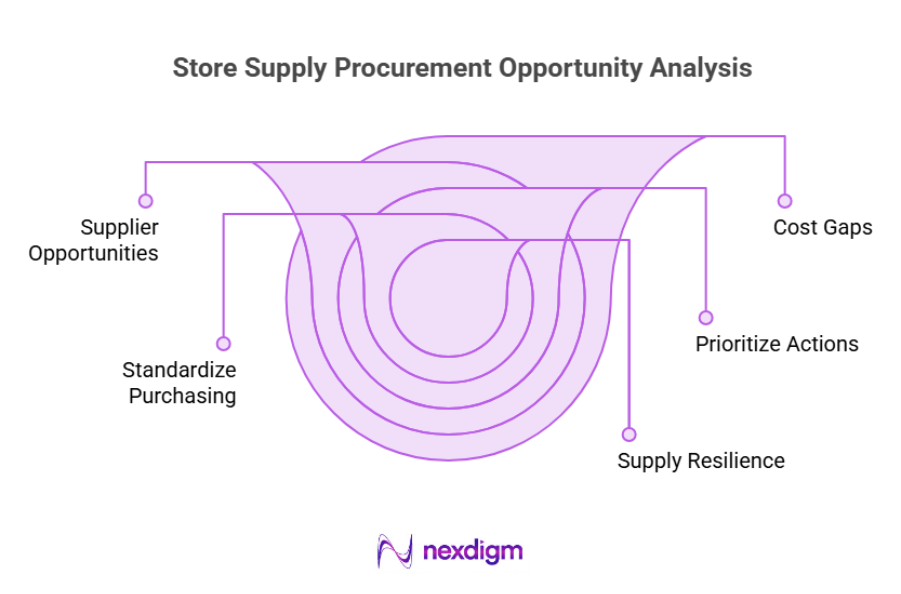
- Identify Cost Gaps: Highlight categories or suppliers where price differences, purchasing volumes, or commercial terms indicate potential savings opportunities.
- Spot Supplier Opportunities: Identify fragmented sourcing, concentrated dependencies, or supplier-performance differences that may support consolidation, renegotiation, or diversification.
- Prioritize Actions: Evaluate opportunities based on spend, savings potential, operational importance, supplier availability, and implementation feasibility to focus attention where impact could be strongest.
- Standardize Purchasing: Identify variations in specifications, pack sizes, suppliers, or purchasing practices across stores that may create opportunities for greater consistency and purchasing leverage.
- Strengthen Supply Resilience: Assess supplier concentration, geographic dependencies, service reliability, and alternative sourcing options to identify areas where store operations could benefit from greater supply flexibility.
Together, these perspectives help Nexdigm turn store-supply benchmarking into focused procurement actions that can improve cost competitiveness, supplier strategy, consistency, and operational resilience.
Nexdigm in Prioritizing High Potential Store Supply Opportunities
Identifying multiple cost and supplier opportunities is only the starting point. Nexdigm helps retailers evaluate which opportunities offer the strongest combination of financial potential, commercial feasibility, operational relevance, and implementation practicality by assessing the following areas:
- Value Potential: Estimation of the potential impact of addressing pricing gaps, supplier terms, fragmented spend, or purchasing inefficiencies.
- Ease of Execution: Considering supplier availability, contractual commitments, switching requirements, store-level constraints, and implementation effort before recommending an action.
- Business Relevance: Giving greater attention to categories and suppliers that directly affect store operations, service continuity, or procurement control.
- Opportunity Sequencing: Grouping initiatives into near-term, medium-term, and longer-term actions so procurement teams can pursue improvements in a practical sequence.
This helps retailers move from a broad list of findings to a focused store-supply improvement roadmap, with attention directed toward opportunities that are both valuable and actionable.
Nexdigm’s Case
Nexdigm benchmarked store-supply procurement across 10 categories, suppliers, and geographic markets, identifying 8 categories with significant cost or commercial gaps. The assessment highlighted a 19% potential cost-improvement opportunity and identified 3 areas where supplier consolidation could strengthen purchasing leverage, helping the retailer prioritize commercially attractive and practical procurement actions.
To take the next step, simply visit our Request a Consultation page and share your requirements with us.
Harsh Mittal
+91-8422857704