

Strategic entry mode consulting enables companies choose the most suitable route for entering a new market, whether through a joint venture, greenfield investment, acquisition, partnership, or other structure. Each model carries different implications for control, cost, speed, risk, compliance, and long-term scalability. A strong market entry strategy requires businesses to compare these options against market conditions, regulatory requirements, investment capacity, operational readiness, and growth objectives.
By using strategic entry mode consulting, companies can avoid unsuitable expansion structures, reduce execution uncertainty, and make better-informed decisions that support faster market access, stronger local positioning, and sustainable international growth.
Studies indicate that around 40%–60% of joint ventures are considered failures, while cross-border mergers and acquisitions have reported failure rates of nearly 70%–90%. Greenfield investments can offer stronger control but often require higher capital, longer setup timelines, and deeper regulatory planning. These figures show why companies need a structured market entry strategy before choosing an entry mode.
Aligning Entry Mode Decisions with Long-Term Market Entry Strategy
Aligning Entry Mode Decisions with Long-Term Market Entry Strategy means selecting joint venture, greenfield, acquisition, or partnership models based on growth goals, investment capacity, control needs, regulatory risks, and scalability.
-
Evaluating Strategic Objectives
Companies must align entry mode choices with growth targets, market share goals, investment priorities, and long-term expansion plans.
-
Assessing Control Requirements
Greenfield models offer higher control, while joint ventures and acquisitions may provide faster access with shared decision-making.
-
Comparing Investment Commitments
Each entry mode requires different capital, resources, setup costs, and financial risk, affecting long-term market entry strategy.
-
Reviewing Regulatory Constraints
Local ownership rules, approvals, sector restrictions, and compliance requirements can influence the most suitable entry mode.
-
Analyzing Speed to Market
Acquisitions may accelerate entry, while greenfield investments often require longer timelines for setup, hiring, and approvals.
Nexdigm’s Regulatory and Tax Advisory for Entry Mode Decision-Making
Nexdigm’s Regulatory and Tax Advisory for Entry Mode Decision-Making helps companies evaluate how different entry models, such as joint ventures, greenfield investments, acquisitions, or partnerships, affect compliance, taxation, ownership, reporting, and operating costs.
By assessing local regulations, tax structures, approvals, and risk exposure, Nexdigm supports informed entry mode selection and smoother market entry execution.
Nexdigm’s Strategic Entry Mode Consulting for Smarter Cross-Border Expansion Decisions
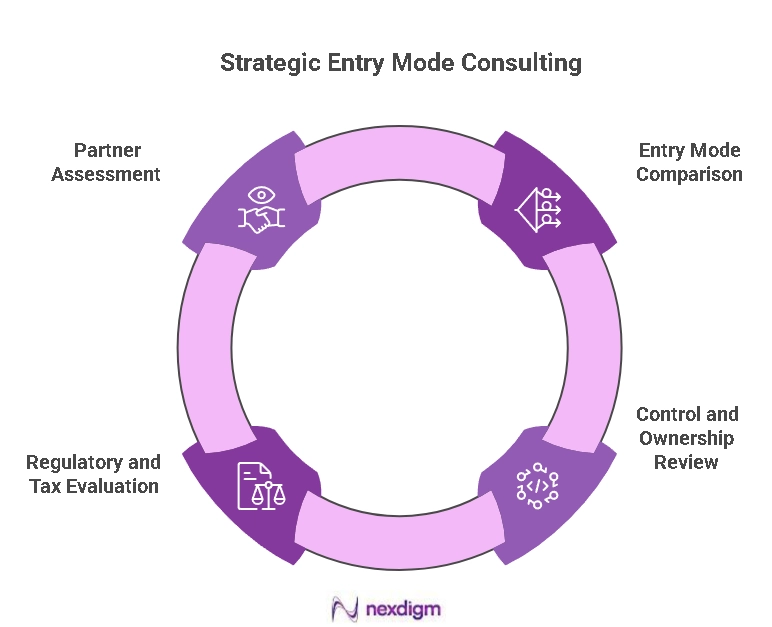
Nexdigm’s Strategic Entry Mode Consulting for Smarter Cross-Border Expansion Decisions helps companies compare joint venture, greenfield, acquisition, and partnership models based on cost, control, risk, compliance, and scalability:
-
Entry Mode Comparison
Nexdigm helps compare joint venture, greenfield, acquisition, and partnership models based on business goals and market conditions.
-
Control and Ownership Review
Nexdigm assesses ownership needs, decision-making control, management flexibility, and governance implications for each expansion model.
-
Regulatory and Tax Evaluation
Nexdigm reviews local regulations, tax structures, approvals, and compliance obligations that influence entry mode selection.
-
Partner Assessment
Nexdigm supports partner screening, acquisition evaluation, and collaboration analysis to reduce risks in joint ventures or acquisitions.
Nexdigm’s case:
In a Nexdigm greenfield expansion collaboration, a hygiene materials manufacturer supplying brands across 25 countries, evaluated India as part of its global strategy. Nexdigm supported entity setup, location planning across three to four Indian states, land acquisition, approvals, vendor negotiations, capital structuring, recruitment, and project management. A key outcome was obtaining pollution clearance in five days instead of the usual 45 days, helping reduce setup delays.
To take the next step, simply visit our Request a Consultation page and share your requirements with us.
Harsh Mittal
+91-8422857704