

A growing student population does not guarantee that every institution will fill its seats. Demand is shaped by demographics, academic eligibility, household finances, employment expectations and the availability of credible alternatives. Some programmes may attract more applicants while others lose relevance. Institutions that plan capacity using historical enrollment alone risk investing in yesterday’s demand.
Forecasting requires a closer look at where students are coming from, what they intend to study and which institutions or delivery formats they can realistically access.
India’s Student Enrollment Trends and the Demand Outlook
India’s school system recorded 24.69 crore students in 2024–25, according to UDISE+. The Ministry of Education’s AISHE 2021–22 reported nearly 4.33 crore students in higher education, up from 3.42 crore in 2014–15. These figures provide a baseline for understanding the scale of the education market, but they cover different stages of education and should not be treated as a direct progression forecast.
The longer-term picture is also not simply one of continuous growth. NITI Aayog’s 2025 analysis of school education, using UDISE+ data, noted that total school enrollment declined from 26.52 crore in 2021–22 to 24.69 crore in 2024–25. Demographic change, retention and other system-level factors all matter. For individual institutions, local population trends and the mix of programmes offered can be more informative than national totals.
Higher education demand will likewise vary by field and institution type. Students may compare general degrees with professional courses, vocational routes, online qualifications or direct entry into work. A forecast needs to capture these alternatives rather than assume that every eligible student will follow the same pathway.
Which Programmes and Institutions Could Gain Demand?
Several factors are likely to influence how student demand is distributed.
- Career-linked programmes may attract applicants when students can see a credible connection between the curriculum and employment opportunities. Technology, healthcare, business and specialised technical fields are worth examining, but demand should be validated by local hiring conditions, entry requirements and competing programmes rather than broad claims about future jobs.
- Affordability and location will continue to shape the institution shortlist. Students who cannot relocate may favour nearby colleges or flexible delivery. Others may be willing to pay more for specialist facilities, strong academic reputation or access to internships.
- Online and open learning can widen access for working adults, learners in remote areas and people who need flexibility. India’s University Grants Commission maintains rules and recognition information for online and open-distance programmes. Students should verify that the institution and programme are appropriately recognised, especially when a qualification is intended to support further study or professional progression.
- Student preferences are also changing within institutions. Demand may shift towards interdisciplinary programmes, practical learning, internships or flexible electives, without necessarily producing a large increase in total enrollment.
Student Demand Forecasting: Turning Signals Into Intake Estimates
A Student demand forecasting exercise should separate the total pool of potential learners from the number an institution can realistically recruit. The distinction requires data on eligible students, competing offers, programme capacity, fees and historical admissions performance.
Institutions should combine several types of evidence: school-leaver numbers, local demographic trends, application and enrollment histories, course searches, competitor offerings and student feedback. Changes in regulations or programme eligibility should also be incorporated where relevant.
The forecast should distinguish between interest, applications, offers and confirmed enrollment. If an institution expects 1,000 students to apply, it cannot assume that all 1,000 will qualify or accept an offer. Conversion rates need to be estimated separately for each programme and student segment.
Student Demand Forecasting Framework
The Education Enrollment Demand Forecasting Framework gives institutions a practical basis for planning programme capacity.
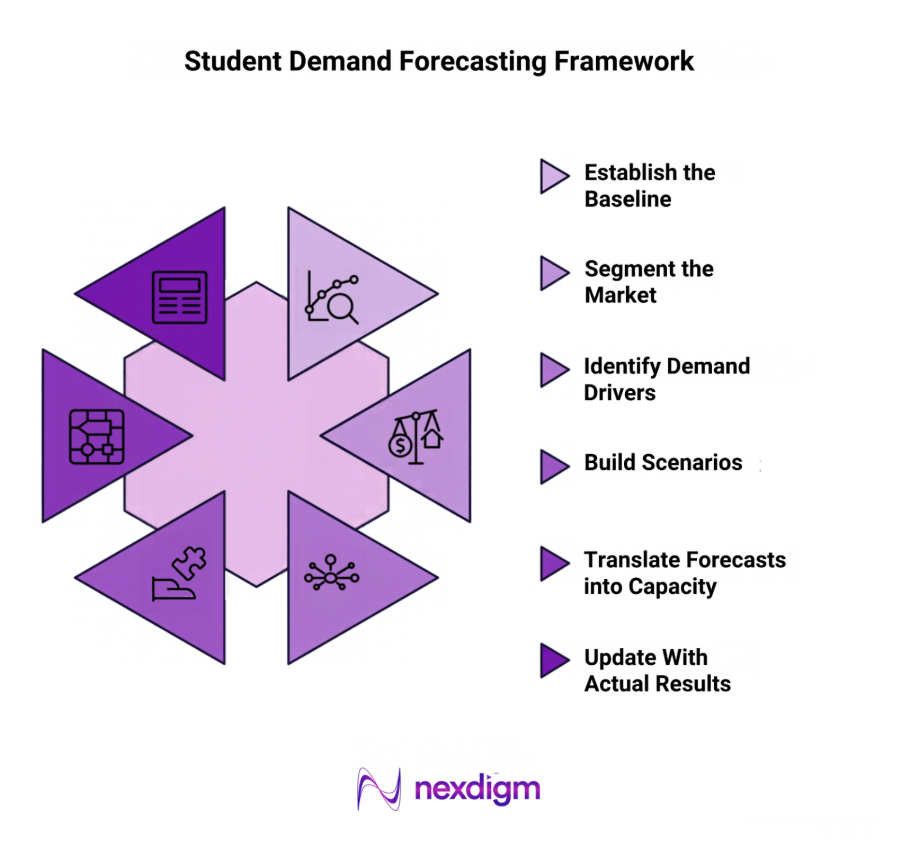
- Establish the Baseline: Review enrollment, applications, eligibility, offer acceptance and withdrawals over several admissions cycles.
- Segment the Market: Separate demand by programme, institution type, geography, student profile and delivery mode.
- Identify Demand Drivers: Assess demographics, affordability, employment expectations, regulation and competing education options.
- Build Scenarios: Model conservative, expected and stronger-demand outcomes using explicit assumptions about applications and conversion.
- Translate Forecasts Into Capacity: Align faculty, classrooms, digital infrastructure, student services and marketing expenditure with the expected intake.
- Update With Actual Results: Compare forecasts against admissions performance and revise assumptions as new evidence emerges.
Scenario planning is particularly important when a new programme has little historical data. In such cases, pilot cohorts, employer feedback and early application behaviour can provide evidence before the institution commits to large-scale delivery.
Nexdigm Case Study: Planning Programme Capacity
Nexdigm assessed enrollment trends across 16 programmes at a higher education institution, combining historical admissions, local demand indicators and competitor offerings. Five programmes showed potential capacity pressure, while four faced weaker conversion and greater competitive exposure. The institution used the assessment to prioritise recruitment resources and review planned seat allocations for the next admissions cycle.
To take the next step, simply visit our Request a Consultation page and share your requirements with us.
Harsh Mittal
+91-8422857704