

A student expressing interest in a college is not the same as a student who will enrol. Between the two sit entrance requirements, family discussions, tuition costs, competing offers, location constraints and doubts about future employment. Institutions that measure only enquiries can mistake attention for demand.
Enrollment planning therefore needs to follow the student’s decision from initial awareness to confirmed admission. Each stage reveals a different constraint, and each calls for a different response.
What Drives Student Enrollment Decisions?
For many students, programme selection begins with a subject or career preference. The shortlist then narrows according to academic eligibility, reputation, fees, location and perceived career prospects. Parents or other family members may influence the final decision, particularly when the financial commitment is substantial.
India’s higher education system had approximately 4.33 crore students enrolled in 2021–22, up from 3.42 crore in 2014–15, according to the Ministry of Education’s All India Survey on Higher Education. The figures establish the scale and expansion of participation, but they do not mean that every institution or programme faces rising demand. Institutions compete within specific geographies, disciplines and fee bands.
School education provides another important context. UDISE+ recorded 24.69 crore students across India’s school system in 2024–25. This large base does not translate directly into future college admissions. Progression depends on completion, affordability, access to institutions and students’ decisions about further study.
Student Enrollment Demand Analysis: From Interest to Admission
A Student enrollment demand analysis should track conversion across the admissions funnel rather than rely on a single enquiry target.
- Awareness and discovery: Where do prospective students first encounter the institution, and which programmes generate attention?
- Qualified interest: How many enquiries meet academic eligibility and reflect a genuine intention to apply?
- Application completion: Where do prospective applicants abandon forms, fail to submit documents or miss deadlines?
- Offer acceptance: How many admitted students accept an offer, pay the required deposit or complete verification?
- Enrollment confirmation: How many students actually join, and how many withdraw before classes begin?
These stages help locate the problem. Strong enquiry volumes with few completed applications may indicate unclear eligibility requirements, a difficult application process or weak follow-up. A high number of offers but low acceptance may point to pricing, competing institutions or doubts about the programme’s value.
Institutions should also segment demand by programme, geography, qualification level and student type. An aggregate conversion rate can hide a popular course that fills quickly alongside several programmes with persistent vacancies.
Affordability, Scholarships and the Cost of Attendance
Tuition is only part of the financial decision. Students may also need to pay for accommodation, transport, devices, examination fees, materials and living expenses. For those moving away from home, the total cost of attendance can be more important than the published course fee.
Institutions should examine whether the gap between the advertised fee and the actual cost is clear before students apply. Scholarship awareness, payment schedules and eligibility rules can influence conversion, particularly when families compare several offers at once.
Discounting should not be the automatic response to weak admissions. If students are unsure about employment outcomes, curriculum quality or institutional support, a lower fee may not resolve their concerns. Conversely, a strong programme may lose eligible applicants if the payment structure is difficult to manage.
Improving Enrollment Conversion: A Practical Framework
The Student Admissions Conversion Framework connects demand research to operational improvements.
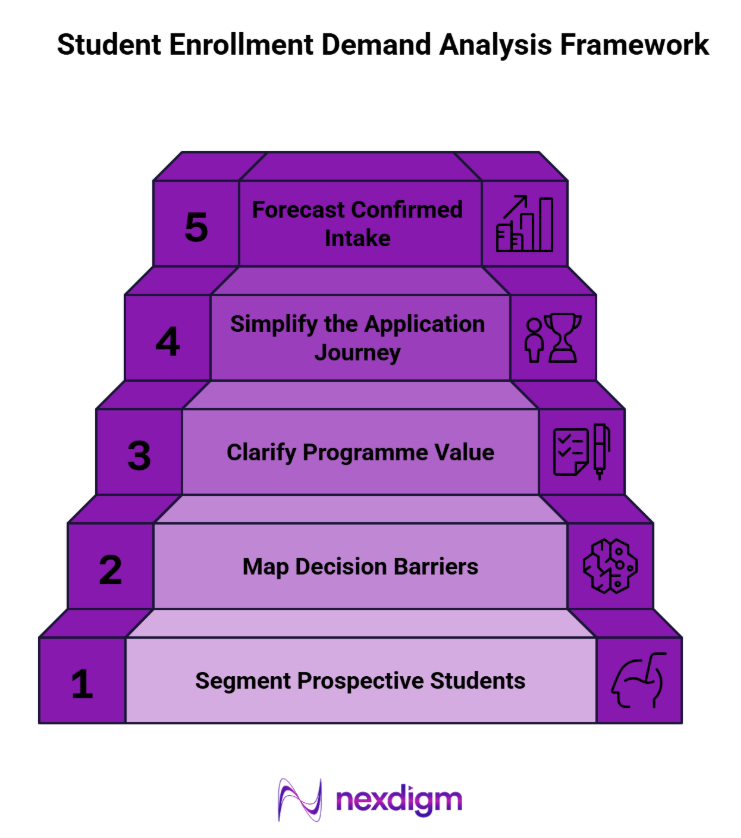
- Segment Prospective Students: Group applicants by programme interest, eligibility, geography, affordability and decision stage.
- Map Decision Barriers: Use enquiry data, applicant feedback and withdrawal reasons to identify points of friction.
- Clarify Programme Value: Communicate curriculum, practical exposure, recognised qualifications, support and credible career pathways.
- Simplify the Application Journey: Make eligibility, deadlines, documents, fees and next steps easy to understand.
- Forecast Confirmed Intake: Use stage-level conversion rates, historical yield and competing-offer patterns to estimate actual enrollment.
Forecasts should include more than a single expected number. A base case, a lower-conversion case and a stronger-conversion case help institutions plan staffing, class sizes and revenue without assuming every offer becomes a student.
Nexdigm Case Study: Diagnosing Admissions Leakage
Nexdigm reviewed the admissions funnel for 12 programmes at a higher education institution. Enquiries were strong, but application completion and offer acceptance varied sharply by programme. The assessment identified unclear fee communication and inconsistent follow-up as two recurring barriers. The institution prioritised changes to applicant communication and stage-level tracking for its next admissions cycle.
To take the next step, simply visit our Request a Consultation page and share your requirements with us.
Harsh Mittal
+91-8422857704