

A student can want a programme without being able to buy it.
That distinction matters more in education than it first appears. Interest surveys can show strong demand for artificial intelligence, biotechnology, international business, healthcare, or other specialised programmes, while actual enrollment remains weak once families encounter tuition, accommodation, transport, and financing requirements.
The commercial question is therefore more specific than “What do students want?” Institutions need to understand which preferences survive contact with household budgets, perceived career value, and the final purchasing decision.
The Price of Aspiration
Programme preference is increasingly tied to expected employability. Students and parents may tolerate higher fees when a programme has a visible career pathway, strong placement record, recognised credentials, or a clear wage premium.
The calculation changes for less differentiated programmes. General degrees can struggle to justify higher fees when families cannot identify a corresponding employment advantage. The challenge for institutions is to understand where perceived value is strong enough to support tuition rather than assuming that academic interest will automatically translate into enrollment.
The same programme can also command very different levels of fee tolerance across markets. Household income, access to education loans, local competition, and the cost of living all influence the point at which aspiration becomes financially impractical.
What Families Actually Have Room to Spend
The 2025 Comprehensive Modular Survey on Education illustrates the scale of this variation. Average household expenditure per student on school course fees was ₹15,143 in urban areas compared with ₹3,979 in rural areas. Private coaching was also widespread, with 27% of students having taken or currently taking private coaching during the academic year.
These figures matter because education spending does not happen in isolation. Tuition competes with accommodation, transportation, coaching, technology, examination costs, and household obligations.
For a university or education provider, affordability therefore needs to be modelled at the household level rather than inferred from competitor pricing.
The Decision Is Shared
The person using an education service is not necessarily the person paying for it.
Students tend to evaluate factors such as:
- programme specialisation and career relevance
- campus experience and peer environment
- institutional reputation
- facilities and academic resources
- perceived future mobility
Parents typically place greater weight on:
- total cost of attendance
- accreditation and institutional credibility
- safety and accommodation
- financing and loan availability
- placement outcomes
- expected return on education spending
The purchase occurs when these perspectives overlap sufficiently.
Nexdigm’s Student Affordability-to-Enrollment Framework
A student needs and affordability assessment can translate student preference and household economics into an enrollment model through six connected dimensions:
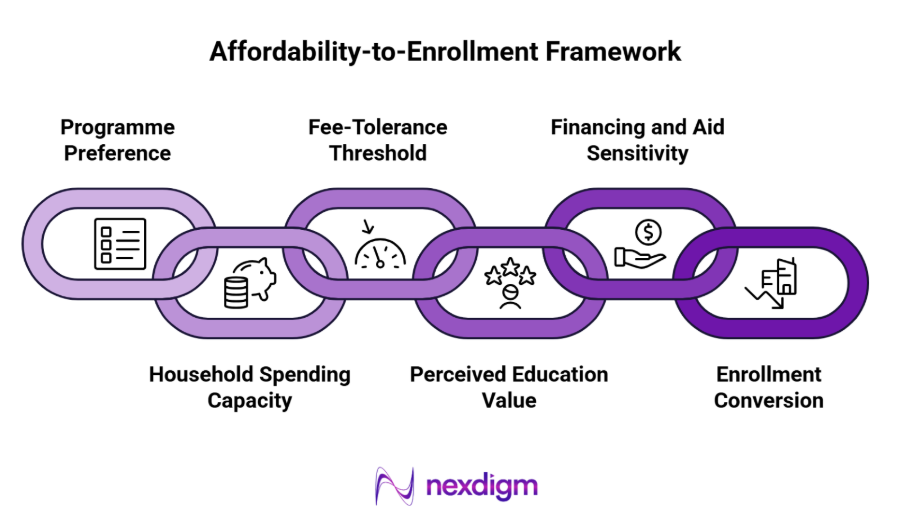
- Programme Preference
Measure demand for individual programmes across student segments, including academic interest, career aspirations, preferred specialisations, and the strength of consideration relative to competing programmes. - Household Spending Capacity
Profile prospective households by income, existing education expenditure, discretionary capacity, and competing financial commitments to establish the realistic pool of fee-paying students. - Fee-Tolerance Threshold
Identify the tuition levels at which willingness to enroll begins to decline, and compare these thresholds across household-income segments, geographies, and programme categories. - Perceived Education Value
Assess how students and parents evaluate programme cost against expected outcomes, including employability, starting salaries, placement rates, institutional reputation, credentials, and long-term career mobility. - Financing and Aid Sensitivity
Model how scholarships, education loans, instalment structures, and other financing mechanisms affect affordability and applicant-to-enrollment conversion at different fee levels. - Enrollment Conversion
Translate preference, affordability, value perception, and financing access into expected enrollment under alternative pricing scenarios, allowing institutions to identify the combination that supports both student intake and sustainable tuition revenue.
Case Study: Reworking Tuition Around Actual Student Demand
A private university network assessed five programmes across multiple campuses and found that high student interest did not translate into equivalent fee tolerance. Price-sensitivity modelling indicated that tuition restructuring and curriculum changes could improve enrollment conversion by 19%, while revised programme positioning increased student satisfaction by 23%.
The commercial value of the framework lies in connecting two numbers that are often examined separately: how many students want a programme and how many can realistically afford it. For institutions planning new programmes, revising tuition, or entering new student segments, that connection provides a stronger basis for pricing and enrollment decisions.
To take the next step, simply visit our Request a Consultation page and share your requirements with us.
Harsh Mittal
+91-8422857704