

A student can be satisfied with a lecturer and still be unhappy with the institution. They may enjoy the course but struggle with administration, find fees difficult to manage or discover that promised career support is hard to access. Satisfaction is rarely determined by one memorable classroom experience. It develops through repeated interactions with the institution.
For education providers, retention and recommendations offer different kinds of evidence. Staying suggests that the overall experience remains acceptable or worthwhile. Recommending an institution involves putting one’s own reputation behind that choice. Switching can signal that a competing provider offers a better combination of value, convenience and outcomes.
Why Students Stay With an Institution
Academic quality is fundamental, but students experience it through several connected elements. They need clear teaching, useful feedback, access to faculty and a curriculum that feels relevant to their goals. When these basics are unreliable, additional facilities or promotional campaigns may do little to improve the overall experience.
Administrative reliability is another major factor. Delayed examination results, confusing fee rules, slow document processing and inconsistent communication create avoidable frustration. Each incident may appear minor to the institution, but together they shape whether students feel supported.
Students may also stay because transferring is expensive or disruptive. Credits may not transfer easily, a change of institution can delay graduation, and relocation may create additional costs. Retention figures should therefore not be treated as proof of satisfaction on their own.
India’s higher education enrollment reached 4.50 crore in 2023–24, according to the Ministry of Education’s AISHE data. As the sector serves a large and diverse student population, providers need to understand differences across programme types, student backgrounds and stages of study rather than assume a single satisfaction profile.
What Makes Students Recommend or Switch?
Recommendations tend to emerge when students believe an institution delivers on its promises. Strong teaching, supportive faculty, accessible facilities, transparent administration and credible career opportunities can all contribute. Peer recommendations matter because prospective students often seek information that institutional marketing does not provide.
Switching can be driven by a different set of triggers:
- Academic disappointment: Teaching quality, course content or assessment practices do not meet expectations.
- Financial pressure: Fees rise, additional costs emerge or a competing programme offers better perceived value.
- Weak career support: Internship access, placement services or practical exposure fall short of what students expected.
- Poor service delivery: Administrative delays, unresponsive support or unreliable digital systems create repeated problems.
- A better-fit alternative: Another institution offers a preferred specialisation, location, schedule or learning format.
These factors need to be investigated, not assumed. A student leaving because of relocation has a different implication from one leaving after repeated complaints about teaching. The first may be difficult to prevent; the second could reveal an operational issue affecting many students.
Student Satisfaction Demand Insights: Measuring the Full Experience
Student satisfaction demand insights become more useful when survey responses are combined with actual behaviour. A high satisfaction score offers a snapshot, while retention, complaints, referrals and withdrawals show what students do over time.
Institutions should examine feedback at meaningful points: after admission, during the first semester, following major assessments and before renewal or progression decisions. Short, targeted surveys are often more actionable than a single annual questionnaire covering every aspect of campus life.
Useful indicators include:
- Satisfaction by touchpoint: Teaching, assessment, administration, facilities, digital services and student support.
- Likelihood to recommend: Whether students would actively endorse the institution and why.
- Retention and progression: Continuation rates, course changes, withdrawals and reasons for leaving.
- Complaint resolution: Response time, resolution rate and whether the same issue recurs.
- Perceived value: Whether students believe the education received justifies its total financial and time commitment.
Results should be segmented. A campus-wide average can conceal poor experiences in one department or among students who commute long distances. Open-ended feedback and follow-up interviews can help explain the numbers.
Student Retention and Satisfaction Improvement Framework
The Student Experience and Retention Framework turns feedback into operational priorities.
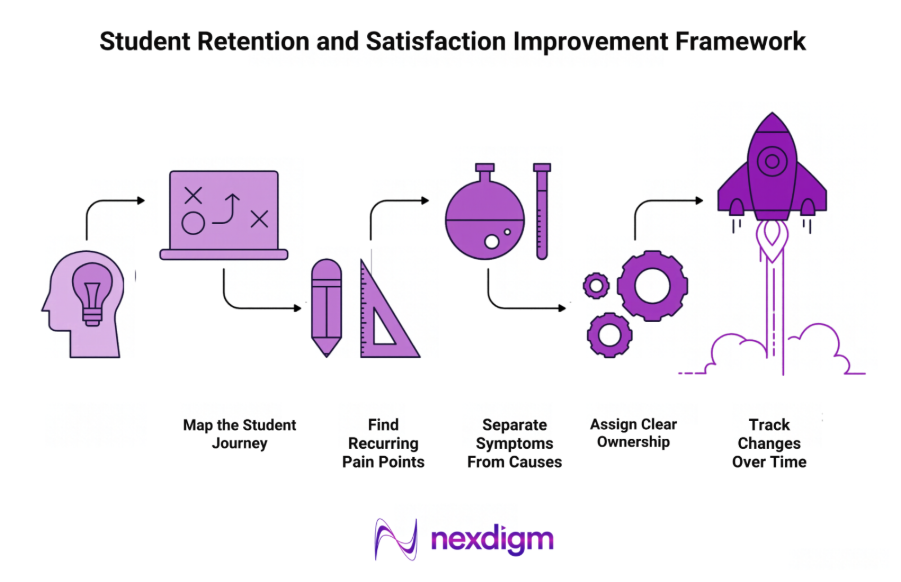
- Map the Student Journey: Identify high-friction interactions from admission through graduation.
- Find Recurring Pain Points: Combine survey results, complaints, withdrawals and service data.
- Separate Symptoms From Causes: Investigate whether dissatisfaction comes from staffing, process design, communication or programme quality.
- Assign Clear Ownership: Give academic and administrative teams responsibility for specific improvements.
- Track Changes Over Time: Check whether satisfaction, repeat complaints, progression and referrals improve after interventions.
Nexdigm Case Study: Identifying Retention Risks
Nexdigm analysed student feedback and retention indicators across 12 programmes at a higher education institution. Academic support and administrative response times emerged as recurring concerns, while satisfaction differed considerably between departments. The institution prioritised improvements in feedback turnaround and complaint ownership, with retention and repeat-complaint rates selected as follow-up measures.
To take the next step, simply visit our Request a Consultation page and share your requirements with us.
Harsh Mittal
+91-8422857704