

Successful product launch planning is critical because first-year adoption often shapes a product’s long-term revenue potential, customer loyalty, and market position. A weak launch can limit awareness, slow sales momentum, and make it harder to recover later, even if the product has strong features.
A strong market entry strategy connects launch planning with demand validation, pricing, competitive positioning, channel readiness, and customer communication. By using successful product launch planning, companies can reduce uncertainty, improve early adoption, and build a stronger foundation for revenue growth, repeat purchases, and scalable expansion across target markets.
The importance of successful product launch planning is clear, as nearly 60% of new products underperform after launch, often due to weak positioning, limited demand validation, or poor customer adoption. Studies also suggest that around 42% of startups fail because there is no market need, highlighting the risk of launching without customer insight. Since early adoption influences repeat purchases, market share, and revenue momentum, launch planning must be closely linked with market entry strategy.
How Successful Product Launch Planning Supports Long-Term Revenue Growth?
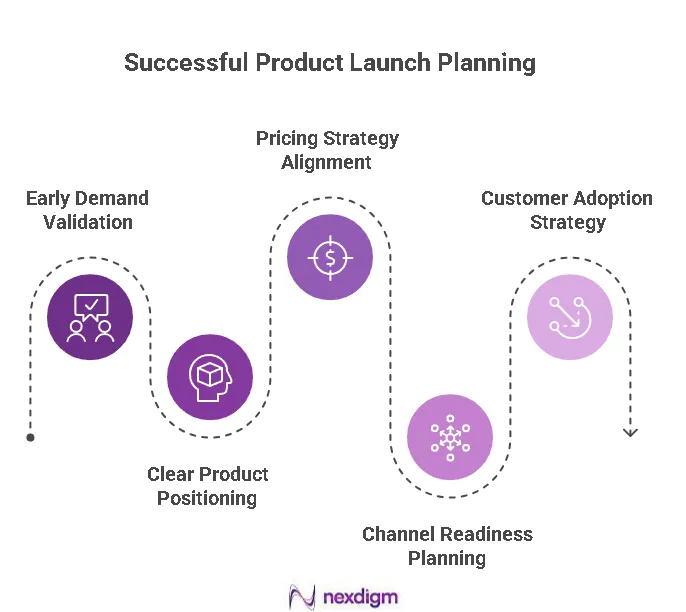
Successful Product Launch Planning Supports Long-Term Revenue Growth means preparing demand validation, pricing, positioning, channels, and customer adoption strategies early to build sales momentum, repeat purchases, and scalable revenue:
-
Early Demand Validation
Confirm customer need, product relevance, and purchase intent before launch to improve adoption and long-term revenue potential.
-
Clear Product Positioning
Define product benefits, differentiation, and customer value clearly to build awareness, trust, and stronger market acceptance.
-
Pricing Strategy Alignment
Set pricing based on affordability, competitor benchmarks, value perception, and margin goals to support sustainable revenue growth.
-
Channel Readiness Planning
Ensure distributors, retailers, digital platforms, and sales teams are prepared to make the product available from launch.
-
Customer Adoption Strategy
Plan trials, demos, promotions, education, and onboarding to encourage first-year adoption and repeat purchases.
Nexdigm’s Post-Launch Performance Review for Revenue Growth Planning
Nexdigm’s Post-Launch Performance Review for Revenue Growth Planning helps companies assess product performance after launch by tracking sales trends, customer adoption, channel effectiveness, pricing response, competitor activity, and market feedback. These insights help identify improvement areas, refine go-to-market actions, strengthen customer retention, and support revenue growth planning for long-term market success.
Nexdigm’s Channel Performance Assessment for Improving Product Availability for long term Revenue
Nexdigm’s Channel Performance Assessment for Improving Product Availability helps companies evaluate distributor reach, retail coverage, stock movement, delivery efficiency, and channel gaps to improve product access and sales performance.
-
Stock Movement Analysis
Nexdigm tracks inventory flow, sales velocity, reorder patterns, and stockouts to identify channel performance issues.
-
Delivery Efficiency Review
Nexdigm assesses lead times, logistics reliability, fulfillment speed, and service levels to improve product availability.
-
Channel Gap Identification
Nexdigm identifies weak territories, underperforming partners, and underserved customer segments affecting market reach.
-
Partner Performance Monitoring
Nexdigm evaluates distributor sales, compliance, reporting, and execution quality to improve channel accountability.
-
Availability Improvement Roadmap
Nexdigm converts channel insights into actions for better coverage, inventory planning, partner alignment, and sales growth.
Nexdigm’s case:
Nexdigm collaborated with a global FMCG brand assess channel performance after launching a new packaged food product across India. Nexdigm reviewed distributor coverage, retail availability, stock movement, reorder frequency, delivery lead times, and outlet-level visibility. The assessment found that 32% of target outlets faced stockout issues, 18% of distributors had delayed replenishment cycles, and improving route planning could increase product availability by 20%–25% in priority markets.
To take the next step, simply visit our Request a Consultation page and share your requirements with us.
Harsh Mittal
+91-8422857704