

Supplier diversification has moved higher on the procurement agenda as companies reassess exposure to geopolitical disruption, trade restrictions, logistics interruptions and concentrated manufacturing bases. In India, 70% of supply-chain executives surveyed by DP World in 2026 identified supplier diversification as a priority, while 59% said they were increasing inventory levels to strengthen resilience.
Adding suppliers, however, does not automatically create a more resilient network. Five suppliers may still depend on the same country, industrial cluster or upstream manufacturer. The real exposure can sit several tiers below the supplier visible on the purchase order.
Supplier Count Does Not Show the Full Risk
A supply base can look diversified while remaining structurally concentrated.
Consider three suppliers located in different cities but dependent on the same imported component. A disruption at the upstream source affects all three simultaneously. The same issue arises when multiple vendors operate from one geographic manufacturing cluster exposed to the same port, power network or regulatory environment. Supplier assessment therefore needs to move beyond Tier 1 and examine the dependencies underneath it.
Criticality Depends on What the Supplier Provides
Not every supplier requires the same level of scrutiny.
A vendor providing a standardised, easily substitutable component presents a different risk from one supplying a proprietary part with lengthy qualification requirements. Switching costs, regulatory approvals, tooling, technical specifications and customer validation can make some supplier relationships difficult to replace even when alternative vendors exist.
Criticality can therefore be assessed across several variables:
- Revenue or production exposure
- Availability of alternative suppliers
- Switching and qualification time
- Geographic concentration
- Capacity and utilisation
- Financial and operational stability
- Component or material substitutability
The result is a clearer distinction between suppliers that are important and suppliers that can actually disrupt the business.
Sourcing Clusters Can Create Hidden Concentration
Geography has become an important part of supplier-network analysis. India’s manufacturing ecosystem is built around clusters such as automotive hubs in Maharashtra and Tamil Nadu, electronics manufacturing centres in southern India, pharmaceutical clusters in Gujarat, Telangana and Andhra Pradesh, and specialised chemical manufacturing regions.
Clusters provide advantages in skills, infrastructure and supplier ecosystems. They can also create correlated risk. A disruption affecting one region can affect several vendors simultaneously. The objective is not to eliminate clustering. It is to understand when cluster exposure becomes excessive relative to the importance of the goods being sourced.
Diversification Has a Cost
A second supplier can reduce disruption exposure, but it may also mean smaller order volumes, higher unit costs, additional qualification work and more complex supplier management. The strongest diversification opportunities are therefore not necessarily the categories with the largest supplier counts. They are the areas where the cost of maintaining an alternative source is justified by the consequence of supply failure.
For some components, dual sourcing may be appropriate. For others, regional sourcing, supplier development or strategic inventory may offer better economics.
Where the Next Supplier Should Come From
Alternative sourcing is increasingly becoming a geographic decision.
India’s growing role in global supply-chain diversification is creating opportunities to develop domestic and regional suppliers, while companies continue to evaluate sourcing alternatives across Southeast Asia, the Middle East and other manufacturing markets.
The choice depends on more than labour or purchase cost. Logistics, tariffs, quality, technical capability, capacity availability, regulatory requirements and lead times all affect the viability of a new source.
How Nexdigm Maps Supplier Network Risk and Opportunity
Nexdigm evaluates supplier networks through five dimensions:
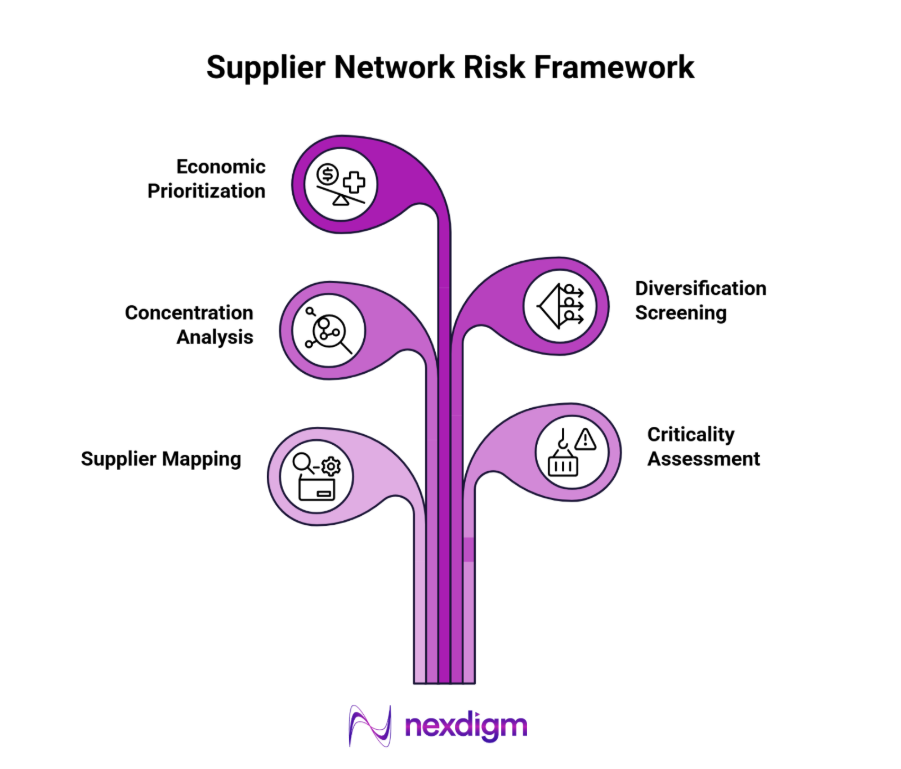
- Supplier mapping: Map Tier 1, Tier 2 and relevant upstream suppliers by product, geography, capability and relationship.
- Criticality assessment: Rank suppliers based on business impact, substitutability, switching costs and disruption exposure.
- Concentration analysis: Identify dependency by supplier, country, manufacturing cluster and upstream input.
- Diversification screening: Assess alternative suppliers, sourcing locations, localisation opportunities and supplier-development options.
- Economic prioritisation: Compare risk reduction against qualification costs, pricing, logistics, inventory and implementation requirements.
A supplier network market assessment can translate a complex supplier base into a prioritised view of where diversification, localisation or supplier development can create the greatest commercial value.
How Nexdigm Strengthened Supply Resilience Through Strategic Sourcing
For a US consumer healthcare company heavily dependent on Chinese suppliers, Nexdigm evaluated the total cost and risk of the existing sourcing model and supported a transition towards local US supply. The programme protected USD 192 million in net trade sales, avoided USD 0.56 million in air-freight costs and created 30 days of safety stock.
To take the next step, simply visit our Request a Consultation page and share your requirements with us.
Harsh Mittal
+91-8422857704