

Supply chain investment is rarely driven by a single objective. Companies may be responding to demand volatility, protecting against disruptions, improving delivery speed, or reducing operating costs. The difficulty is determining which of these pressures deserves capital first.
That decision is becoming more important as supply chains carry higher expectations around resilience and responsiveness. Gartner estimated that 79% of supply chain organizations increased their technology investments in 2025, reflecting continued spending on visibility, planning, automation, and execution capabilities. The challenge is ensuring that investment addresses a measurable business requirement rather than simply following the latest technology cycle.
Volatility Is Changing How Companies Think About Capacity
Demand volatility makes fixed planning assumptions increasingly difficult.
Large swings in orders can leave companies with excess inventory during slow periods and insufficient capacity when demand rises. Businesses may respond by increasing safety stock, adding flexible warehouse capacity, diversifying suppliers, or investing in better forecasting and planning systems.
Holding more inventory ties up working capital.
Building permanent capacity can leave assets underutilised.
Flexible capacity may cost more per unit but provide greater protection during demand peaks.
Is volatility frequent and costly enough to justify structural changes to the supply chain?
Resilience Has Become an Investment Criterion
A supply chain designed purely around minimum cost can become expensive when a supplier failure, port disruption, geopolitical event, or transport interruption stops production. Companies are consequently considering dual sourcing, alternative routes, strategic inventory, regional suppliers, and backup logistics capacity.
The economic case for resilience is different from the case for cost reduction. A second supplier may increase procurement costs while reducing the potential cost of a prolonged shutdown.
Investment decisions need to quantify both sides: the cost of additional resilience and the financial exposure it is intended to reduce.
Speed Can Create Value When Customers Pay for It
Shorter lead times can reduce inventory requirements, improve product availability, support faster replenishment, and help businesses respond to changing demand. In e-commerce and time-sensitive industries, delivery speed can also influence conversion and customer retention.
An investment that reduces delivery time by one day has limited commercial value if customers are unwilling to pay for it or if existing service levels already meet expectations. The relevant measure is therefore the revenue, working-capital, or retention benefit generated by the improvement.
Cost Still Determines Whether the Investment Survives the Business Case
Even resilience and speed ultimately have to compete for capital against productivity improvements.
Transport costs, warehouse labour, inventory carrying costs, energy, detention, expedited freight, and inefficient asset utilisation can create recurring leakage. Addressing these areas can sometimes produce a more immediate return than adding new infrastructure.
Improving truck utilisation can reduce the number of vehicles required. Better demand planning can reduce excess inventory. Reducing warehouse dwell time can increase effective capacity without constructing another facility.
This is why investment decisions should begin with the underlying cost structure rather than with a predetermined technology or infrastructure solution.
The Four Drivers Often Overlap
In practice, volatility, resilience, speed, and cost are interconnected.
A regional distribution centre may reduce transportation cost while also shortening delivery times. Additional inventory may protect against supply disruption but increase carrying costs. Automation may improve throughput and labour productivity while providing the flexibility needed during demand peaks.
The right investment is therefore the one that improves the economics of the supply chain under the conditions the business is likely to face.
A useful assessment should quantify the trade-offs rather than ranking the four drivers independently.
What Should Companies Measure Before Committing Capital?
Investment priorities can be tested through a small set of operational and financial measures:
- Demand volatility: forecast error, peak-to-average demand, order variability, and capacity swings.
- Resilience exposure: supplier concentration, route dependency, inventory buffers, disruption frequency, and recovery time.
- Speed economics: lead time, service-level requirements, lost sales, customer retention, and inventory impact.
- Cost leakage: expedited freight, underutilised assets, excess inventory, warehouse inefficiencies, and detention or demurrage.
- Investment return: capex, recurring savings, incremental revenue, working-capital impact, and payback period.
This creates a more objective basis for deciding whether the next investment should address capacity, technology, inventory, network design, or operational efficiency.
How Nexdigm Ranks the Drivers Behind Supply Chain Investment
Nexdigm’s supply chain demand drivers’ analysis evaluates the economic impact of each investment driver and translates it into a prioritised capital plan.
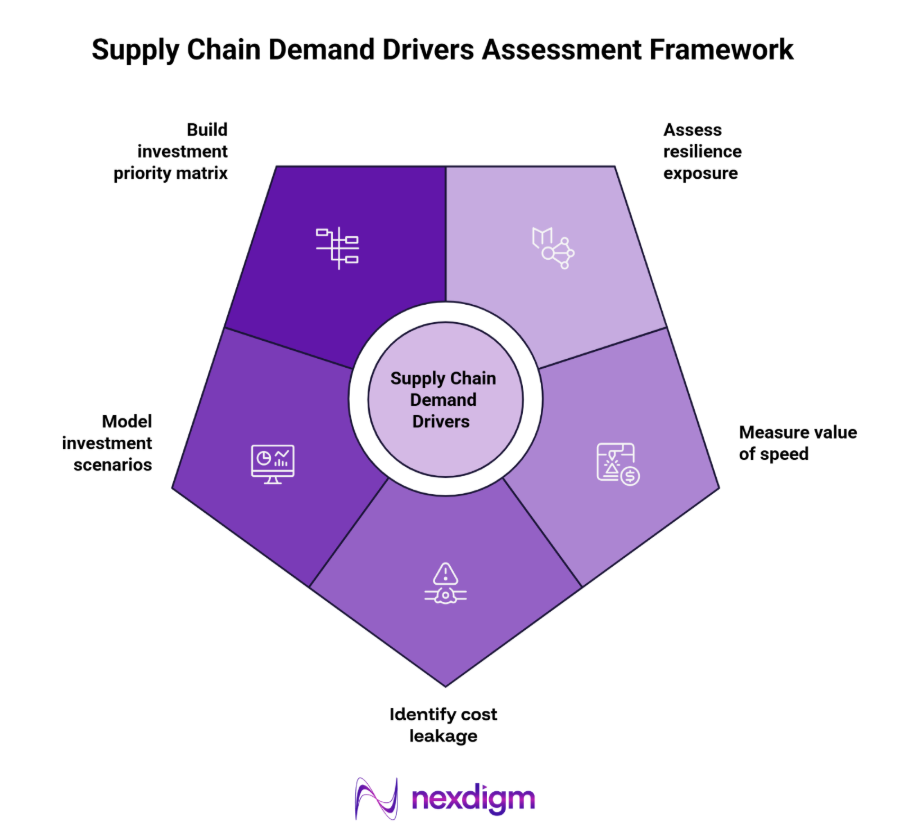
- Quantify demand volatility: Measure variability across products, customers, and markets to determine where flexibility or additional capacity is justified.
- Assess resilience exposure: Map supplier, route, inventory, and facility dependencies and estimate the financial impact of potential disruptions.
- Measure the value of speed: Connect lead-time improvements with revenue, customer service, inventory, and working-capital outcomes.
- Identify cost leakage: Benchmark transportation, warehousing, inventory, labour, and expedited logistics costs to identify recurring inefficiencies.
- Model investment scenarios: Compare infrastructure, technology, network, inventory, and supplier-diversification options using capex, opex, savings, revenue impact, and payback.
- Build an investment priority matrix: Rank initiatives according to financial return, strategic importance, risk reduction, implementation complexity, and timing.
How Nexdigm Reallocated Supply Chain Capital Toward Higher-Value Priorities
A manufacturer was preparing a ₹120 crore supply chain investment programme focused primarily on warehouse automation. Nexdigm assessed demand volatility, supplier concentration, transport costs, and service-level losses across six facilities. The analysis redirected 35% of planned capital toward inventory optimisation, alternate sourcing, and network changes. Within 18 months, logistics costs fell 9.6%, inventory reduced by 14%, and disruption recovery time improved by 37%.
To take the next step, simply visit our Request a Consultation page and share your requirements with us.
Harsh Mittal
+91-8422857704