

A purchase order is approved in seconds. The supplier confirmation may still arrive by email. A shipment can be tracked in real time while the warehouse team updates its inventory spreadsheet at the end of the day.
This unevenness defines much of supply chain digitalisation today. Companies are investing across planning, logistics, warehousing and analytics, but adoption is moving at different speeds. The commercial question is therefore becoming more specific: which processes are mature enough to benefit from further digital investment, and where is technology still running ahead of operational readiness?
In 2025 research found that 57% of operations and supply-chain leaders had integrated AI into selected functions or across the organisation, while 56% reported using cloud technologies. Yet 92% said technology investments had not fully delivered expected results. Integration complexity and data quality were among the principal barriers.
Planning Has the Cleanest Starting Point
Demand forecasting and inventory planning tend to digitise earlier because their inputs are already relatively structured.
Sales history, inventory positions, supplier lead times and order patterns can be consolidated into planning platforms and analysed continuously. Scenario planning can then test what happens when demand changes, suppliers fall behind or inventory needs to be repositioned.
The value is measurable when those insights alter purchasing, replenishment or stocking decisions. A sophisticated forecast sitting outside the operating workflow has considerably less impact.
The Physical Network Is Harder to Digitize
Warehouses require physical handling, trucks follow physical routes, and ports rely on gates, queues, and heavy equipment. While software can record these activities, digitising the core operations requires dependable event data and tight integration with the people and systems executing the work.
That is why adoption can look very different across two companies using the same technology. One may have real-time inventory visibility and automated picking. Another may still depend on manual scans and reconciliation. Technology availability does not determine process maturity by itself.
Visibility Is Becoming the Common Layer
There is a practical reason visibility platforms have attracted so much attention: supply chains generate information at every handoff.
Supplier confirmations, purchase orders, warehouse movements, vehicle locations, delivery events and customer orders can potentially feed a shared operating view. Once connected, the system can flag exceptions rather than requiring teams to discover them manually.
The challenge is integration. PwC found that 47% of respondents identified integration complexity as a barrier to technology value, while 44% pointed to data issues.
For many organisations, improving the quality and connectivity of existing data may therefore create more value than adding another standalone application.
Automation Follows Process Volume
Warehouse and transport processes become stronger candidates for automation when transactions are frequent, repetitive and sufficiently standardised.
Barcode and RFID systems can reduce manual inventory recording. Warehouse management systems can coordinate picking and replenishment. Transport platforms can automate shipment tracking, freight reconciliation and delivery documentation.
More advanced automation requires a different threshold. Robotic handling, dynamic routing or automated exception management involve greater integration and capital expenditure. Their case becomes stronger where high transaction volumes create enough recurring labour, service or capacity costs to justify the investment.
Adoption Gaps Reveal the Next Market
The most interesting opportunities may sit between highly digitised and largely manual processes.
A company might have advanced demand planning but weak supplier collaboration. It may track every truck but still reconcile freight invoices manually. It may have a warehouse management system without using the underlying data for slotting or capacity decisions.
These gaps create a more useful basis for assessing digital demand than simply counting software deployments. The question becomes what a process currently costs, what information is available, what technology can change, and whether the organisation can capture the resulting value.
Nexdigm’s Approach to Supply Chain Digitalization
Nexdigm’s supply chain digitalization market analysis can assess digital adoption across supply-chain processes and identify where further investment has the strongest commercial rationale.
Its assessment can examine:
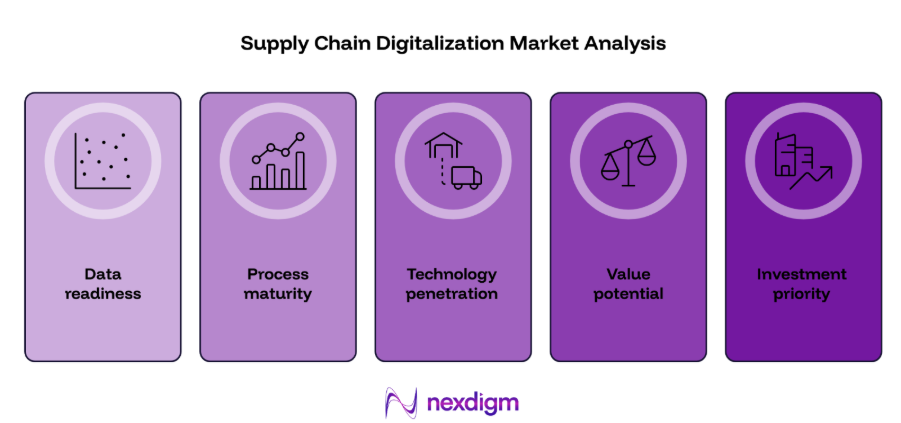
- Process maturity: Map manual, partially digitised and automated activities across planning, sourcing, warehousing and logistics.
- Technology penetration: Assess adoption of cloud platforms, analytics, visibility systems, automation and control towers.
- Data readiness: Evaluate data availability, quality, integration and frequency.
- Value potential: Quantify potential effects on cost, inventory, productivity, service levels and cycle time.
- Investment priority: Compare expected value against implementation complexity and organisational readiness.
This allows businesses to separate technology adoption from genuine digital opportunity and determine where investment should be accelerated, redesigned or deferred.
A Digital Intervention with a Measurable Outcome
Nexdigm supported a global healthcare company dealing with fragmented pricing data across more than 165 countries. By standardising data workflows, automating cleansing and analysis, and introducing a Power BI dashboard, the engagement reduced analytical turnaround time from 14.83 days to 8.9 days, a 40% reduction.
To take the next step, simply visit our Request a Consultation page and share your requirements with us.
Harsh Mittal
+91-8422857704