

Collaborative supply chain ecosystems improve efficiency and resilience across value chains by connecting suppliers, manufacturers, logistics partners, distributors, retailers, and technology providers through shared planning and coordinated execution. These ecosystems help businesses reduce disruptions, improve visibility, optimize resources, and respond faster to changing market conditions. For companies entering new markets, a strong market entry strategy must assess partner capabilities, infrastructure readiness, compliance requirements, data-sharing systems, and risk management practices.
A well-planned supply chain ecosystem collaboration strategy supports smoother market access, stronger operational control, faster scalability, and improved value chain performance across regional and international business environments.
The global supply chain management market is expected to reach USD 58.42 billion by 2030, growing from USD 38.51 billion in 2025 at 8.7% annually. Additionally, 86.2% of surveyed manufacturers reported working to de-risk supply chains, highlighting the need for stronger collaboration, visibility, and resilience in market entry strategy.
Using Ecosystem Collaboration to Improve Market Access and Scalability
Using ecosystem collaboration to improve market access and scalability helps businesses coordinate suppliers, logistics partners, distributors, and technology systems for faster entry, stronger reach, and resilient operations.
- Partner Network Development: Build coordinated relationships with suppliers, logistics partners, distributors, and service providers to improve market access.
- Shared Planning and Coordination: Align demand forecasts, inventory plans, production schedules, and delivery timelines for faster market execution.
- Technology and Data Integration: Connect digital systems for real-time visibility, order tracking, inventory control, and better decision-making.
- Distribution and Market Reach: Use ecosystem partners to access regional channels, customer clusters, and last-mile delivery networks more efficiently.
Nexdigm Supply Chain Ecosystem Assessment for Efficiency and Resilience
Nexdigm supply chain ecosystem assessment for efficiency and resilience helps businesses evaluate suppliers, logistics partners, distributors, infrastructure, technology systems, and risk controls. This supports smoother market entry, stronger coordination, improved visibility, reduced disruptions, optimized resources, and scalable operations across regional and international value chains.
Nexdigm Market Entry Strategy Through Collaborative Supply Chain Ecosystems
Nexdigm market entry strategy through collaborative supply chain ecosystems helps coordinate suppliers, logistics partners, distributors, technology systems, and compliance processes for efficient, resilient, and scalable expansion:
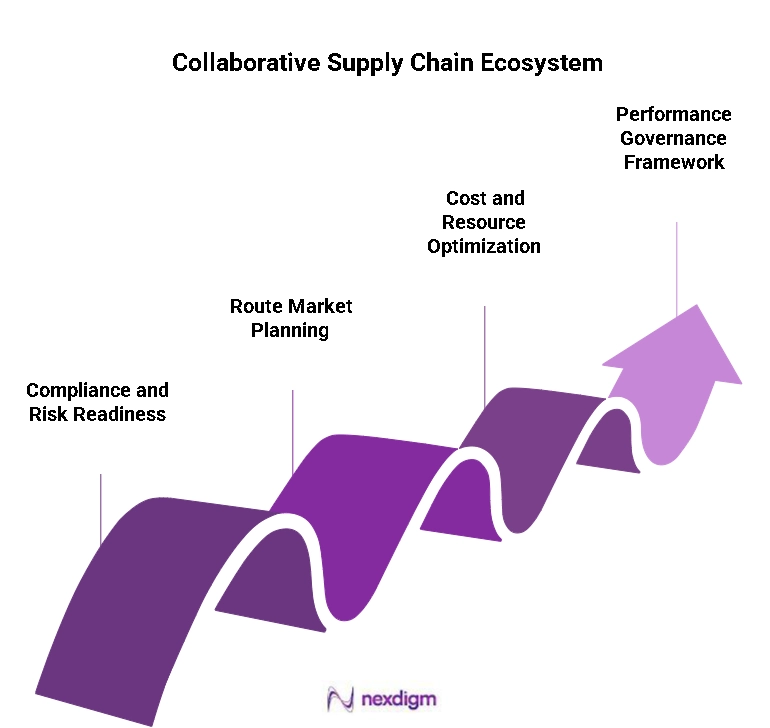
- Compliance and Risk Readiness: Nexdigm assesses regulatory requirements, documentation controls, partner risks, and disruption risks across multi-partner supply chains.
- Route Market Planning: Nexdigm supports channel selection, logistics flow design, distribution planning, and partner alignment for faster market access.
- Cost and Resource Optimization: Nexdigm helps optimize shared infrastructure, logistics resources, inventory planning, and operating costs across ecosystem partners.
- Performance Governance Framework: Nexdigm defines KPIs, review cycles, accountability structures, and escalation mechanisms to manage ecosystem-wide supply chain performance.
Nexdigm’s case:
Nexdigm supported a manufacturing company build a collaborative supply chain ecosystem before entering new markets. By aligning suppliers, logistics partners, distributors, compliance processes, and data-sharing systems, Nexdigm helped improve supply chain visibility by 32%, reduce coordination delays by 24%, and increase on-time fulfillment from 86% to 95%.
To take the next step, simply visit our Request a Consultation page and share your requirements with us.
Harsh Mittal
+91-8422857704