

The largest supply chain costs do not always appear on freight invoices. Transportation and warehousing spend may look manageable while planning errors, excess inventory, poor vehicle utilization, delays, and emergency shipments quietly erode margins.
These costs accumulate across operational handoffs. A forecast error can create excess inventory in one location and a stockout in another. A delayed truck can trigger detention charges and disrupt warehouse schedules. Poor load planning can leave vehicles moving with substantial unused capacity. Understanding these leakages requires looking at how the network operates as a whole.
The Cost of Inefficiency Extends Beyond Freight
Direct logistics expenditure is only one part of the cost-to-serve. Businesses can also incur:
- Excess inventory: Safety stock held to compensate for unreliable supply or transportation ties up working capital.
- Expedited freight: Air freight and dedicated transport are often used to recover from planning or execution failures.
- Underutilized capacity: Partially filled containers, trailers, and delivery vehicles increase the cost of every shipment.
- Detention and demurrage: Delays at warehouses and ports can create avoidable carrier and equipment charges.
- Stockouts: Poor inventory positioning can result in lost sales and retailer penalties even when total inventory levels remain high.
The challenge is identifying which of these costs are structural and which can be removed through better planning or execution.
Planning Errors Travel Through the Network
Supply chain inefficiency often begins before a shipment is booked. When demand forecasting, production scheduling, inventory planning, and transportation planning operate independently, small inaccuracies can create larger downstream distortions.
An overestimated forecast can push excess production into warehouses, increasing storage and handling requirements. An underestimated forecast can have the opposite effect, forcing emergency production, inter-depot transfers, or expedited freight.
Better coordination through Sales and Operations Planning (S&OP) can connect demand signals with production and logistics decisions, reducing the need for costly interventions later in the network.
Visibility Is Only Valuable When It Enables Action
Tracking systems can provide detailed information on vehicles, shipments, inventory, and warehouse activity. But visibility by itself does not eliminate cost.
The value comes when information changes an operational decision. A delayed inbound truck, for example, can trigger dock rescheduling before yard congestion develops. A disrupted route can prompt a cross-dock diversion. A container approaching its free-time limit can be prioritized for unloading before detention charges accumulate.
This makes the connection between visibility and execution critical. Organizations that integrate operational data with dispatch, warehouse, and transportation workflows have greater scope to prevent costs rather than simply report them.
Measure the Leakage Before Investing in Technology
Technology does not automatically resolve inefficient processes. Before investing in new planning, transportation, or warehouse systems, businesses need a clear baseline of where costs are actually being generated.
Cost-to-Serve analysis can examine performance at the SKU, customer, facility, and transportation-lane level. This helps separate technology gaps from operational problems such as poor warehouse slotting, low vehicle utilization, weak replenishment rules, or fragmented delivery routes.
The result is a more targeted technology investment, with improvements tied to measurable financial outcomes rather than software adoption alone.
Where Should Supply Chain Efficiency Be Improved First?
The strongest opportunities are usually found where operational friction and financial exposure overlap.
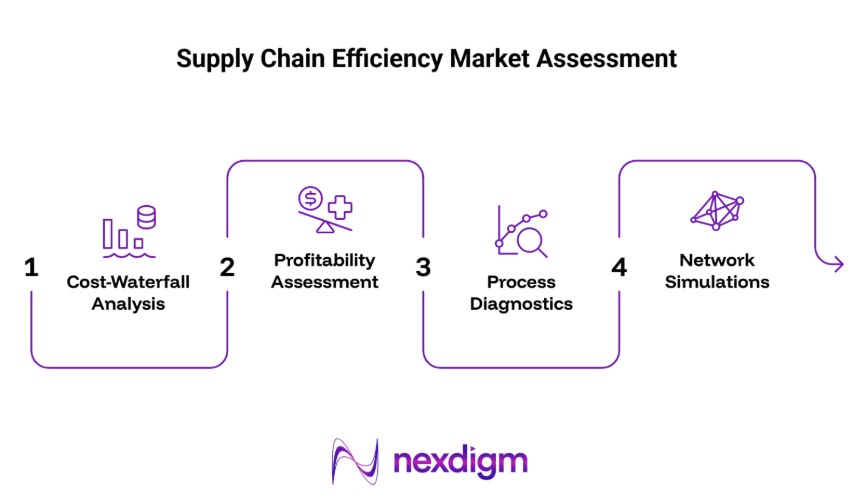
Nexdigm’s supply chain efficiency market study examines these points through :
Cost-Waterfall Analysis: Breaks down total cost layer by layer.
SKU and Customer Profitability: Shows which products/customers make or lose money.
Process Diagnostics: Finds process gaps and inefficiencies.
Network Simulations: Tests supply chain changes before implementation.
The assessment can help businesses determine:
- Where cost is leaking Trace expenditure across inventory, freight, warehousing, handling, and delivery activities.
- Which SKUs and customers drive cost: Identify products, accounts, and lanes with disproportionate cost-to-serve.
- Where capacity is being wasted: Assess vehicle utilization, warehouse productivity, dock turnaround, and delivery density.
- What is driving emergency spend: Link expedited freight and excess inventory to underlying planning or execution failures.
- Which interventions have the strongest economics: Compare network, inventory, routing, and process changes against their expected savings.
- What should be automated: Distinguish problems requiring technology from those better addressed through operational redesign
How Nexdigm Helped Recover ₹38.6 Crore in Annual Logistics Costs
A manufacturer with ₹450 crore in annual logistics spends was facing declining fill rates despite ₹310 crore tied up in inventory. Nexdigm analysed 185,000 truckload movements and identified planning, load utilization, warehouse, and routing inefficiencies.
Within 12 months, the resulting program generated ₹38.6 crore in recurring annual savings, improved OTIF from 87% to 96.5%, and released ₹62 crore in working capital.
To take the next step, simply visit our Request a Consultation page and share your requirements with us.
Harsh Mittal
+91-8422857704