
Supply chain outsourcing used to be relatively easy to divide. A logistics provider moved and stored goods. A sourcing partner worked with suppliers. Technology vendors supplied planning or visibility systems.
That separation is becoming harder to maintain.
Supply chain providers are increasingly being asked to connect decisions across procurement, planning, logistics and fulfilment. In HFS Research’s 2025 assessment, 91% of enterprise clients said they engage service providers for real-time planning, making it the most actively outsourced area across the supply chain value chain. Analytics and cloud together accounted for 57% of enterprise technology spending among the clients surveyed.
The change is also visible in India. 3PL providers accounted for more than 30% of industrial and logistics leasing in H1 2025, while around 80% of Indian 3PL players surveyed by CBRE said they planned to expand their portfolios by more than 10% over the following two to five years.
Sourcing Is Moving Closer to Supply Chain Strategy
Procurement decisions increasingly extend beyond purchase price.
Supplier concentration, lead times, freight exposure, tariffs, inventory requirements and production continuity can materially change the economics of a sourcing decision. A cheaper supplier can create a more expensive supply chain if it requires longer transport routes, larger safety stocks or costly emergency shipments.
Service providers are consequently being brought into broader sourcing decisions involving supplier assessment, total-cost modelling, risk management and category strategy.
Logistics Is Becoming More Integrated
Transportation and warehousing remain the foundation of outsourced logistics, but the scope of managed services is widening.
3PL providers are moving into fulfilment, reverse logistics, specialised shipments, inventory management and technology-enabled visibility. CBRE found that 3PLs accounted for an average 43% of industrial and logistics leasing activity in India between 2020 and 2024, reflecting the increasing physical footprint of outsourced supply-chain operations.
The next layer is orchestration. Customers increasingly expect providers to coordinate multiple logistics partners, facilities and transport modes rather than manage an isolated activity.
Planning Is Moving into the Service Relationship
Planning has become one of the fastest-growing areas of external support.
Demand forecasting, inventory planning, scenario modelling and real-time exception management increasingly sit alongside physical logistics services. HFS found that real-time planning was cited by 91% of clients engaging supply-chain service providers, ahead of supplier collaboration and automated procurement.
That changes what enterprises are buying. The requirement is increasingly for a provider that can translate operational data into decisions about inventory, capacity, suppliers and fulfilment.
Technology Is Becoming Part of the Service
Technology spending is following the same direction.
HFS estimates that analytics represented 31% of enterprise supply-chain technology spending among its 2025 client references, with cloud at 26%. GenAI accounted for 12% and agentic AI 7%, already exceeding traditional AI at 2%.
The technology itself is becoming less important than what it enables. Control towers, analytics platforms and AI tools are being incorporated into planning and execution rather than treated as separate digital projects.
For service providers, that raises the bar. Operational capability increasingly needs to sit alongside data, integration and analytical expertise.
The Market Is Moving Toward Fewer, Broader Relationships
This convergence is also changing the commercial model.
HFS describes a supply-chain services market moving toward consolidation, with enterprises seeking single accountability across larger parts of the value chain. A client may still use specialist providers, but the coordination layer becomes increasingly important.
That creates opportunities for 4PL and managed-service models, particularly where companies operate fragmented networks of carriers, warehouses, technology platforms and suppliers.
The competitive question is consequently shifting from who can perform an individual supply-chain task to who can manage the interaction between those tasks.
How Nexdigm Assesses the Changing Supply Chain Services Market
Nexdigm evaluates supply-chain services across five connected dimensions:
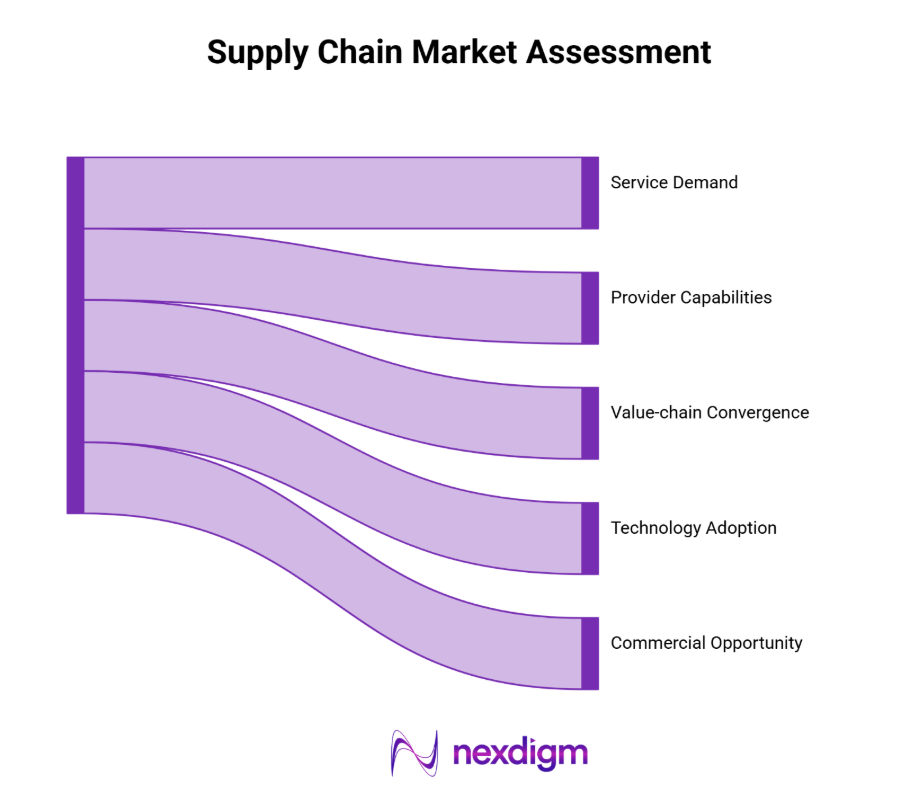
- Service demand: Identify outsourcing requirements across sourcing, logistics, planning, procurement and fulfilment.
- Provider capabilities: Benchmark service portfolios, technology capabilities, geographic coverage and sector expertise.
- Value-chain convergence: Assess where individual services are being bundled into integrated or 4PL models.
- Technology adoption: Evaluate demand for analytics, cloud, visibility, automation and emerging AI capabilities.
- Commercial opportunity: Size addressable demand, segment buyers and identify the service areas with the strongest growth potential.
A supply chain market assessment can help providers identify where the market is moving, while helping enterprises evaluate which activities to outsource, integrate or retain internally.
How Nexdigm Connected Procurement with Supply Chain Performance
For a global healthcare company dependent on an intermediary for key chemical raw materials, Nexdigm analysed spend and volumes, worked with Quality, Planning, Site and Warehouse teams, and evaluated direct manufacturer sourcing. The resulting model reduced raw-material costs by approximately 23% and shortened delivery times by up to 30%.
To take the next step, simply visit our Request a Consultation page and share your requirements with us.
Harsh Mittal
+91-8422857704