

Supply chain resilience analysis enables organizations to assess their ability to reduce disruptions affecting operations. By leveraging competitive intelligence, companies can compare their risk management strategies with industry peers, identify vulnerabilities, and adopt best practices. This approach not only minimizes operational and financial impact but also strengthens strategic decision-making, ensuring continuity, agility, and a competitive advantage in increasingly complex and unpredictable global supply chains.
Industry data shows that companies implementing supply chain resilience analysis reduce the impact of disruptions on 10–20% of operations by 15–18%, maintaining service levels despite unexpected events. Firms adopting competitor benchmarking and risk assessment strategies report 12% faster recovery times and 10% lower operational costs during disruptions.
Additionally, resilient organizations improve inventory and resource utilization by 7–10%, highlighting how data-driven resilience planning, combined with competitive intelligence, enhances continuity, efficiency, and overall supply chain performance.
Understanding The Importance of Supply Chain Resilience in a Competitive Landscape
Understanding the importance of supply chain resilience in a competitive landscape involves recognizing how robust, adaptable operations mitigate disruptions, maintain service levels, reduce costs, and provide a strategic advantage over competitors:
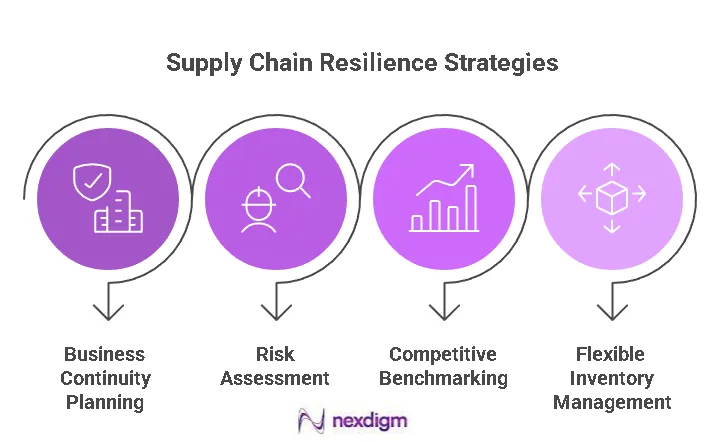
- Business Continuity Planning – Developing strategies to maintain operations during disruptions, ensuring minimal impact on service levels and customer satisfaction.
- Risk Assessment and Vulnerability Analysis – Identifying potential internal and external threats to proactively address weaknesses in the supply chain network.
- Competitive Benchmarking for Resilience – Analyzing industry peers’ resilience strategies to adopt best practices and gain a strategic advantage.
- Flexible Inventory and Resource Management – Optimizing stock levels and resource allocation to absorb shocks and maintain operational efficiency.
Optimizing Inventory, Transportation, and Supplier Strategies with Nexdigm Solutions
Optimizing inventory, transportation, and supplier strategies with Nexdigm solutions involves using data-driven analytics and competitive intelligence to enhance supply chain efficiency. Nexdigm evaluates stock levels, delivery routes, and supplier performance to minimize costs, reduce disruptions, and improve responsiveness.
By aligning resources with demand patterns and implementing best practices, organizations achieve higher operational resilience, faster deliveries, and sustained competitive advantage.
How Does Nexdigm Leverage Predictive Analytics for Proactive Risk Management?
Nexdigm leverages predictive analytics for proactive risk management by analyzing historical and real-time supply chain data, forecasting potential disruptions, enabling early interventions, minimizing operational impact, and enhancing overall resilience and efficiency.
- Data Collection and Integration – Nexdigm gathers historical, operational, and market data to create a comprehensive view for predictive modeling and risk analysis.
- Risk Forecasting Models – Advanced analytics identify potential disruptions in inventory, transportation, and supplier operations, enabling proactive mitigation strategies.
- Scenario Simulation and Planning – Nexdigm tests multiple “what-if” scenarios to evaluate impacts and optimize response strategies before disruptions occur.
- Early Warning Alerts – Predictive systems generate real-time notifications, allowing timely interventions to prevent delays and reduce operational losses.
- Decision Support Dashboards – Centralized analytics dashboards provide actionable insights, guiding managers in risk mitigation and supply chain optimization.
Nexdigm’s case:
Nexdigm partnered with a French logistics company to review transportation, warehousing, and operations. The engagement uncovered revenue leakages of ₹45 lakhs, standardized processes, and redesigned workflows, leading to improved efficiency and procedural clarity for over 90 warehouses. This structured business process review enhanced operational control and reduced inefficiencies across the client’s expansive logistics network.
To take the next step, simply visit our Request a Consultation page and share your requirements with us.
Harsh Mittal
+91-8422857704