

Automotive procurement teams are facing risks that extend beyond direct supplier relationships. Recent industry research indicates that around 60% of companies have experienced increased distress across their automotive supplier base, while another analysis found that six of 10 critical automotive inputs face their greatest vulnerability during refining and processing. These trends highlight how supplier concentration and upstream dependencies can influence sourcing continuity.
Visibility is another concern. Research across automotive supply chains found that only 57% of Tier 2 suppliers and 13% of Tier 3 suppliers surveyed had implemented supply-chain risk monitoring. As risks increasingly span suppliers, logistics networks, costs, and production capacity, supply chain risk assessment automotive procurement can help organizations identify where exposure is concentrated and prioritize appropriate mitigation.
Risk Can Build Across Multiple Procurement Dimensions
Supply-chain exposure rarely comes from a single weakness. A supplier may face capacity constraints, while the same sourcing arrangement depends on a concentrated logistics route or volatile input costs. These factors can reinforce one another and make seemingly manageable risks more significant. For automotive procurement teams, viewing supplier, logistics, cost, and capacity exposure together can provide a more realistic understanding of sourcing vulnerability and where preventive action may be needed.
Not Every Supply Risk Carries the Same Procurement Impact
A disruption does not affect every sourcing category equally. A common component with several qualified suppliers may be relatively manageable, while a specialized part with long qualification timelines can create significant production exposure. Similarly, a logistics issue may have limited consequences where alternative routes exist but become critical when transportation options are restricted. Assessing criticality, alternatives, lead times, and potential business impact can help procurement teams focus risk-management efforts where they matter most.
Nexdigm’s Role in Prioritizing Procurement Risk
Once critical exposures are identified, procurement teams need to determine where mitigation efforts can create the greatest value. Nexdigm can support this decision by bringing together supplier, market, logistics, cost, and capacity insights:
- Rank Critical Exposures: Compare risks based on severity, likelihood, component importance, and potential supply impact.
- Evaluate Available Alternatives: Examine alternate suppliers, sourcing regions, logistics routes, inventory options, and substitution possibilities.
- Connect Risk With Cost: Consider the commercial implications of mitigation choices, including additional sourcing, inventory, logistics, or supplier-development requirements.
- Guide Procurement Priorities: Translate the assessment into focused actions across supplier diversification, contingency planning, negotiations, capacity management, and ongoing monitoring.
Through supply chain risk assessment automotive procurement, Nexdigm can help organizations move from identifying multiple exposures to deciding which risks require action first and where procurement resources should be directed.
How Nexdigm Turns Risk Insights Into Procurement Value
Nexdigm can help procurement teams translate supply-chain risk findings into practical sourcing and supplier-management decisions:
- Strengthen Supplier Selection: Incorporate risk exposure alongside cost, capacity, capability, and performance when comparing sourcing options.
- Target Mitigation Efforts: Identify high-impact supplier, logistics, cost, and capacity risks where focused intervention can create the greatest value.
- Build Practical Contingencies: Use assessment findings to evaluate alternate suppliers, inventory strategies, logistics options, and capacity arrangements.
- Improve Cost-Risk Decisions: Help procurement teams understand the commercial implications of different risk-mitigation choices before committing resources.
- Support Ongoing Monitoring: Establish a basis for tracking critical exposures and changing supplier conditions over time.
Through supply chain risk assessment automotive procurement, Nexdigm can help organizations connect risk intelligence with supplier strategy, sourcing decisions, cost management, and supply continuity.
Nexdigm’s Risk-to-Action Framework for Automotive Procurement
Nexdigm can structure supply chain risk assessment automotive procurement around four connected dimensions:
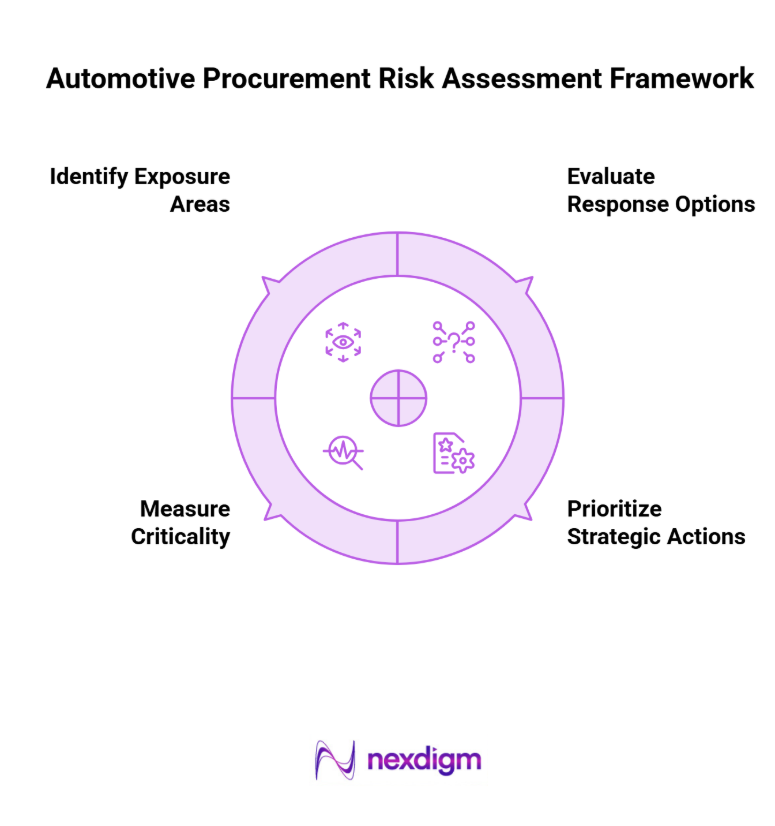
- Identify Exposure: Map supplier, logistics, cost, capacity, geographic, and dependency-related vulnerabilities.
- Measure Criticality: Evaluate each exposure based on likelihood, component importance, production impact, financial implications, and recovery difficulty.
- Evaluate Response Options: Compare alternatives such as supplier diversification, inventory buffers, logistics changes, capacity arrangements, or supplier development.
- Prioritize Action: Determine which risks require immediate mitigation, continued monitoring, contingency planning, or longer-term strategic intervention.
This framework helps procurement teams move from risk identification to practical decision-making, while giving Nexdigm a structured basis for connecting supply-chain insights with sourcing and business priorities.
Nexdigm’s Case
An automotive OEM assessed 45 critical suppliers across five regions using Nexdigm’s supply chain risk assessment automotive procurement approach. The analysis identified 24% of relationships with elevated supplier or capacity exposure, while 19% showed significant logistics or cost sensitivity. The findings helped procurement prioritize supplier diversification, contingency planning, and capacity-focused mitigation.
To take the next step, simply visit our Request a Consultation page and share your requirements with us.
Harsh Mittal
+91-8422857704