

Visibility platforms are gaining adoption as businesses prioritize end-to-end supply chain transparency across sourcing, production, warehousing, transportation, and delivery operations. As part of a market entry strategy, these platforms help companies monitor inventory movement, shipment status, supplier performance, and delivery risks in new markets.
Supply chain visibility platform expansion strategy enables businesses to reduce uncertainty, improve coordination with partners, and respond faster to disruptions or demand shifts. By using real-time data, alerts, and performance dashboards, companies can strengthen operational control, improve service reliability, and build scalable supply chain networks across domestic and cross-border markets.
The need for a Supply chain visibility platform expansion strategy is supported by rapid software adoption. The global supply chain visibility software market was estimated at USD 3.3 billion in 2025 and is expected to reach USD 10.9 billion by 2034, growing at a CAGR of 13.4%. With many businesses still lacking complete end-to-end visibility, visibility platforms are becoming essential to market entry strategy, risk control, and operational transparency.
Improving Market Entry Readiness Through Real-Time Supply Chain Transparency
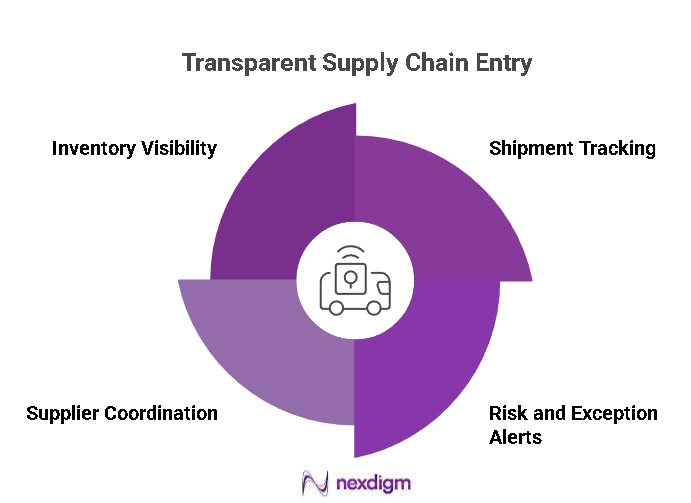
Real-time supply chain transparency improves market entry readiness by tracking inventory, shipments, suppliers, and delivery risks, enabling faster decisions, stronger coordination, and more reliable operations in new markets:
-
Inventory Visibility
Tracks stock levels across warehouses and transit points, helping businesses maintain availability during new market entry.
-
Shipment Tracking
Monitors freight movement, delivery milestones, and delays to improve control over market entry logistics operations.
-
Supplier Coordination
Improves communication with suppliers and partners by sharing real-time data on orders, timelines, and fulfilment status.
-
Risk and Exception Alerts
Identifies disruptions, delays, stockouts, and compliance risks early, enabling faster corrective action during market expansion.
Nexdigm Inventory and Shipment Visibility Assessment for Market Entry
Nexdigm can assess inventory tracking, shipment monitoring, warehouse data, supplier updates, and delivery milestone visibility for new market entry. This helps businesses identify visibility gaps, improve stock availability, reduce delays, strengthen partner coordination, and build more transparent supply chain operations across target markets.
Nexdigm Technology Partner Assessment for Visibility Platform Implementation
Nexdigm can evaluate technology partners based on platform capability, integration readiness, data security, reporting features, scalability, implementation support, and fit with supply chain visibility requirements.
-
Platform Capability Review
Assesses tracking, dashboarding, alerts, analytics, and workflow features needed for end-to-end supply chain visibility.
-
Integration Readiness
Reviews compatibility with ERP, warehouse, transport, supplier, and customer systems for smooth visibility platform implementation.
-
Data Security Assessment
Examines access controls, data protection, user permissions, and security protocols to reduce technology and compliance risks.
-
Scalability Evaluation
Evaluates whether the platform can support higher order volumes, additional markets, and expanding partner networks.
Nexdigm’s case:
Nexdigm helped a consumer goods company assess technology partners for visibility platform implementation across five supply chain locations. By evaluating platform capability, integration readiness, data security, scalability, and implementation support, Nexdigm helped the company shortlist two suitable partners, improve shipment visibility by 42%, reduce manual tracking efforts by 35%, and cut exception response time by 28%.
To take the next step, simply visit our Request a Consultation page and share your requirements with us.
Harsh Mittal
+91-8422857704