

A shipment moving between a manufacturer, warehouse, carrier and customer generates information at every stage. However, this information is often distributed across different systems, making it difficult for businesses to establish a consistent view of inventory positions, shipment status and delivery timelines. Supply chain visibility platforms address this problem by bringing operational data together and making it accessible across supply chain functions.
Selecting the right platform requires an assessment of data integration, shipment tracking, inventory visibility, predictive capabilities and interoperability with external logistics partners.
Why Supply Chain Visibility Platforms Matter
Limited shipment visibility can affect inventory planning, customer commitments and transportation decisions. A delayed shipment may remain undetected until a carrier provides an update, while discrepancies between warehouse and enterprise systems can create inaccurate inventory records.
A visibility platform helps organisations consolidate information from transportation management systems, warehouse management systems, enterprise resource planning platforms, carriers, suppliers and connected devices.
The need for interoperability is particularly important in supply chains involving multiple organisations. GS1’s Electronic Product Code Information Services (EPCIS) standard provides a common approach to capturing and sharing information about products and assets as they move through business processes. EPCIS 2.0 also supports sensor-related information, including temperature and shock data.
This creates a useful reference point when evaluating platforms expected to exchange information across different supply chain participants.
What Separates Strong Visibility Platforms?
Not all platforms provide the same level of transparency. Some primarily track transportation milestones, while others combine shipment monitoring, inventory intelligence, supplier data and predictive analytics.
The evaluation should begin with the organisation’s visibility requirements.
- Shipment tracking and monitoring: The platform should provide shipment locations, estimated arrival times, milestone updates and exception notifications. Procurement teams should establish whether tracking data is obtained directly from carriers, telematics devices, APIs or manual updates.
- Inventory visibility: Businesses should be able to view stock positions across warehouses, distribution centres and other storage locations. The system should support inventory reconciliation and identify discrepancies between recorded and actual stock movements.
- Predictive capabilities: Advanced platforms may use historical shipment data, traffic information, weather conditions and operational patterns to identify potential delays. However, procurement teams should test the accuracy of these predictions rather than relying on demonstrations.
- Data interoperability: The platform should support integration with existing enterprise systems and external logistics partners. Standards such as GS1 EPCIS can help establish a consistent structure for exchanging supply chain event information.
Evaluating Integration, Scalability and Reporting
Integration often determines whether a visibility platform can deliver meaningful operational value.
A system that cannot reliably exchange data with carrier portals, warehouse applications and enterprise platforms may create another information silo rather than eliminate existing ones.
Procurement teams should examine API availability, EDI support, data synchronisation frequency, event standardisation and integration maintenance requirements.
Scalability should also be assessed against expected shipment volumes, additional warehouses, new geographical markets and increasing numbers of trading partners.
Reporting capabilities deserve equal attention. Useful dashboards should provide visibility into on-time delivery, inventory accuracy, shipment exceptions, dwell time and carrier performance. Businesses should also be able to customise reporting according to product categories, distribution regions and operational priorities.
Security and data governance are additional considerations. The vendor should explain how it manages access permissions, sensitive commercial information, data retention and third-party integrations.
Comparing Visibility Platforms Against Business Requirements
A platform should be selected based on the operational problems it is expected to solve, not simply the number of features it offers.
For example, a manufacturer with a complex supplier network may prioritise inbound shipment visibility and supplier event tracking. An e-commerce business may place greater emphasis on last-mile tracking, estimated delivery times and customer notifications.
Procurement teams should also evaluate implementation requirements, subscription models, transaction-based charges, onboarding costs and ongoing technical support.
A proof of concept using actual shipment and inventory data can help determine whether the platform provides reliable information across the organisation’s operating environment.
Supply Chain Visibility Platform Evaluation Framework
A structured supply chain visibility platform supplier comparison should assess providers across six areas:
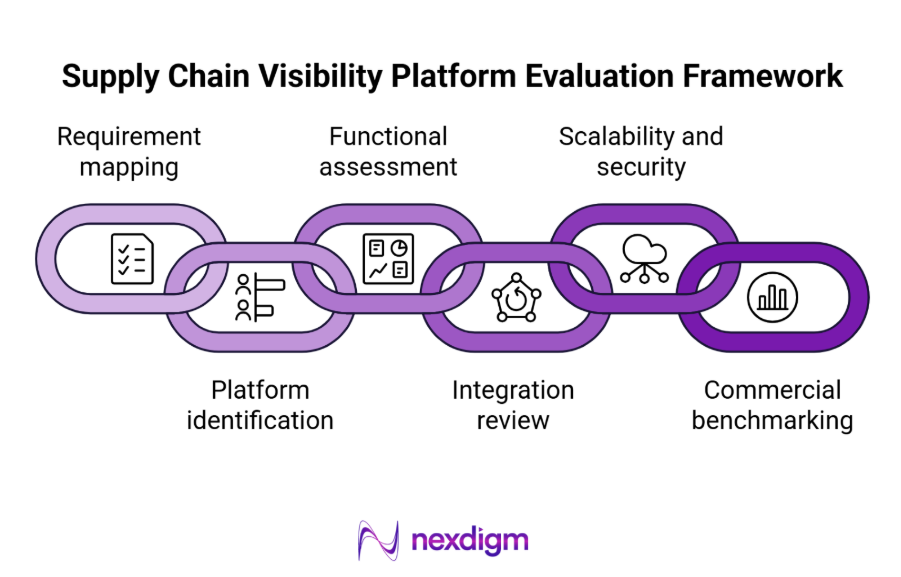
- Requirement mapping: Identify visibility requirements across shipments, inventory, suppliers and distribution locations.
- Platform identification: Map providers according to shipment tracking, inventory visibility and supply chain intelligence capabilities.
- Functional assessment: Compare milestone tracking, exception management, predictive alerts and reporting.
- Integration review: Evaluate ERP, WMS, TMS, carrier and supplier connectivity.
- Scalability and security assessment: Review transaction capacity, geographical coverage, access controls and data governance.
- Commercial benchmarking: Compare licensing, implementation, integration and ongoing support costs.
Nexdigm can support organisations through technology market research, platform benchmarking, supplier intelligence and procurement assessments. The objective is to help businesses compare visibility solutions against operational requirements and identify platforms capable of improving supply chain transparency.
Nexdigm’s Case Study: Bringing Disconnected Supply Chain Data Together
Nexdigm assessed 9 visibility platform providers across 4 supply chain requirements, comparing shipment tracking, inventory visibility and integration capabilities. The research shortlisted 3 platforms, identified a 21% variation in implementation costs and established 6 performance benchmarks for technology selection.
To take the next step, simply visit our Request a Consultation page and share your requirements with us.
Harsh Mittal
+91-8422857704