

Surgical device penetration is accelerating as adoption of advanced procedures continues to rise across hospitals, specialty clinics, and surgical centers. Growing demand for minimally invasive surgeries, robotic-assisted procedures, faster recovery, and improved clinical precision is encouraging healthcare providers to adopt advanced surgical technologies.
For companies entering this space, a structured market entry strategy is essential to assess procedure volumes, regulatory requirements, surgeon adoption, pricing, reimbursement, distribution channels, and training needs. A focused Surgical device market penetration strategy helps manufacturers expand adoption, build provider confidence, strengthen commercialization plans, and improve access to advanced surgical care across competitive healthcare markets.
Recent statistics show strong momentum in surgical device adoption. The minimally invasive surgical instruments market is projected to grow from USD 31.7 billion in 2024 to USD 49.9 billion by 2029, at a 9.5% annual growth rate. Surgical robots are also expanding, with the market valued at USD 13.69 billion in 2025 and expected to reach USD 27.14 billion by 2030.
Surgical Device Market Penetration Strategy for Advanced Procedure Adoption
Surgical Device Market Penetration Strategy for Advanced Procedure Adoption focuses on assessing procedure demand, surgeon readiness, regulatory requirements, pricing, training needs, distribution channels, and hospital adoption barriers:
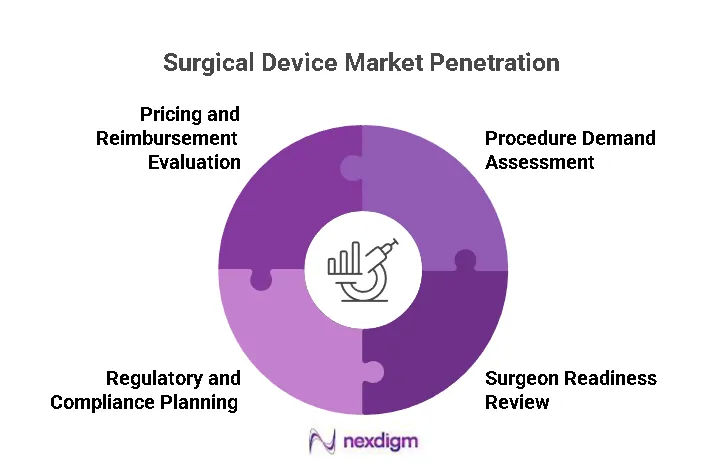
- Procedure Demand Assessment: Evaluates surgical volumes, specialty needs, patient demand, and hospital interest in advanced procedure adoption.
- Surgeon Readiness Review: Assesses surgeon familiarity, training needs, usage confidence, and willingness to adopt advanced surgical devices.
- Regulatory and Compliance Planning: Reviews approvals, product classification, documentation, clinical safety requirements, and market-specific compliance obligations.
- Pricing and Reimbursement Evaluation: Assesses hospital budgets, payer coverage, procedure costs, competitive pricing, and reimbursement pathways for adoption.
Nexdigm’s Clinical Evidence Expertise for Surgical Device Acceptance
Nexdigm’s Clinical Evidence Expertise for Surgical Device Acceptance helps companies define the clinical data, pilot outcomes, safety evidence, procedure benefits, and provider validation needed to support surgical device adoption.
Nexdigm enables stronger market entry planning by aligning evidence requirements with hospital expectations, regulatory needs, reimbursement considerations, and surgeon confidence.
Nexdigm’s Training and Onboarding Strategy for Surgeons and Operating Teams for penetration
Nexdigm’s Training and Onboarding Strategy for Surgeons and Operating Teams supports market penetration by building surgeon confidence, improving device handling, standardizing procedure workflows, and enabling faster adoption across hospitals.
- Operating Team Readiness: Assesses nurses, technicians, and support staff readiness for device setup, handling, sterilization, and procedure assistance.
- Workflow Standardization: Creates consistent usage protocols, safety steps, documentation processes, and troubleshooting guidance for operating room teams.
- Hands-On Demonstration Support: Plans practical training sessions, simulations, product demonstrations, and supervised usage to build clinical confidence.
- Adoption Feedback Tracking: Monitors usage rates, surgeon feedback, training effectiveness, and adoption barriers to improve market penetration.
Nexdigm’s case:
Recently, Nexdigm engaged with a surgical device company to strengthen training and onboarding for surgeons and operating teams before market penetration. The assessment found that 54% of surgeons required hands-on product demonstrations, 41% of operating room staff needed workflow training, and 33% of hospitals lacked standardized usage protocols.
To take the next step, simply visit our Request a Consultation page and share your requirements with us.
Harsh Mittal
+91-8422857704