

In the global climate challenges, sustainable agriculture has become a critical area of focus for ensuring long-term food security and environmental health. Benchmarking sustainability practices across agriculture systems provides a structured approach to evaluate and compare the effectiveness of different farming practices, such as soil conservation, water management, and energy efficiency. This process not only identifies the most efficient methods to combat climate change but also fosters innovation within the agricultural sector.
When integrated with competitive intelligence, sustainable agriculture benchmarking offers valuable insights into how various agricultural systems adapt to climate pressures, enabling stakeholders from farmers to policymakers to stay ahead of trends, enhance operational efficiency, and optimize resource use. By leveraging this intelligence, agricultural businesses and organizations can better navigate the evolving landscape of climate resilience and sustainability.
As per the reports, approximately 25% of global greenhouse gas emissions come from agriculture, highlighting the urgent need for sustainable practices. Studies show that adopting sustainable farming techniques can reduce emissions by up to 30% while improving soil health and biodiversity.
Furthermore, the Food and Agriculture Organization (FAO) reports that climate change could reduce crop yields by 10-25% by 2050, emphasizing the importance of benchmarking and improving agricultural practices to enhance climate resilience and ensure food security.
Using Competitive Intelligence to Identify Climate-Resilient Farming Techniques
Using competitive intelligence in agriculture involves analyzing market trends, innovations, and environmental data to identify farming techniques that are resilient to climate change, helping businesses adapt and improve sustainability and productivity.
-
Analyzing Competitors’ Practices
Studying competitors’ innovative strategies helps understand successful climate-resilient farming techniques and their impact on agricultural productivity.
-
Technological Advancements in Farming
Technology like AI, sensors, and drones provide data to optimize water usage and crop growth, boosting climate resilience.
-
Adopting Sustainable Farming Practices
Sustainable practices such as crop rotation, agroforestry, and organic farming contribute to soil health and climate resilience.
-
Risk Management and Adaptation
CI aids in understanding potential climate risks and how other farmers adapt, allowing for better risk management strategies.
Nexdigm’s Assessment of Climate Pressures on Agricultural Systems
Nexdigm’s assessment of climate pressures on agricultural systems involves analyzing the impact of changing weather patterns, extreme events, and environmental stressors on crop yields, soil health, and water resources. By leveraging advanced data analytics, Nexdigm identifies vulnerabilities, recommends climate adaptation strategies, and supports the development of resilient, sustainable agricultural practices to mitigate the effects of climate change on farming systems.
How Can Nexdigm Support the Adoption of Climate Sustainability Practices in Agriculture?
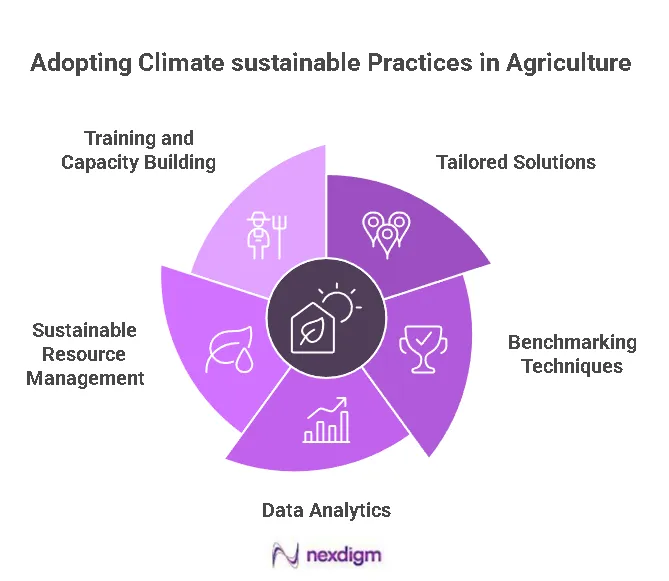
Nexdigm supports the adoption of climate-smart practices by providing tailored solutions, benchmarking effective strategies, leveraging data analytics, and promoting sustainable techniques that enhance agricultural resilience to climate change impacts:
-
Tailored Solutions for Climate-Smart Agriculture
Nexdigm customizes strategies based on regional climate risks, ensuring agricultural systems adopt climate-resilient practices specific to their needs.
-
Benchmarking Effective Climate-Smart Techniques
Nexdigm benchmarks best practices from global agricultural systems, helping farmers implement proven methods for enhanced climate resilience.
-
Leveraging Data Analytics for Climate Resilience
Nexdigm uses advanced data analytics to assess climate risks, optimizing farming practices and boosting resilience against extreme weather events.
-
Sustainable Resource Management
Nexdigm focuses on water, soil, and energy conservation, promoting practices that ensure efficient use of resources under climate stress.
-
Training and Capacity Building
Nexdigm provides training to farmers, enabling them to understand and apply climate-smart techniques that enhance productivity and sustainability.
Nexdigm’s case:
Nexdigm successfully partnered with a large agricultural cooperative to enhance climate resilience through data-driven strategies. By implementing advanced analytics, the cooperative saw a 15% increase in crop yields and reduced water usage by 20% over two seasons. The integration of climate-smart practices such as crop rotation and efficient irrigation techniques helped mitigate the impact of droughts and extreme weather, ensuring sustainable productivity under climate pressures.
To take the next step, simply visit our Request a Consultation page and share your requirements with us.
Harsh Mittal
+91-8422857704