
Sustainable farming becomes commercially interesting when it changes the farm’s economics. A practice that reduces water use, fertilizer expenditure, diesel consumption, or labour requirements can create a financial reason for adoption even when the crop continues to be sold at a conventional market price.
This matters because most sustainable practices do not automatically generate a consumer premium. The commercial case is often built inside the farm itself, through lower operating costs and more efficient use of resources.
The Strongest Business Case May Come from Saving Inputs
Direct Seeded Rice, micro-irrigation, biological inputs, and laser land levelling illustrate different routes to commercial value.
Direct Seeded Rice can reduce irrigation requirements by approximately 20% to 30% while eliminating some puddling and transplanting costs. The resulting savings can reach ₹2,500–₹4,000 per acre, although poor weed management can create significant yield risk.
Micro-irrigation can reduce water consumption by 30% to 45% and support precision fertigation, with potential reductions of 20% to 25% in synthetic fertilizer use. In high-value crops, the capital investment can potentially achieve payback within 14–24 months under the researched economics.
Bio-stimulants and bio-fertilizers can reduce chemical fertilizer expenditure where they successfully complement or partially replace conventional nutrient inputs. Laser land levelling can reduce pumping hours and subsequent tractor fuel requirements.
The common factor is not the environmental label. It is measurable resource efficiency.
Sustainability Does Not Mean Every Practice Works Everywhere
The economics change significantly by crop, farm size, irrigation access, labour availability, and capital structure.
A drip system may have an attractive payback in commercial horticulture but be harder to justify for a low-value rainfed crop. Direct seeding can reduce labour and water costs, but poor execution can create yield losses. A laser leveller can deliver immediate savings when a service provider has enough acreage to maintain high utilisation, but individual ownership may not be viable for a small farm.
Adoption should therefore be assessed according to the conditions under which a practice creates positive cash flow.
Where the Commercial Case Can Break
There are several barriers between technical performance and large-scale adoption.
- Upfront investment: Equipment such as laser levellers, zero-till seeders, and drip systems can exceed what smallholders are willing or able to finance.
- Transition risk: Some practices can create yield uncertainty during the first one or two seasons.
- Knowledge requirements: The economic benefit may disappear if application, irrigation scheduling, or weed management is poorly executed.
- Service availability: Smallholders may need access through FPOs, Custom Hiring Centres, or rural entrepreneurs rather than ownership.
- Premium uncertainty: More than 90% of crops produced through practices such as conservation tillage, DSR, or micro-irrigation may still enter conventional markets without a distinct sustainability premium.
This makes resource savings more dependable as a commercial driver than speculative green premiums.
The Question Is Which Practices Can Scale, Not Which Are Most Sustainable
A sustainable agriculture market assessment can identify practices where environmental improvement and farm economics reinforce each other. Nexdigm can assess resource savings, farm-level cash flow, technology costs, adoption barriers, financing, service availability, and supply-chain requirements.
The assessment can distinguish practices that are economically viable through direct farm savings from those that require subsidies, premium markets, contract farming, or third-party service models to become commercially attractive.
Nexdigm’s Framework for Commercial Sustainability
Nexdigm structures the assessment across five analytical dimensions:
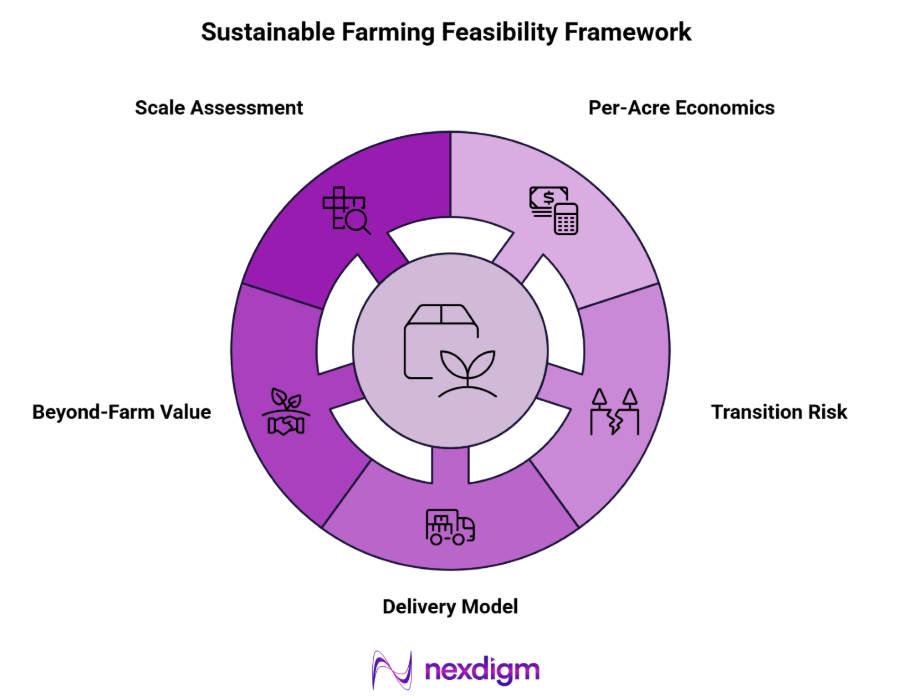
- Per‑Acre Economics: Water, fertilizer, electricity, diesel, labour, machinery, and other operating costs are compared before and after adoption to establish the direct financial benefit available to the farmer.
- Transition Risk: Yield changes, learning requirements, crop‑cycle disruption, and implementation quality are assessed across the first one to two seasons to evaluate short‑term uncertainty that may hinder adoption despite strong long‑term economics.
- Delivery Model: Where individual ownership is uneconomic, options such as Custom Hiring Centres, FPO‑led services, equipment rental, contract farming, and input provider partnerships are considered to distribute costs across multiple farms.
- Beyond‑Farm Value: Certification, traceability, buyer requirements, export access, financing, and sustainability linked procurement are analysed as incremental sources of value rather than assumed premiums.
- Scale Assessment: Adoption rates, service capacity, financing requirements, resource savings, and crop‑level economics are modelled to determine whether a practice can scale from pilot acreage to a commercially meaningful supply chain.
Together, these dimensions connect farm‑level economics with transition feasibility, delivery mechanisms, extended value capture, and scalability, enabling Nexdigm to identify practices that can achieve sustainable adoption and commercial impact.
Nexdigm Case Study: Making Resource Efficiency Pay
A resource-conservation and smart-irrigation study covered 2,200 contracted acres of commercial cash-crop production. The programme deployed scheduled drip-fertigation systems and reported a 32% reduction in aggregate water usage, a 24% reduction in agricultural electricity consumption, and a 14% improvement in crop-size uniformity.
The commercial significance was that the model did not depend on consumers paying a sustainability premium. The economics were generated through resource efficiency and improved production consistency.
For agribusinesses, lenders, and contract-farming operators, this illustrates how sustainable farming can be evaluated as an investment decision: quantify the resource savings, establish the transition risk, build the delivery model, and determine whether the economics remain attractive when deployed across a larger acreage.
To take the next step, simply visit our Request a Consultation page and share your requirements with us.
Harsh Mittal
+91-8422857704