

Sustainability commitments are increasingly translating into tangible investment decisions across factories, supply chains, and industrial operations. The transition is measurable: global investment in clean energy reached approximately $2.2 trillion in 2025, nearly twice the amount directed toward fossil-fuel supply, according to the IEA.
Renewable capacity additions also reached a record 800 GW in 2025, while spending on clean-energy manufacturing capacity approached $245 billion. These trends indicate that sustainability is moving beyond corporate reporting toward equipment purchases, facility upgrades, energy-efficiency projects, electrification, renewable power integration, and low-carbon production technologies.
For manufacturers, the opportunity lies in understanding where these commitments are creating actual procurement and capital expenditure. Assessing policy incentives, customer requirements, technology adoption, energy economics, emissions pressures, and investment pipelines can help identify markets where ESG priorities are becoming measurable industrial demand.
Sustainability Investments Are Reshaping Manufacturing Priorities
As sustainability objectives become increasingly integrated into business strategy, manufacturers are directing greater investment toward cleaner and more efficient operations. Energy-efficient equipment, renewable energy integration, emissions reduction initiatives, and circular production models are becoming important components of manufacturing transformation. These investments not only support sustainability goals but also influence competitiveness, operational performance, and long-term business resilience.
Identifying Where Sustainability Demand Is Emerging
The growth of sustainability-led manufacturing demand is influenced by a combination of regulatory, commercial, and technological factors. Government incentives, corporate ESG commitments, customer sustainability expectations, and advancements in clean technologies are accelerating investment across industrial sectors. Understanding how these factors interact helps businesses identify markets where sustainability priorities are translating into measurable procurement activity, capital expenditure, and industrial development opportunities.
Nexdigm Helping Businesses Understand Sustainability Demand
As sustainability demand becomes increasingly visible through procurement activity, capital investments, and industrial expansion, businesses need a structured way to evaluate where the strongest opportunities exist. Nexdigm helps organizations move beyond broad sustainability trends by assessing the commercial, regulatory, and market factors driving adoption.
By analyzing investment pipelines, technology uptake, customer requirements, and policy support, Nexdigm helps businesses identify markets where sustainability commitments are translating into tangible manufacturing and growth opportunities.
Nexdigm’s Sustainable Manufacturing Demand Analysis Framework
As businesses seek to capture sustainability-led growth, understanding where demand is translating into actual purchasing and investment activity becomes increasingly important. Nexdigm’s Sustainable manufacturing demand analysis framework follows a structured process to identify markets, industries, and applications:
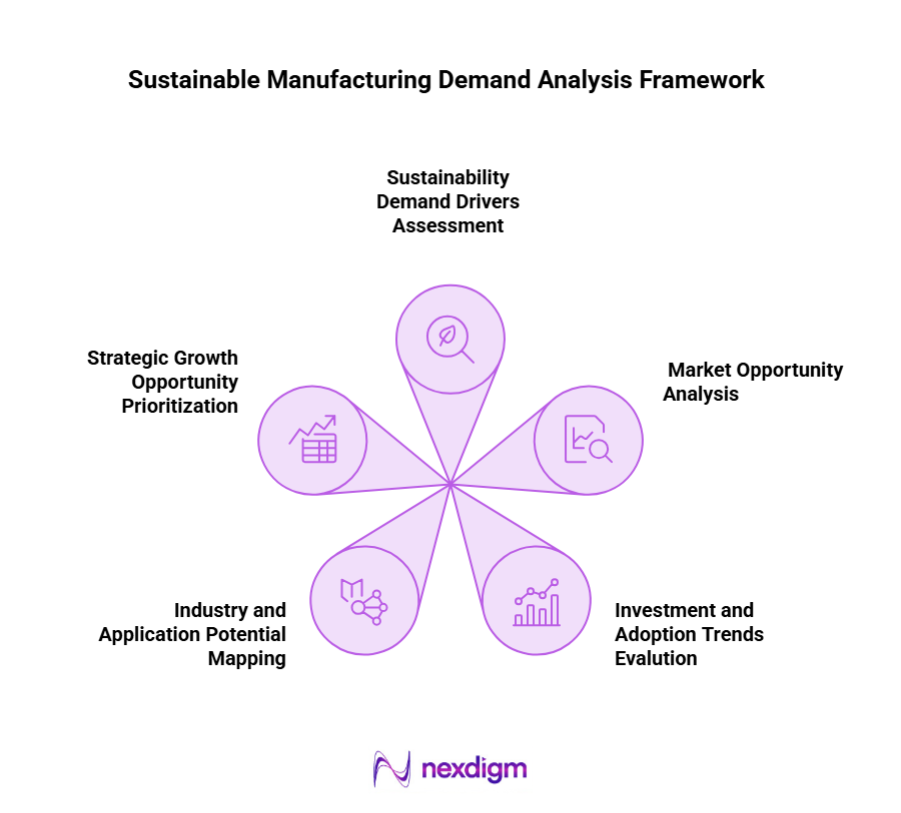
- Assess Sustainability Demand Drivers: Evaluate policy initiatives, customer expectations, ESG commitments, decarbonization targets, and industry trends influencing demand for sustainable manufacturing solutions across key markets.
- Analyze Market Opportunities: Assess market size, growth potential, adoption rates, customer requirements, and commercial attractiveness to identify sustainability-driven opportunities with stronger demand prospects.
- Evaluate Investment and Adoption Trends: Examine capital investments, technology deployment, industrial projects, and sustainability initiatives to understand where demand is converting into measurable market activity.
- Map Industry and Application Potential: Identify industries, end-use sectors, and applications where sustainability objectives are driving procurement decisions, operational changes, and manufacturing investments.
- Prioritize Strategic Growth Opportunities: Compare opportunities based on market attractiveness, competitive conditions, organizational capabilities, and long-term business objectives to support strategic decision-making.
Through this structured approach, Nexdigm helps businesses identify where sustainability commitments are becoming measurable industrial demand and where the strongest opportunities for long-term growth exist.
Industrial Applications of Nexdigm’s Sustainable Manufacturing Demand Analysis
Nexdigm’s Sustainable manufacturing demand analysis supports businesses across a range of industries by identifying where sustainability priorities are creating measurable demand and investment opportunities. Such as:
- Renewable Energy Manufacturing: Assess demand opportunities across solar, wind, energy storage, and supporting clean energy equipment manufacturing value chains.
- Low-Carbon Materials: Evaluate growth potential for sustainable materials, recycled inputs, and lower-emission alternatives used across industrial sectors.
- Energy-Efficient Technologies: Identify opportunities linked to industrial automation, efficient equipment, electrification solutions, and resource optimization technologies.
- Circular Economy Solutions: Analyze demand for recycling, waste recovery, remanufacturing, and resource-efficiency initiatives supporting sustainable production models.
- Industrial Decarbonization Applications: Examine opportunities emerging from emissions reduction initiatives, cleaner production processes, and sustainability-focused industrial investments.
By understanding how sustainability trends influence different industrial applications, businesses can better prioritize growth opportunities and align investment strategies with evolving market demand.
Why Businesses Partner With Nexdigm
Businesses choose Nexdigm for its ability to combine sustainability intelligence, market assessment, and strategic advisory into actionable business insights. Through its Sustainable manufacturing demand analysis, Nexdigm helps organizations evaluate emerging opportunities, understand industry-specific demand drivers, assess commercial viability, and prioritize investments. This enables businesses to make informed decisions that align sustainability ambitions with growth objectives, competitive positioning, and long-term value creation.
Nexdigm’s Case
Nexdigm supported an industrial client assessing sustainability-driven investment opportunities across clean energy and resource efficiency. The engagement evaluated 17+ applications, assessed 30+ market and demand indicators, and identified priority opportunities, helping reduce the initial opportunity set by 36% and sharpen investment priorities.
To take the next step, simply visit our Request a Consultation page and share your requirements with us.
Harsh Mittal
+91-8422857704