

Financial institutions are increasingly expected to assess the environmental and social impact of their procurement decisions alongside cost, quality, and operational risk. The 2026 EcoVadis Sustainable Procurement Barometer found that 98% of surveyed companies have started embedding ESG data into procurement processes, while only 48% have visibility into ESG practices across most Tier 1 suppliers. Furthermore, 30% of suppliers still do not report emissions data.
The OECD’s 2026 Responsible Business Outlook also highlights a gap between supplier expectations and actual risk evaluation. These findings underline the need for sustainable procurement in financial services to move beyond policy commitments towards structured supplier evaluation, measurable performance, and informed sourcing decisions.
Why Sustainable Procurement Matters for Financial Institutions
Banks, insurers, and other financial institutions engage suppliers across technology, facilities, consulting, outsourcing, infrastructure, and business services. These relationships influence operating costs, service continuity, regulatory exposure, and environmental and social outcomes. Integrating sustainability into procurement enables institutions to evaluate suppliers more comprehensively, identify supply-chain vulnerabilities, strengthen accountability, and align purchasing decisions with long-term business and responsible-business objectives.
Considerations That Shape Sustainable Supplier Selection
Financial institutions can integrate sustainability into procurement by evaluating suppliers across four connected dimensions:
- Environmental and Social Responsibility: Examine emissions, resource consumption, labour practices, human rights safeguards, diversity, and environmental management commitments.
- Commercial and Cost Competitiveness: Assess pricing structures, total cost of ownership, lifecycle expenses, resource efficiency, and long-term financial viability.
- Risk and Regulatory Alignment: Review governance practices, compliance records, supply-chain transparency, business continuity, and exposure to environmental and social risks.
- Supplier Performance and Accountability: Monitor service quality, sustainability targets, delivery consistency, reporting accuracy, and progress against agreed performance indicators.
Considering these dimensions together helps institutions avoid treating sustainability as a standalone procurement criterion and incorporate it into broader supplier decisions.
Nexdigm’s Expertise in Supporting Sustainable Procurement
Nexdigm supports financial institutions in translating sustainability objectives into practical procurement assessments. Our approach towards sustainable procurement in financial services connects supplier intelligence and performance evaluation through four complementary lenses:
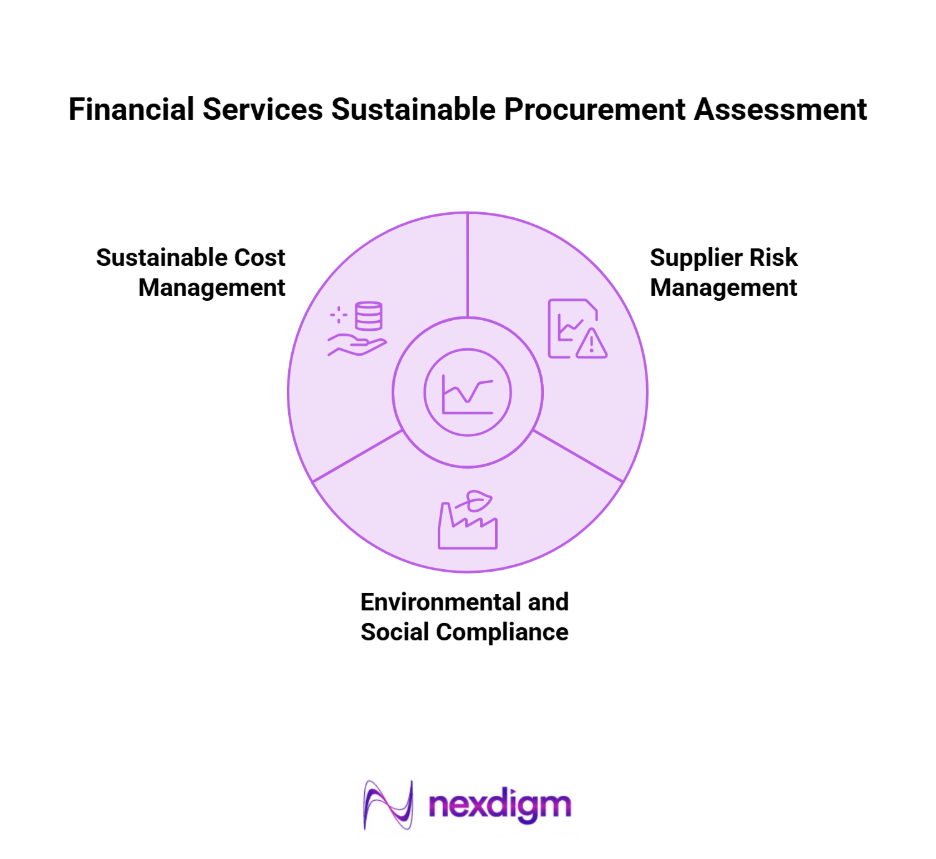
- Environmental and Social Compliance: Assess suppliers’ environmental policies, emissions, resource consumption, labour practices, human rights safeguards, and adherence to relevant sustainability standards.
- Sustainable Cost and Resource Management: Evaluate pricing, lifecycle costs, resource efficiency, material consumption, and operational expenses to balance sustainability objectives with commercial viability.
- Supplier Risk and Performance Management: Monitor supplier governance, regulatory compliance, supply-chain dependencies, service quality, sustainability disclosures, and performance indicators to support responsible supplier relationships.
Addressing these areas enables financial institutions to incorporate sustainability into supplier selection, procurement governance, and ongoing vendor management.
Why Financial Institutions Choose Nexdigm for Sustainable Procurement
Effective sustainable procurement in financial services requires more than ESG assessments; it demands reliable market insights and a clear understanding of commercial and supplier considerations. Financial institutions can benefit from Nexdigm’s support through:
- Research-Backed Decision Support: Gain access to structured supplier intelligence, market research, and benchmarking insights to support evidence-based procurement decisions.
- Commercially Grounded Perspectives: Evaluate sustainability priorities alongside cost competitiveness, supplier capabilities, operational requirements, and long-term sourcing objectives.
- A Broader Supplier Market View: Understand supplier landscapes, emerging alternatives, market positioning, and potential supply-chain dependencies to support informed sourcing strategies.
By bringing these perspectives together, Nexdigm helps financial institutions make procurement decisions that balance sustainability ambitions with commercial value, supplier reliability, and long-term business priorities.
How Nexdigm Drives Sustainable Procurement Priorities Into Business Value
Building on its supplier intelligence and commercially grounded assessments, Nexdigm helps financial institutions convert sustainability objectives into actionable procurement improvements by offering the following benefits:
- Improved Supplier Visibility: Nexdigm’s supplier research and market intelligence help institutions gain better visibility into ESG practices, sustainability disclosures, and supply-chain dependencies.
- Strengthened Sourcing Decisions: Through cost analysis and supplier benchmarking, Nexdigm helps compare providers across commercial competitiveness, sustainability maturity, and operational capabilities.
- Support towards Long-Term Supplier Performance: Nexdigm’s comparative assessments help identify supplier gaps, evaluate improvement opportunities, and inform ongoing procurement and vendor management priorities.
By connecting sustainability insights with supplier and commercial intelligence, Nexdigm helps financial institutions make more informed sourcing decisions and build a responsible, resilient, and commercially balanced supplier ecosystem.
Nexdigm’s Case
A financial institution aimed to integrate sustainability into its procurement process while maintaining cost and operational efficiency. Nexdigm conducted supplier landscape research and comparative assessments across ESG practices and service capabilities. The evaluation identified 32% of reviewed suppliers as demonstrating strong alignment with the institution’s requirements and 16% required further assessment of ESG disclosures or operational capabilities. These insights supported a more structured supplier evaluation process and informed responsible sourcing decisions.
To take the next step, simply visit our Request a Consultation page and share your requirements with us.
Harsh Mittal
+91-8422857704