

In an increasingly competitive business landscape, expanding into a new market is no longer just about identifying growth opportunities. Organizations must carefully assess market attractiveness, competitive intensity, customer demand, regulatory complexity, and long-term scalability before committing resources. A structured target market evaluation process enables businesses to make data-driven decisions, minimize risks, and maximize return on investment.
Also, a strong target market evaluation process helps businesses identify potential markets that align with their capabilities, growth objectives, and risk appetite. By consistently evaluating key market factors, organizations can prioritize the most promising opportunities and build a more effective expansion strategy.
Why Target Market Evaluation Is Critical for Business Growth
Businesses often face the challenge of selecting a high-potential market. It seems to be a major task before entering into the competitive market. An effective target market evaluation process helps organizations:
- Prioritize markets with the highest growth potential
- Understand customer demand and purchasing behavior
- Assess competitive dynamics
- Identify regulatory and operational challenges
- Optimize resource allocation
- Develop a targeted market entry strategy
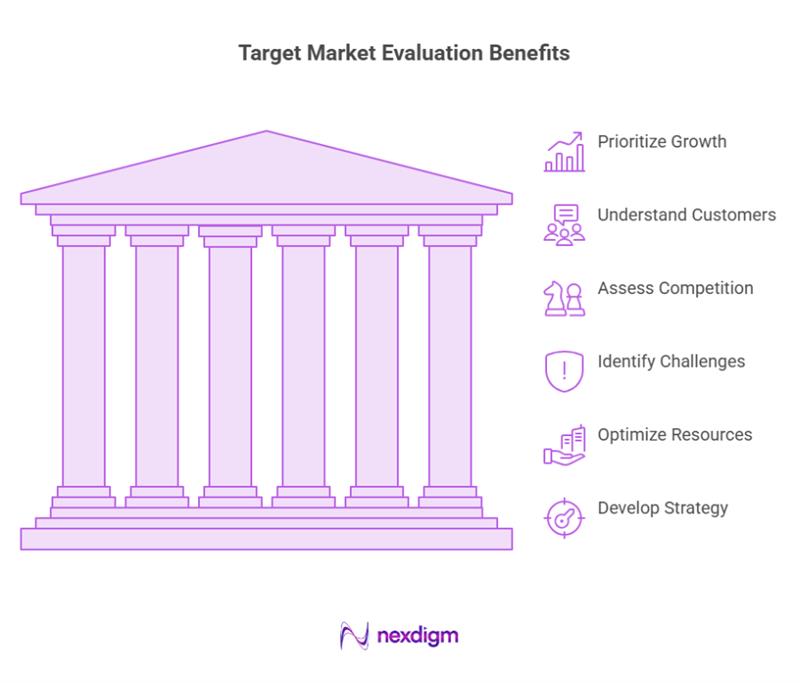
By evaluating these factors, businesses can identify emerging opportunities, reduce market entry risks, and make informed decisions that support sustainable growth and long-term profitability.
Identifying Markets That Truly Deserve Investment
The most important markets are those where opportunity aligns with an organization’s strengths, resources, and long-term goals. In such cases, businesses should focus on markets where they can create meaningful value and establish a sustainable competitive advantage. When determining whether a market deserves investment, organizations should consider:
- Growth and revenue potential
- Strategic fitness
- Ease of market entry
- Risk versus reward
- Scalability
- Resource Requirements
Building a Structured Target Market Evaluation Framework
A target market selection requires evaluation of both quantitative and qualitative factors. A structured framework allows decision-makers to compare opportunities accordingly.
Assess Market Size and Growth Potential
The first step in target market evaluation is understanding how big the opportunity is. Businesses should assess the overall market size, expected growth rates, industry maturity, and key demand drivers. Markets supported by strong economic trends, changing consumer behavior, or increasing digital adoption often provide greater long-term growth potential.
Analyze Customer Demand
Understanding customer needs is critical before entering any market. Organizations should evaluate:
- Customer segments
- Consumer preferences
- Purchasing behavior
- Brand preferences
Understanding these factors help businesses gain deeper insights about the customers and help team shape product positioning and marketing strategies accordingly.
Evaluate Competitive Intensity
A large, saturated market often has competitors, and it is important to gain insights about the competitors, their performance and activity to help organizations identify market gaps and areas where they can establish a meaningful presence. Some key factors to examine include:
- Number of competitors
- Market concentration
- Pricing dynamics
- Customer loyalty levels
- Competitive advantages of existing players
Understanding Regulatory and Compliance Requirements
Before entering a new market, businesses must understand the regulatory environment that governs how they operate. Regulatory requirements can influence market entry timelines, operational costs, and overall business performance. Key areas to assess such factor include:
- Industry-specific regulations
- Licensing requirements
- Tax structures
- Data privacy laws
- Foreign investment restrictions
Understanding such potential compliance and regulatory requirements help businesses avoid unexpected challenges, reduce risks, and enter the market with greater confidence.
Prioritizing Selected Investment Markets for Expansion
Once businesses build identify and build effective strategies for the target markets, the next challenge is prioritization. Organizations rarely have the resources to pursue every opportunity. A market prioritization approach helps decision-makers compare opportunities based on attractiveness, strategic fit, investment requirements, and risk levels, ensuring that resources are allocated to the markets with the greatest potential for success.
Nexdigm In Helping Businesses Identify Investment Opportunities
In an increasingly complex global business environment, Nexdigm supports businesses through a structured and insight-driven target market evaluation approach designed to help them identify high potential opportunities for investment.
By combining market intelligence, commercial due diligence, regulatory assessment, and strategic advisory capabilities, Nexdigm enables companies to make confident expansion and investment decisions. Nexdigm’s approach includes:
- Customer and Demand Analysis: Providing deeper insights into customer behavior, preferences, and purchasing patterns across segments.
- Competitive Landscape Evaluation: Assessing competitors, market positioning, and potential gaps to uncover differentiation opportunities.
- Regulatory and Compliance Review: Identifying legal requirements and regulatory challenges that may impact market entry.
- Market Prioritization Frameworks: Comparing multiple opportunities using structured criteria to support investment decisions.
- Risk Assessment and Mitigation: Evaluation of operational, commercial, and regulatory risks to improve decision-making confidence.
Through the strategic approach, Nexdigm enables businesses to focus on markets that offer the strongest combination of growth potential, strategic fit, and long-term value in terms of investment.
Nexdigm’s Case
Nexdigm supported a business in evaluating priority markets through structured attractiveness, demand, competition, and investment analysis, contributing to a 22% improvement in market prioritization, 17% stronger investment efficiency, and 14% faster market-entry decisions, enabling focused and scalable expansion.
To take the next step, simply visit our Request a Consultation page and share your requirements with us.
Harsh Mittal
+91-8422857704