

Technology procurement is becoming more complex as organizations manage different supplier markets, commercial arrangements, and operational dependencies. The 2026 Procurement Executive Insight Report by The Hackett Group, in partnership with GEP, found that only 43% of purchasing categories have proactive risk monitoring.
It also highlights a growing focus on high-spend and high-risk categories as procurement teams strengthen market intelligence and supplier engagement. These findings underline the importance of moving beyond transaction-based purchasing towards structured category management.
For technology procurement teams, a technology category sourcing strategy can help prioritize sourcing activities, assess supplier markets, and establish appropriate approaches for categories such as cloud infrastructure, enterprise software, cybersecurity, and IT services.
What Makes Technology Category Sourcing Challenging?
Technology categories have different cost structures, supplier ecosystems, and business implications. Some involve concentrated vendor markets and complex licensing arrangements, while others require frequent innovation assessments or specialized technical support. Managing them under a common sourcing model can limit visibility into category-specific opportunities and dependencies. Enterprises therefore need to distinguish sourcing priorities according to business criticality, market conditions, and supplier characteristics.
Ways to Organize Technology Sourcing Priorities
Rather than treating every technology purchase equally, enterprises can classify categories according to their sourcing requirements:
- Strategic Categories: Prioritize long-term supplier relationships, technical compatibility, service continuity, and innovation for business-critical technologies such as cloud infrastructure and cybersecurity.
- Competitive Categories: Use supplier comparisons, commercial benchmarking, and competitive negotiations for categories with multiple capable providers and opportunities for cost optimization.
- Emerging Technology Categories: Monitor specialist vendors, new solutions, and market developments to identify innovation opportunities while evaluating maturity and implementation risks.
This classification helps procurement teams determine where to build partnerships, strengthen competition, or explore new supplier options.
Nexdigm’s Role in Developing a Category-Led Sourcing Strategy
Nexdigm can help organizations understand the commercial and competitive dynamics shaping technology procurement. Our research examines supplier ecosystems, category-level market developments, pricing practices, and provider capabilities across enterprise software, cloud services, cybersecurity, IT infrastructure, networking, and IT consulting. By connecting these insights with business requirements, we can help enterprises identify sourcing opportunities, evaluate supplier alternatives, and establish priorities across technology categories.
How Nexdigm Supports Category-Level Sourcing Decisions
Our research can contribute to technology sourcing plans through four areas of technology category sourcing strategy assessment. The following areas assessed are through:
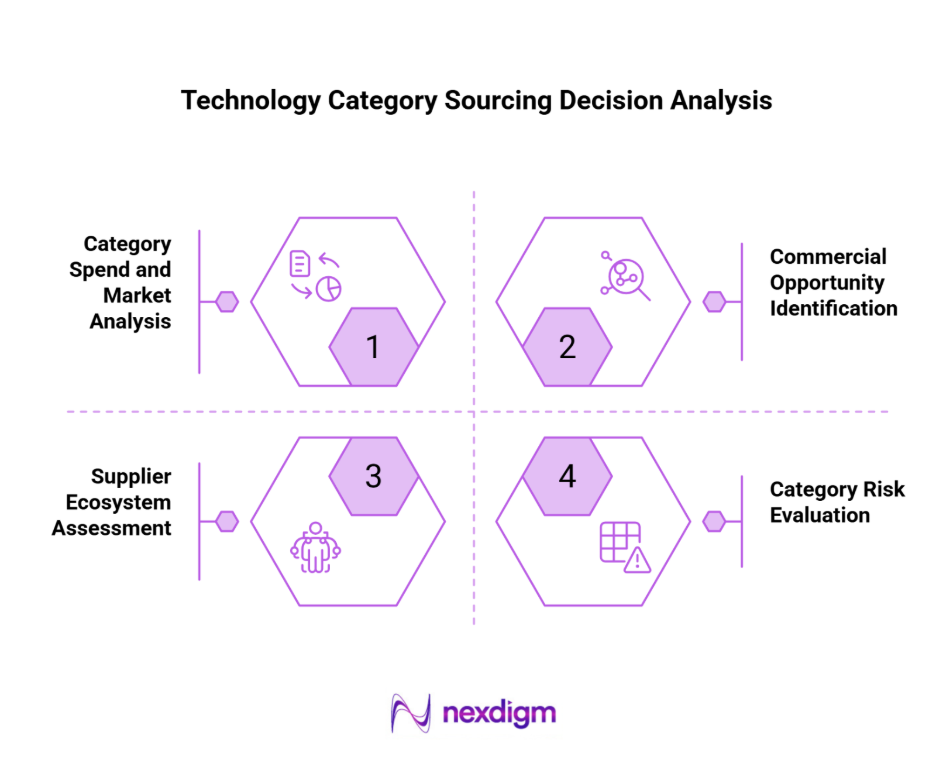
- Category Spend and Market Analysis: Examination of spending patterns, market developments, pricing structures, and category characteristics to identify areas requiring procurement attention.
- Supplier Ecosystem Assessment: Mapping of established providers, specialist vendors, emerging participants, and competitive alternatives across relevant technology markets.
- Commercial Opportunity Identification: Reviewing of licensing models, subscription costs, contract structures, renewal practices, and potential areas for commercial improvement.
- Category Risk Evaluation: Examination of supplier concentration, technology dependencies, service continuity, and other exposures that could affect sourcing decisions.
These assessments can help businesses establish sourcing priorities based on category-specific opportunities and requirements.
Nexdigm’s Assessment in Identifying Category-Specific Sourcing Opportunities
Our structured assessment can help enterprises translate category-level research into practical sourcing priorities. By evaluating each technology segment against its market conditions, our experts can help organizations identify where sourcing approaches may need to differ. The assessment can help businesses identify opportunities across four areas:
- Supplier Diversification Opportunities: Identify alternative providers and emerging specialists in categories where supplier concentration or limited competition may restrict sourcing flexibility.
- Category-Wise Cost Improvement: Examine pricing structures, licensing arrangements, subscription models, and renewal terms to identify potential commercial efficiencies.
- Strategic Supplier Alignment: Identify providers whose technical expertise, service portfolios, and innovation capabilities align with category-specific business requirements.
- Technology Sourcing Risk Mitigation: Highlight supplier dependencies, market concentration, integration challenges, and service continuity concerns that may influence sourcing decisions.
These insights can help enterprises determine where to diversify, consolidate, renegotiate, or establish strategic supplier relationships.
Nexdigm’s Case
A multinational enterprise wanted to review its sourcing strategy across major technology categories. In this illustrative scenario, Nexdigm assessed 18 suppliers across 5 categories, identified cost improvement opportunities in categories, and highlighted supplier concentration concerns in 2 areas. The findings helped prioritize commercial reviews, explore alternative providers, and refine category-level sourcing plans.
To take the next step, simply visit our Request a Consultation page and share your requirements with us.
Harsh Mittal
+91-8422857704