

In the digital economy, technology businesses are facing increasing pressure to manage rising infrastructure expenses, escalating talent costs, and growing operational complexity. Cloud migration, cybersecurity investments, software development demands, and competition for skilled technology professionals are significantly impacting cost structures across technology organizations. This has made technology cost benchmarking an essential strategy for businesses seeking to optimize operational spending, improve financial efficiency, and maintain long-term profitability in highly competitive technology markets.
Industry research indicates that technology infrastructure and workforce expenses can account for nearly 50–70% of total operating costs for digital-first and technology-driven organizations. Businesses that regularly benchmark technology cost structures report measurable improvements in resource allocation, infrastructure optimization, and operational scalability. Studies show that organizations leveraging advanced technology cost benchmarking frameworks can reduce cloud infrastructure expenses by up to 25%, improve workforce productivity by approximately 20%, and enhance cost visibility through data-driven financial governance and operational monitoring initiatives.
Technology Cost Benchmarking to Improve Operational Efficiency
Leveraging technology cost benchmarking to improve operational efficiency involves evaluating infrastructure spending, workforce costs, software utilization, and operational performance metrics to identify opportunities for optimization and sustainable cost management across technology businesses:
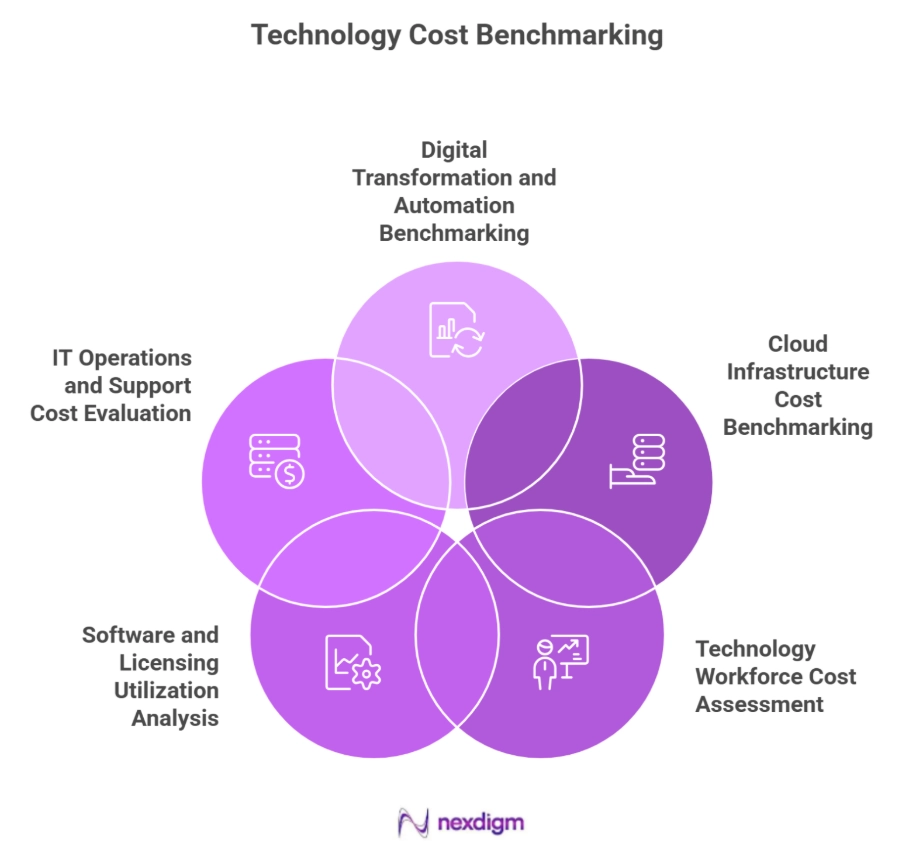
- Cloud Infrastructure Cost Benchmarking – Evaluate cloud utilization, storage expenses, compute efficiency, and network consumption patterns to identify infrastructure optimization opportunities and reduce overall technology operating costs.
- Technology Workforce Cost Assessment – Benchmark employee compensation, contractor expenses, productivity ratios, and talent allocation efficiency to improve workforce planning and optimize technology staffing investments.
- Software and Licensing Utilization Analysis – Compare software adoption rates, licensing utilization, subscription spending, and application redundancy against industry benchmarks to improve software cost efficiency and eliminate unnecessary expenditures.
- IT Operations and Support Cost Evaluation – Assess helpdesk efficiency, system maintenance expenses, incident management costs, and infrastructure support performance to improve operational productivity and service reliability.
- Digital Transformation and Automation Benchmarking – Leverage automation frameworks, AI-driven analytics, and process optimization tools to reduce manual workloads, improve operational scalability, and enhance technology cost transparency across business functions.
Nexdigm Technology Cost Benchmarking and Operational Efficiency Solutions
Nexdigm Technology Cost Benchmarking, operational efficiency solutions support organizations and Technology cost benchmarking in implementing data-driven financial governance frameworks that improve infrastructure visibility, optimize workforce spending, automate cost monitoring, and strengthen technology investment decision-making across enterprise environments.
- Technology Cost Monitoring Dashboards – Implement centralized analytics platforms to track infrastructure spending, cloud utilization, workforce allocation, software consumption, and operational cost trends, enabling proactive cost management and faster financial decision-making across technology operations.
- Automated Cost Optimization Analytics – Use advanced analytics tools to monitor cloud efficiency, software utilization, vendor contracts, and workforce productivity metrics for continuous technology cost optimization and improved budgeting accuracy across business units.
- Technology Vendor and Infrastructure Benchmarking – Compare cloud providers, software vendors, outsourcing models, and infrastructure costs against industry standards to identify performance gaps, strengthen vendor governance, and improve overall technology investment efficiency.
- Predictive Financial and Resource Planning – Leverage AI-driven forecasting, demand planning, and capacity modeling tools to optimize infrastructure investments, workforce scalability, and long-term technology budgeting while minimizing operational inefficiencies and cost overruns.
Nexdigm’s Case:
Nexdigm supported a multinational technology services company in optimizing enterprise cost structures through infrastructure benchmarking, workforce cost assessment, and cloud utilization analysis, reducing operational expenses by 22%, improving infrastructure efficiency by 28%, and enhancing financial visibility, scalability, and technology governance across global operations.
To take the next step, simply visit our Request a Consultation page and share your requirements with us.
Harsh Mittal
+91-8422857704