

Technology markets can produce an uncomfortable contradiction for vendors. Enterprise spending may be rising, adoption may be widespread and executives may describe a technology as strategically important, while actual purchasing remains constrained by security reviews, integration requirements, data readiness, skills and uncertainty about returns.
The distinction matters because market demand and purchase readiness are different measurements.
BCG’s September 2026 IT Spending Pulse found that technology buyers expect IT budgets to grow 5.8% year over year in 2026, while measured ROI from GenAI and AI agents averaged 13.8% among respondents. However, the gap between high- and low-maturity organizations remains substantial, with reported ROI of 19% versus 9%.
The implication is straightforward: customers are spending, but the conditions under which they spend are becoming more demanding.
Adoption has moved into an evaluation problem
G2’s 2026 Buyer Behavior research shows that evaluation is now the longest stage of the software buying journey for 40% of buyers. Security review is the largest post-selection source of delay at 39%, followed by budget approval at 32% and implementation planning at 25%.
This changes what customer-demand research needs to capture.
A technology can generate strong interest while still failing to convert because buyers cannot establish its security, implementation cost, internal ownership or financial return.
For vendors, this means customer research should go beyond asking whether a product is desirable. It should establish what has to be true before the customer can purchase and deploy it.
What customers are funding
Current enterprise demand is concentrating around several areas:
- Artificial intelligence and automation
- Cybersecurity
- Cloud infrastructure
- Data platforms
- Application modernization
- Productivity technology
- Industry-specific software
India illustrates the difference between investment appetite and readiness. Dun & Bradstreet’s 2026 AI Momentum Survey found that 69% of surveyed Indian businesses planned to increase AI investment and 73% reported measurable returns. Yet only 4% considered their enterprise data fully ready to support AI at scale.
The market therefore contains two simultaneous opportunities: selling the technology itself and solving the conditions that prevent adoption.
The customer-readiness architecture
A technology customer demand assessment consulting approach can translate those conditions into a structured buying-readiness model.
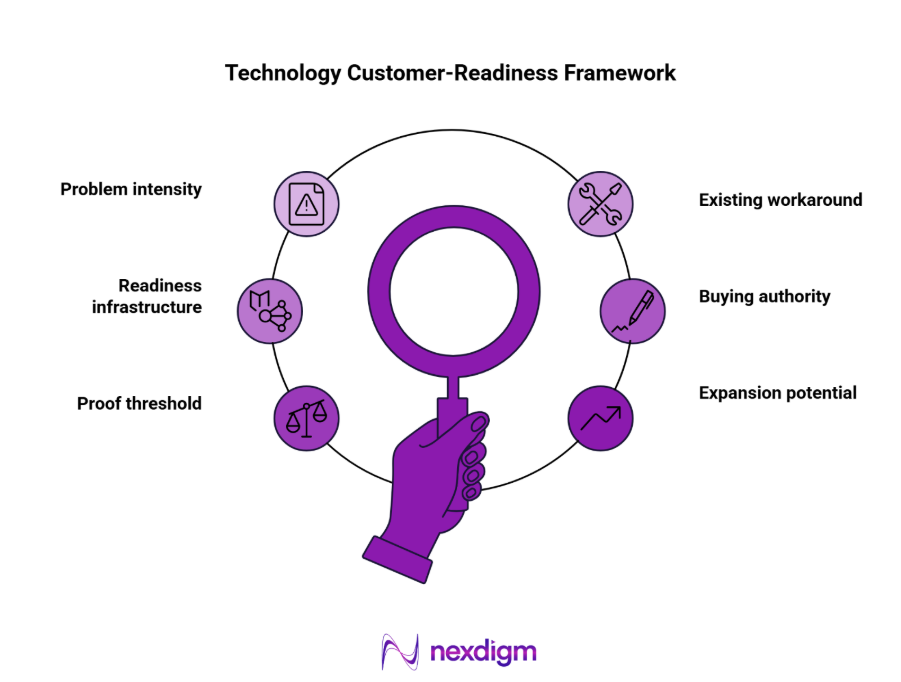
- Problem intensity
Identify the operational or commercial problem the technology addresses. Problems linked to revenue leakage, regulatory exposure, security incidents, labour costs or customer experience typically have clearer economic consequences than abstract productivity goals. - Existing workaround
Map what customers use today. Manual processes, spreadsheets, legacy systems, internal development and competing software all represent alternatives that the new technology must displace or integrate with. - Readiness infrastructure
Assess data quality, integration architecture, cybersecurity, cloud environment, skills and governance. A customer can express strong purchase intent while lacking the infrastructure required for deployment. - Buying authority
Identify who owns the problem, who controls the budget, who evaluates the technology and who can block implementation. Enterprise technology purchases rarely involve a single decision-maker. - Proof threshold
Determine what evidence buyers require before purchasing. Depending on the category, this may include ROI calculations, security certifications, reference customers, pilots, performance benchmarks or integration demonstrations. - Expansion potential
Assess whether the initial use case can scale across departments, locations or business processes. A technology with limited expansion potential may have strong initial demand but weak account economics.
The pilot-to-production gap
The largest opportunity may sit in the distance between interest and deployment.
Dun & Bradstreet found that 44% of surveyed Indian businesses were still planning or piloting AI, while 30% were scaling AI into production and 19% had operationalized it across multiple core processes.
This distribution demonstrates why adoption-stage segmentation matters. A customer preparing a pilot has different requirements from an organization already deploying technology across core processes.
For a vendor entering a market, the assessment should therefore identify where customers sit on the adoption curve, what prevents movement to the next stage, and whether those barriers can be addressed commercially.
The resulting market view becomes more useful than a simple estimate of total technology spending. It shows which customer segments have the problem, budget and organizational readiness to purchase, which remain constrained, and what vendors must prove to move them forward.
Nexdigm Case: Technology Adoption Readiness
A cybersecurity vendor with $11M annual revenue faced 31% pilot-to-contract leakage. Nexdigm assessed 260 enterprise buyers across 5 sectors, identifying security validation and integration as primary barriers and a 36% higher conversion opportunity among readiness-qualified accounts.
To take the next step, simply visit our Request a Consultation page and share your requirements with us.
Harsh Mittal
+91-8422857704