

A technology product can have strong demand and still struggle to scale if the route to the customer is too expensive, too slow, or too dependent on intermediaries.
Enterprise technology vendors increasingly have several routes available: direct enterprise sales, distributors and resellers, cloud marketplaces, system integrators, and combinations of these models. The decision is no longer simply about geographic reach. It affects customer acquisition cost, sales-cycle length, implementation capability, margin retention and ownership of the customer relationship.
Cloud marketplaces have added another layer to this equation. Microsoft Marketplace, for example, supports negotiated private offers and multiparty private offers, while eligible purchases can contribute toward an organisation’s Azure consumption commitment. AWS similarly supports private offers and Channel Partner Private Offers, allowing partners to participate in commercial and contractual relationships with customers.
The result is a more complicated route-to-market decision.
Direct Sales Preserve Control
A direct enterprise model provides the strongest control over positioning, pricing, account relationships and customer feedback.
It also requires the vendor to fund the entire commercial engine: sales personnel, solution consultants, marketing, account management and often implementation support.
This model becomes attractive when contract values are high, customer relationships are strategically important and the product requires consultative selling. It becomes harder to justify when the addressable customer base is geographically dispersed or the cost of maintaining direct coverage exceeds the incremental margin retained.
Distribution Solves Reach, at a Price
Distributors and resellers extend geographic coverage without requiring the vendor to build every local sales capability itself.
They can provide established customer relationships, local market knowledge, procurement access and implementation support. The trade-off is shared economics and reduced direct visibility into customer relationships.
For hardware, infrastructure products and technology categories requiring local fulfilment or support, these advantages can outweigh the additional channel margin. For highly specialised enterprise software, however, a large reseller network may add complexity without solving the primary sales constraint.
The relevant question is therefore what capability the intermediary contributes.
Marketplaces Change the Procurement Equation
Cloud marketplaces increasingly allow enterprise software to be purchased through an environment that customers already use for cloud procurement.
Microsoft states that eligible Marketplace purchases can count toward Azure consumption commitments, while its private-offer model allows vendors and customers to negotiate customised pricing and terms. AWS Marketplace similarly allows sellers to negotiate private pricing and contractual terms with buyers.
This can reduce procurement friction, particularly when the customer’s finance and technology teams already have established cloud purchasing arrangements.
The marketplace therefore becomes more than a digital catalogue. It can become part of the commercial transaction architecture.
Partners Still Matter When Software Needs People
A marketplace transaction does not eliminate the need for implementation.
Enterprise software may require migration, configuration, integration, security assessment, training or managed services. In those cases, system integrators and channel partners remain commercially important.
AWS Channel Partner Private Offers allow authorised partners to receive wholesale pricing and maintain the financial and contractual relationship with customers. Microsoft similarly supports multiparty private offers that allow an ISV and selling partner to participate in the same transaction.
The emerging model is therefore increasingly hybrid: the marketplace handles procurement while the partner contributes implementation and customer access.
Route-to-Market Economics Need to Be Compared by Product
A single channel strategy can create very different economics across products.
A self-service SaaS application may support marketplace-led acquisition with limited partner involvement. A cybersecurity platform requiring extensive deployment may benefit from a systems-integrator ecosystem. A hardware product requiring local stock and support may still depend heavily on distribution.
A useful technology distribution channel assessment therefore needs to compare the economics of each route by customer segment, product and geography.
How Nexdigm Maps the Route to Market
Nexdigm evaluates technology distribution models across eight connected dimensions:
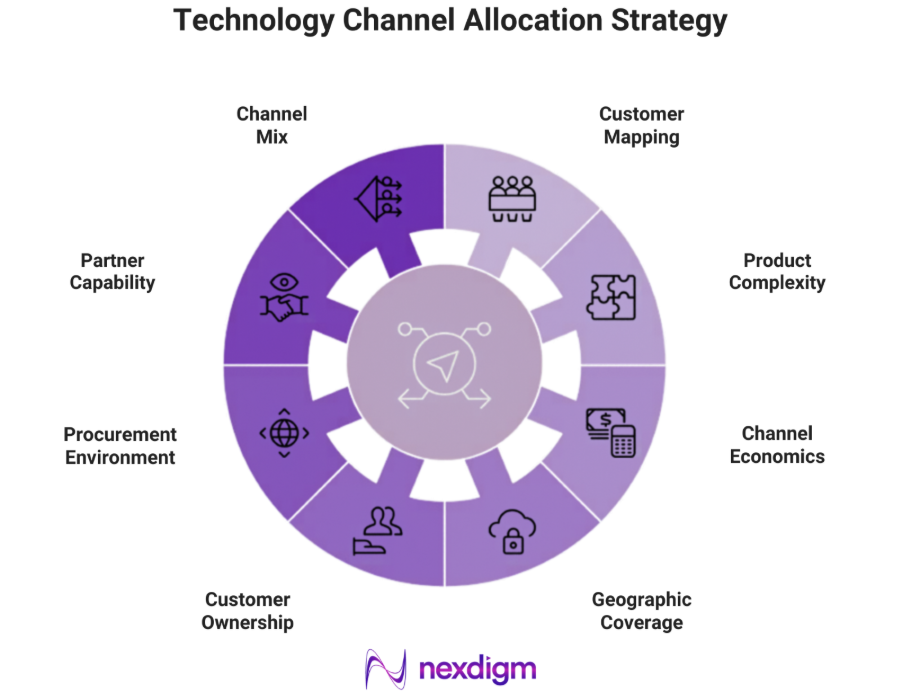
- Customer and Buyer Mapping: Identifies economic buyers, technical influencers, procurement stakeholders and existing channel relationships.
- Product Complexity: Determines whether customers can deploy independently or require partners for integration, implementation and support.
- Channel Economics: Compares direct CAC, distributor discounts, reseller margins, marketplace economics and partner-delivered services.
- Procurement Environment: Examines cloud commitments, approved-vendor structures, contracting requirements and marketplace eligibility.
- Customer Ownership: Measures the degree of direct account visibility and relationship control retained by the vendor.
- Geographic Coverage: Identifies markets where distributors or partners can provide access more efficiently than a direct sales build-out.
- Partner Capability: Evaluates sales coverage, technical certification, implementation capacity, vertical expertise and customer relationships.
- Channel Mix: Models when direct, distributor, marketplace and partner-led routes should operate independently or together.
The output is a channel allocation strategy showing where each route creates the strongest commercial and strategic fit.
A Distribution Strategy Should End with Revenue Economics
Nexdigm’s public technology distribution work demonstrates the value of this analysis. In one engagement for a global technology company, Nexdigm benchmarked distribution networks, partner performance, regional coverage and pricing structures. The client subsequently increased channel-led sales by 24%, expanded into six regional markets, generated $11.2 million in additional revenue and improved operating profit by $2.3 million.
The objective of route-to-market analysis is therefore not simply to select a channel. It is to determine how products, customers, partners and geography should be connected to produce scalable revenue.
To take the next step, simply visit our Request a Consultation page and share your requirements with us.
Harsh Mittal
+91-8422857704